Reply To:
Name - Reply Comment
By Nishel Fernando
To successfully execute its national Artificial Intelligence strategy, Sri Lanka must establish a central coordinating body such as a National AI Centre and forge its own path rather than copying models from Silicon Valley or China.
This was the consensus among a panel of global and local experts speaking at the inaugural National AI Expo and Conference 2025, an initiative pioneered by the Ministry of Digital Economy and SLT-Mobitel, in Colombo this week.
During a fireside chat on “Global Lessons in AI Strategy Execution,” industry experts stressed that while Sri Lanka has a solid 68-page AI strategy document, the real challenge lies in implementation, a phase where an estimated 95 percent of AI projects globally fail.
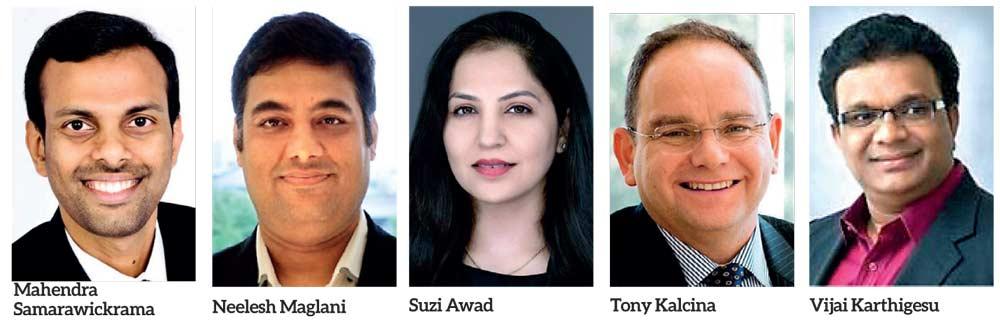
The discussion, moderated by Tony Kalcina, CEO of Clarity, focused on practical steps to bridge the gap between strategy and successful, impactful execution.
A key recommendation emerging from the discussion was the urgent need for a National AI Centre. Dr. Mahendra Samarawickrama, an OECD AI expert and a contributor to Sri Lanka’s AI strategy, joined the panel remotely from Australia.
He argued that such a centre would be critical to breaking down existing silos where AI development currently occurs in isolation across universities and private entities.
“At present, Sri Lankan AI developments are in silos. A National AI Centre can bring these together and present them as a central repository. It can orchestrate the national AI policy and unify the different AI development silos,” Dr. Samarawickrama said.
He pointed to Australia’s successful National AI Centre as a model, suggesting that a similar body in Sri Lanka could also establish hubs to support small and medium-sized enterprises (SMEs), provide an accessible entry point for young entrepreneurs, and ensure the nation’s capabilities are accurately represented in global AI indexes.
Panelists were unanimous in their advice that Sri Lanka should not simply “copy and paste” global AI models. Instead, it should leverage AI to solve its unique local problems.
“Sri Lanka shouldn’t be copying Silicon Valley or China or India,” insisted Vijai Karthigesu, CEO of Swarn. “We have to develop our own (models) with our own languages, with our culture and our issues, and apply AI to our plantation, public health, and education. These are unique problems.”
Suzi Awad, Regional Sales Director at Group-IB, echoed this sentiment from a cybersecurity perspective. She explained that fraud patterns in Sri Lanka or India are vastly different from those in Europe or the US. An effective AI-driven security strategy, therefore, requires local data and context.
“If there is some communication which is happening in the Sinhala language on the dark web, can anyone interpret (it))?” Awad questioned. “Everyone has to go local with data, with rules, and with people. That’s where AI can be impactful.”
The experts went on to stress that viewing AI as a simple technology upgrade is a primary reason for failure. Karthigesu drew parallels to the early days of cloud computing, emphasising that AI must be treated as a top-down business transformation strategy.
“Don’t look at AI as a technology. It is a business transformation strategy,” he urged, noting that successful implementation requires retraining staff, re-engineering processes, and securing buy-in from the highest levels of government and corporate leadership.
Neelesh Maglani, Telco CTO for Southeast Asia at Hewlett Packard Enterprise, identified data quality and the talent pipeline as two of the biggest challenges governments face.
“The action before we implement any AI strategies is that we need to see the quality of data which is being collected,” Maglani said. He stressed the importance of eliminating biases related to religion, race, or colour and ensuring data privacy and security are built-in from the start—a point reinforced by Awad, who advocated for a “secure by design” approach.
While acknowledging the talent challenge, the panel expressed optimism about Sri Lanka’s potential, advising that continuous upskilling is key for the workforce to remain relevant.