Reply To:
Name - Reply Comment

 Mindful international relations is not about retreating into silence or dismissing external perceptions. It is about engagement. It is about presenting our own narratives, learning from others, remaining open to transformation, and cultivating resilience
Discussions spanned governance, religion, maritime cooperation, trade diversification, tourism, education, climate change, and sustainable development. This multidimensional engagement is relatively rare in diplomatic roundtables, which often operate in thematic silos
Have you ever heard Sri Lanka described as a middle power? For too long, as academics, policy makers, practitioners and people in Sri Lanka, we have internalized the perception that we are a small state. ‘Smallness’ however is a relative measurement.
We measure ‘small’ in relation to what we believe as ‘big’. In traditional measurements of power capability of states, factors such as the size of the geography, population, economy and the military capability were known as the central powers that can buy ‘influence’.
In this measurement, no doubt, we are ‘small’. But, looking at it from other measurements, such as the welfare facilities for people, democratic values, governance styles, natural resources etc, one can ask back, whether we are acturally that ‘small’.
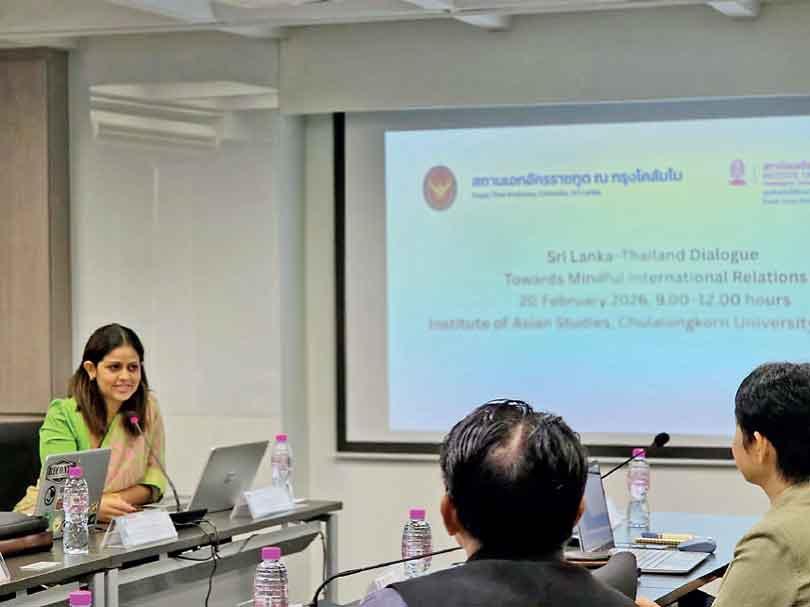
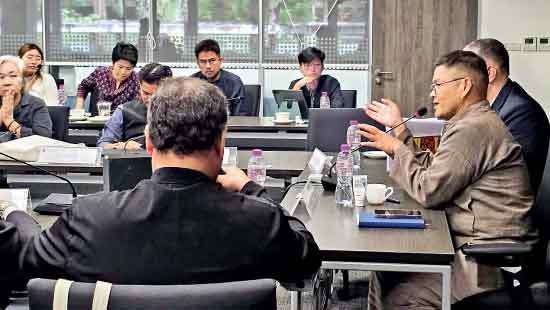
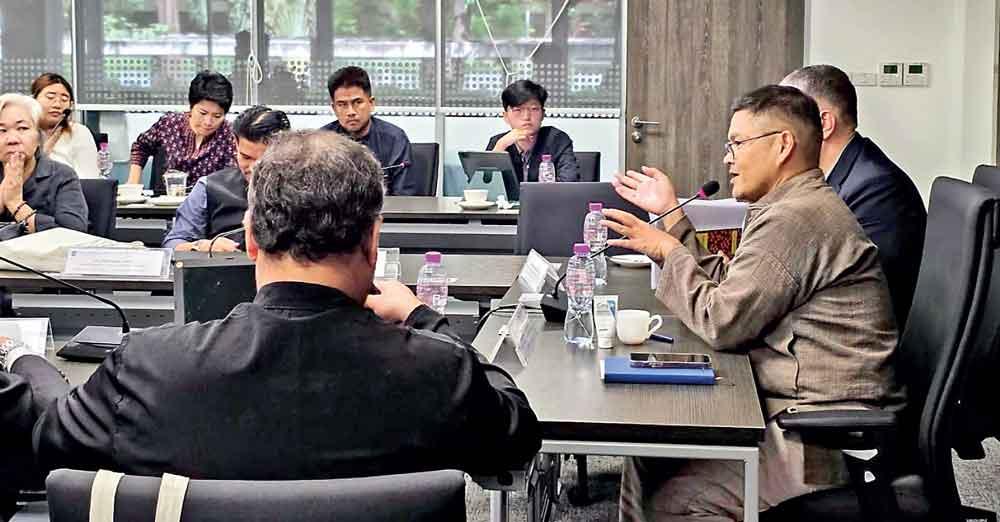
At the Sri Lanka–Thailand Dialogue 2026, held on 20 February at the Institute of Asian Studies of Chulalongkorn University, Sri Lanka was recognised as a ‘middle power’ – a different new narrative that led us think about us (Sri Lanka) differently.
In fact, the theme, Middle Path for Middle Powers: Towards Mindful International Relations, set the tone for a thoughtful and forward-looking exchange between academics from Sri Lanka and Thailand.
Relations between Sri Lanka and Thailand are neither new nor superficial. Rooted in centuries of Theravada Buddhist exchanges, monastic networks, and maritime interactions across the Indian Ocean, the two countries share a civilizational familiarity that predates modern diplomacy. Formal diplomatic relations, marking 70 years, have since expanded into trade, education, tourism and regional cooperation. Both countries are active members of Bay of Bengal Initiative for Multi-Sectoral Technical and Economic Cooperation (BIMSTEC), positioning them within a shared Bay of Bengal strategic space that links South and Southeast Asia.
It was within this broader historical and regional context that the Sri Lanka–Thailand Dialogue was designed. The Dialogue was not merely a commemorative event; it was a serious intellectual exercise in rethinking Global South–South cooperation at a time when the international system is undergoing profound uncertainty.
The Dialogue, was organised with the support of the Royal Thai Embassy in Colombo to commemorate 70 years of diplomatic relations between Sri Lanka and Thailand.
Designed as a Track 1.5/2 platform, it brought together approximately fifteen scholars, from Thailand and from Sri Lanka, to review bilateral relations and explore innovative pathways for cooperation. In international relations practice, such dialogues allow academics and policy thinkers to jointly brainstorm ideas that can gradually influence public policy.
The proceedings opened with brief remarks Assistant Professor Dr. Jirayudh Sinthuphan of the Center for South Asian Studies.
The sessions were chaired by myself - Dr. Pavithra Jayawardena – as the Head of the Department of International Relations at the University of Colombo. Two thematic roundtables structured the discussions. The first, on “Middle Path in Governance,” examined ethical governance, civilisational linkages and transoceanic knowledge networks.
Contributions came from Prof. S. Chaminda Padmakumara (University of Colombo), Dr. George I. H. Cooke (University of Kelaniya), Dr. Somrak Chaisingkananont (Mahidol University), and Dr. Narut Charoensri (Chiang Mai University). Associate Professor Surat Horachaikul of Chulalongkorn University served as discussant, encouraging comparative and regional reflections.
The second session focused on trade and economic relations, addressing sustainable economic models, climate change, intergenerational justice and long-term policy planning. Dr. Nadeesh de Silva (Open University of Sri Lanka), Mr. Hashan Wijesinghe (University of Kelaniya), Dr. Siriporn Somboonboorana (Walailak University), and Dr. Abdunrohman Mukem (Chulalongkorn University) explored how both countries could design “home-grown” strategies in a rapidly shifting global order.
Particular attention was given to ongoing negotiations on a Sri Lanka–Thailand Free Trade Agreement. Thailand’s extensive experience with FTAs contrasts with Sri Lanka’s more cautious and restrictive trade framework.
Participants agreed that in a context where multilateral trade institutions such as the World Trade Organization face increasing strain, smaller and middle powers must craft pragmatic, context-sensitive partnerships.
What made this Dialogue particularly distinctive was its refusal to remain confined to a single sector. Conversations ranged from state-level foreign policy and regional security considerations to community-level concerns such as agriculture, plantation economies, local livelihoods and environmental stewardship.
Discussions spanned governance, religion, maritime cooperation, trade diversification, tourism, education, climate change, and sustainable development. This multidimensional engagement is relatively rare in diplomatic roundtables, which often operate in thematic silos.
Here, however, the intersections were intentional. A special presentation by Ms. Pavithra Attanayake of the Wildlife and Nature Protection Society of Sri Lanka highlighted privately led conservation efforts and their regional relevance.
Perhaps the most thought-provoking moment of the Dialogue emerged when a Thai academic shared a question frequently raised by his undergraduate students in comparative politics: “What can Southeast Asians learn from South Asia?”
The question was both unsettling and illuminating.
As South Asianists, we take pride in our histories, in our anti-colonial struggles, democratic experiments, intellectual traditions, cultural richness and deep social diversity.
Yet beyond the region, South Asia is often reduced to simplified narratives: poverty, rivalry, instability, intolerance. These portrayals, repeated often enough, begin to shape how others measure and judge us.Those of us who live and work within South Asia know that the story is far more complex.
However, we have not always articulated that complexity confidently or consistently in global conversations.
Mindful international relations is not about retreating into silence or dismissing external perceptions. It is about engagement. It is about presenting our own narratives, learning from others, remaining open to transformation, and cultivating resilience. This is where, these dialogues with those who recognize us as equals become important and powerful.
If trust is the foundation of bilateral relations, Sri Lanka and Thailand already possess a strong base rooted in centuries-old religious and cultural connections. The challenge now is to translate that trust into deeper cooperation across academic, economic and people-to-people domains. Encouragingly, the discussions moved beyond theory.
Participants proposed concrete steps including joint conferences, collaborative research projects, credit-sharing arrangements, summer schools and student exchanges. Informal academic diplomacy, though gradual, may ultimately prove more durable and transformative.
As middle powers navigating a turbulent global order, Sri Lanka and Thailand appear ready to embrace a mindful, balanced and mutually respectful path forward, together.