07 Apr 2026 - {{hitsCtrl.values.hits}}
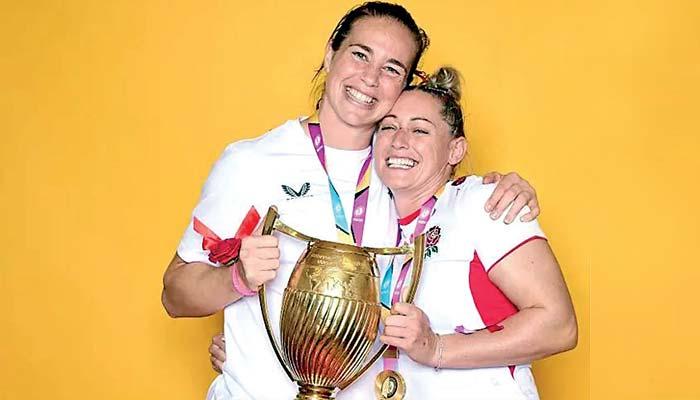 When Emily Scarratt returns to Allianz Stadium on Saturday, it will be in a different role to the one she played during England’s World Cup win in September.
The Red Roses’ record points-scorer, who had been player-coaching at Loughborough Lightning, hung up her boots after England’s final victory over Canada.
Injury and high-level competition in the centres resulted in arguably the greatest England women’s player being deployed on the ground as the team’s water carrier.
The role had her connected with the coaching team via an earpiece to bring on valuable information to the team.
Now she returns for the 2026 Women’s Six Nations as England’s new lead attack and backs coach, replacing former assistant coach Lou Meadows.
With Scarratt’s former team-mate Sarah Hunter the side’s defence coach, England are developing two of the game’s biggest talents as the Red Roses’ wait for a female head coach continues.
When asked about the value of having women coaching women’s teams, Scarratt told BBC Sport: “It is huge.
“I have spent so much of my career being coached by men, and brilliant men, and men who have had so much experience and can bring so much from their own experiences into our world.
“Having females around the environment makes a big difference. Just being able to check in with players differently, have different sorts of conversations, be comfortably able to go into the changing room and grab somebody you know, just simple logistics like that.
“I found it in terms of the girls feeling like they can say stuff to me that perhaps they wouldn’t feel comfortable saying to either an older coach and/or a male coach.”
At the Women’s World Cup last year, 32% of coaches were female, up from 15% in 2021. However, that number fell short of the 40% target set by World Rugby after the previous tournament in New Zealand.
In March, it was announced that every team in Fifa’s women’s football tournaments must include at least one female head coach or assistant coach following the introduction of new regulations.
Asked whether head coach John Mitchell is actively trying to promote promising female coaches, Scarratt told BBC Sport: “I don’t know if Mitch [Mitchell] will admit it or not, but I think it has been part of his master plan all along.
“There are a few of us who have only just recently retired. There are also a few of the older players who, I am sure, would love to get involved, stay in the RFU or coach somewhere.
“He [John Mitchell] understood that, along with [RFU head of women’s performance] Charlie Hayter, in terms of future planning.”
In 2018, Hunter’s former England head coach Simon Middleton tipped his captain to take over his role one day.
Asked whether Scarratt or Hunter, who have a combined total of 260 international caps, have the capability to take over as head coach for the next World Cup in 2033, Mitchell said: “Most definitely. I will probably be an old man by then, in my 70s I think.”
He added: “They have been challenged for a long time in their careers and they are extremely curious.
“You don’t play over 100 Test matches or become the most-capped English women’s player in history if you don’t have a strong work rate.
“You have two wonderful people who are authentic, easy to work with and fun to work with.”
A challenge for Scarratt, which Hunter has already had to navigate, is coaching her former team-mates.
Scrum-half Natasha Hunt appears regularly on Scarratt’s podcast, ‘The Good, the Scaz and the Rugby’, and the pair were room-mates in camp.
(BBC sport)
04 Jun 2026 3 minute ago
04 Jun 2026 1 hours ago
04 Jun 2026 1 hours ago
04 Jun 2026 1 hours ago
04 Jun 2026 1 hours ago