22 Sep 2025 - {{hitsCtrl.values.hits}}
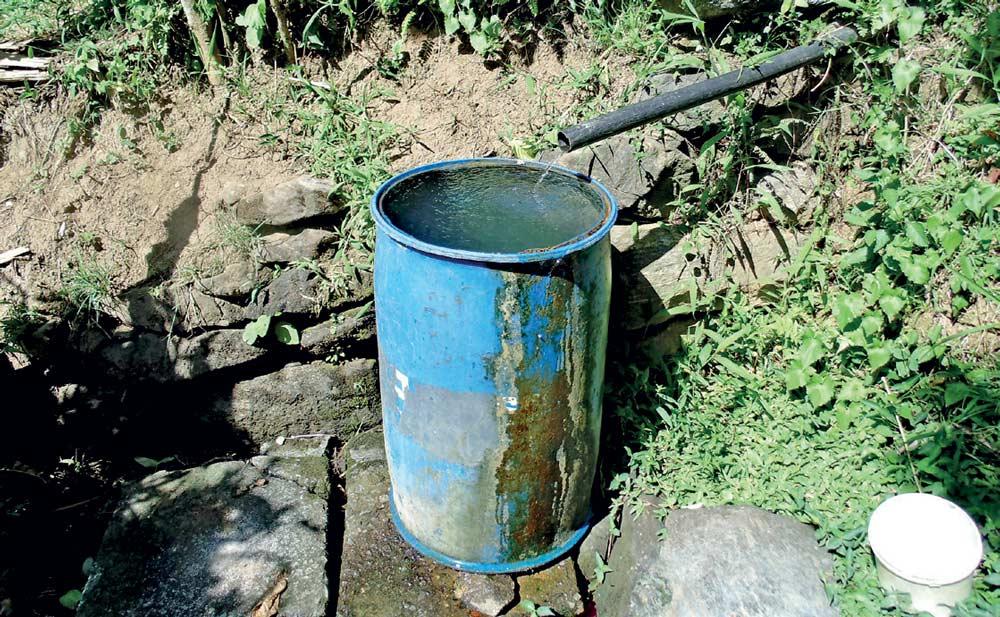
The spout where Robert Knox bathed still never runs dry
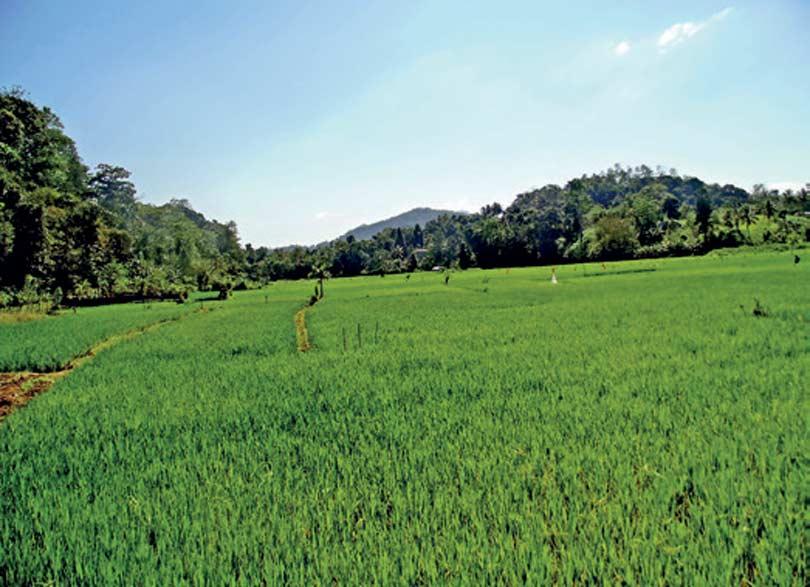 A paddy field cultivated by Knox
 Robert Knox had lived in captivity for 19 years in the Eladetta village
His book ‘A Historical Relations of Ceylon’ gives a vivid account of his experiences in Sri Lanka
Eladetta has a history that runs as far back to the time of legendary ruler Rawana
 The captain of the ship, his son Robert Knox and 18 sailors were taken prisoner by King Rajasinghe II and held in captivity. They were first captive at Bandara Koswatta in Kurunegala and later at Eladetta, where he lived as farmer until he fled to England
By Shantha Chandrasiri
|
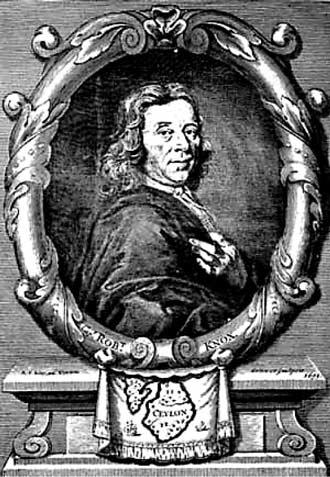
And image of Robert Knox |
|
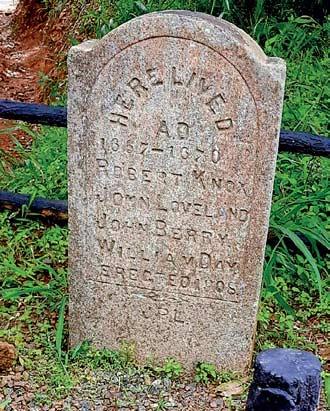
The stone plaque built in memory of Robert Knox |
Eladetta village is located in a lovely and attractive countryside in the Udunuwara Division in the district of Kandy. This village has a long tradition behind it.
History has it recorded that the English trader, sailor and writer Robert Knox, who had been taken prisoner by King Rajasinghe 11 who ruled in Kandy, had lived in captivity for 19 years in Eladetta village. His name has gone down in the annals of Sri Lankan history owing to “A Historical Relations of Ceylon”. This book contains a vivid account of his experiences and a nice portrayal of the socio-economic and cultural sphere of Sri Lanka and the rule of the Kandyan Kingdom.
A village skirted by a vast stretch of smiling paddy fields and a highly sensitive environment, Eladetta has a history that runs as far back to the time of legendary ruler Rawana.
Eladetta has been the seat of many a legend associated with the life of Robert Knox, who spent the prime of his life as a prisoner of the Kandyan Kingdom.
“A Historical Relations of Ceylon” authored by him is a rich source of history of the Kandyan Kingdom, which was under the Sinhala kings.
Robert Knox’s father was the captain of a merchant ship that lost its course, was damaged by a gale force wind in the Mediterranean Sea and drifted away. Captain Knox managed to steer clear of the hazardous situation and headed his ship towards the ancient Kottiyaram Port in Muthur.
However the captain of the ship, his son Robert Knox and 18 sailors were taken prisoner by King Rajasinghe II and held in captivity. They were first captive at Bandara Koswatta in Kurunegala and later at Eladetta, where he lived as farmer until he fled to England.
Mahaweli Ganga flows into the sea at Kottiyar Bay at which place stood the tree under which Robert Knox’s father was captured in 1660. It had been popularly known as the ‘White Man’s Tree’. The tree was later destroyed.
It is said that Robert Knox’s father died of fever in a short time and his body was buried at Bandara Koswatta by Robert Knox.
Robert Knox was a young man of 19 years when he was taken prisoner in 1660. He had been under house arrest in Deyala Dahamunupattu in Kegalle and later at Legumdeniya in Gampola.
The king had ordered the villagers to provide him with three square meals and to look into his needs.
As recorded by Knox in his work “A Historical Relations in Ceylon” Lagumdeniya was the most infertile land and had the smallest population he had ever seen. He had left Lagumdeniya and made his way along a stream to Eladetta village where he built a small house on Punahelakanda.
Residents of the area maintain that the remnants of his house could be seen to date. A sign carved in a rock by him exists there. Robert Knox an English boy of 19, who was interested in taking a trip to the distant places of the globe, jointed his father’s merchant ship sailing for the far East on trade.
Although in captivity, he took to agriculture and according to legend was an unmatched farmer with sinew hands who look a keen interest in paddy and vegetable cultivation and livestock. The track paved with stone slabs leading to his goat shed had been erected by him. It is in ruins today.
The tract of paddy fields cultivated by Robert Knox stretching as far as the eye could see exists to date. These plots of land are cultivated by the villagers. Villagers said that the foot path running through the paddy fields was the bund of an ancient tank and that the anicut erected by Robert Knox is in ruins today.
The vast tract of paddy fields is hounded by a canal running through a 160ft long tunnel. This canal was build of stone slabs without using any kind of concrete mortar. Villagers pointed out that it is a marvelous creation of Robert Knox.
The canal flows though Lagumdeniya village into the Mahaweli River. According to legend, Robert had made his way to Eladetta village through this canal.
The large threshing flow used by Robert Knox that required about 30 buffaloes is still used by the farmers.
It is believed that the spout where Robert Knox bathed never runs dry. It is the only source of water for a large population in the area. Villagers believe that the spout had been covered with a stone slabs that protects it during the drought.
In 1908 Commissioner of Archaeology J.P. Louise had erected stone plaques on the main access road to Eladetta Village and in Legumdeniya village in memory of Robert Knox.
Robert Knox had managed to escape and flee from this island on. However, back in England, he had written several books that are of great importance and serve as source material that supports the history of Sri Lanka. The content in these books relate particularly to the Kandyan Kingdom, that runs as far back as 360 years ago in the history of time.
It is sad that steps have not been taken to protect the monuments of this writer’s life spent in Eladetta Village. The house protected by a fortress, the spout, the canal flowing through tunnel way , the threshing flow and the stretch of paddy fields should be protected for posterity and the memory of this distinguished foreigner should be resuscitated.
22 Jun 2026 1 hours ago
22 Jun 2026 3 hours ago
22 Jun 2026 3 hours ago
22 Jun 2026 3 hours ago