17 Feb 2026 - {{hitsCtrl.values.hits}}
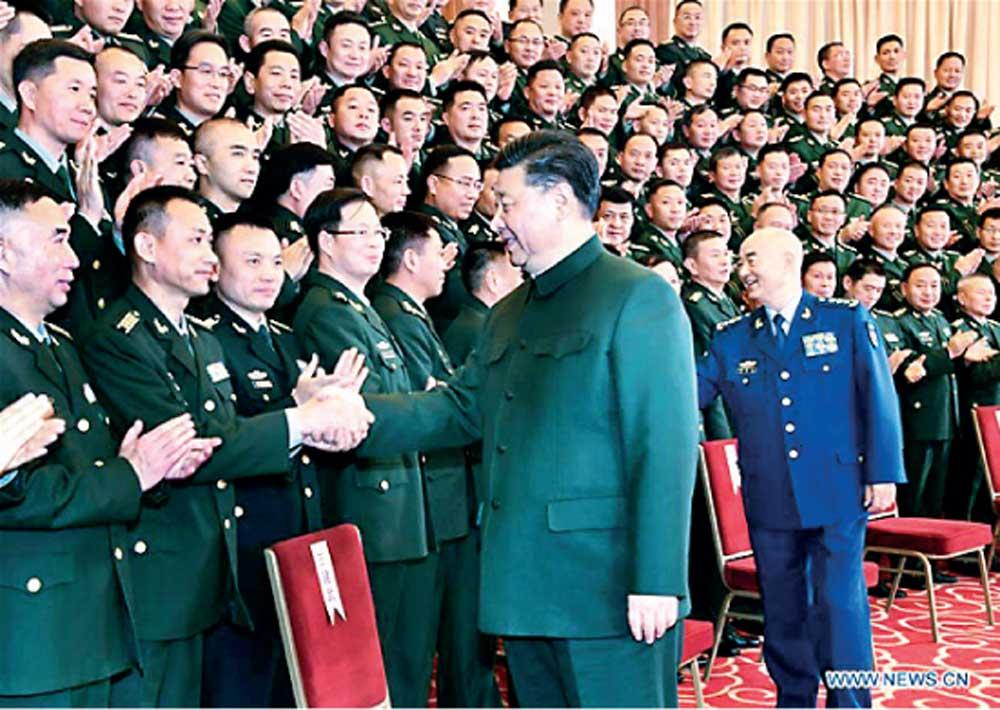
The Chinese leader wants to keep the PLA firmly under his control, and combat ready at the same time
Corruption is also alluded to as the main cause, because corruption has been rampant in the PLA and has been the most common cause of removals
 Through a series of purges, Chinese President Xi Jinping has been trying to curb the power and autonomy of the generals of the People’s Liberation Army (PLA) and assert his -- or the Communist Party’s -- supremacy in the Central Military Commission (CMC), PLA’s top-most decision-making body.
In the overall Chinese system, power should be vested in the Communist Party and its General Secretary. President Xi Jinping is also the General Secretary of the Communist Party and Chairman of the CMC. Therefore he is the fountain head of power.
In the latest purge in the PLA announced on January 24 by the Defence Ministry, top PLA officer Gen. Zhang Youxia, and the Chief of Staff, Gen. Liu Zhenli, were being investigated for “serious violations of party discipline and law.” These terms generally allude to political insubordination and corruption.
The PLA Daily, the main organ of the Chinese military, accused Zhang and Liu of “seriously trampling on and undermining the system of ultimate responsibility resting with the Central Military Commission chairman.”
The chairman of the CMC is President Xi Jinping himself, and the purged General Zhang was China’s most senior uniformed officer, and First Vice Chairman of the CMC.
Most say that the series of purges conducted by Xi was meant to assert his or the Communist Party’s control over the military. Others say that Xi’s repeated resort to purges only shows his inability to control the military in a sustained way. But the bottom line is that civilian control over the armed forces is being asserted through the purges.
Christopher K Johnson, President of the China Strategies Group, and a former Senior China Analyst at the CIA, wrote in the journal Foreign Affairs last month that the Defence Ministry’s terse announcement “masked the biggest political earthquake to hit the top brass of the People’s Liberation Army since the 1989 Tiananmen Square crackdown.”
The sacking was also the zenith of President Xi’s purges, which have touched every section of the PLA. These purges have claimed all but one top military officer in the CMC.
However, Gordon G. Chang argues in Newsweek that Xi purged Zhang and Liu because he could not influence them or persuade them. Chang submits that Xi had not been able to control the top echelons of the military.
“A decade ago, Xi looked as if he had cemented control. The continual corruption purges carried out in the early years of his rule, along with a major re-organisation of the PLA in the middle of the last decade, allowed him to install loyalists throughout the chain of command. Yet, since then, China’s leader has been continually removing flag officers and then removing their replacements. If Xi were in such total command today, why did he have to remove so many officers over the past decade?” Chang asks.
Chang believes that Xi’s adversaries in the military were responsible for at least some of the recent purges. For example, Zhang Youxia turfed out Gen. He Weidong, who was described as Xi’s number-one enforcer in the military. China scholar Charles Burton told Chang that “Xi’s enemies—not Xi himself—removed Xi’s loyalists!”
In the midst of these theories about purges, speculation is rife as to what exactly was the wrongdoing of Zhang and Liu. A section of the Western media went to the extent of saying that Zhang leaked nuclear secrets to the United States. But this is discounted by others.
Corruption is also alluded to as the main cause, because corruption has been rampant in the PLA and has been the most common cause of removals. The other reason cited is Xi’s fear of being ousted by a rump in the CMC led by Zhang.
Civilian Control
But the most likely and basic reason is Xi’s anxiety to keep the CMC, and through it the PLA, under his thumb or broadly under the control of the political leadership as represented by the Communist Party.
These purges have reduced the CMC’s strength to half of what existed after the last overhaul in 2022. The plenum left those seats vacant, though fresh appointments should usually come along with reshuffles.
According to Christopher Johnson, these vacancies are kept because Xi plans to establish complete authority over the CMC before he seeks a fourth five-year term in 2027. He could, at the appropriate time, pack the CMC with handpicked men, Johnson believes.
Fighting Fit but Subservient to the Political Master
Johnson’s speculation is that Xi wants to have a military which is at once fighting fit and firmly under the control of the political leadership (in essence, his leadership). Zhang and Liu were axed perhaps because they might not have filled the bill as leaders of the PLA in these two important respects.
Threat from US led by Trump
Xi’s anxieties about the PLA makes sense because US President Donald Trump is preparing for war, though he declares that he is a peace maker and not a war monger.
Trump has openly talked of the US militarily taking over Greenland and Canada, and had actually invaded Venezuela to abduct President Maduro and bring that country under the American heel. Trump had also renamed the Department of Defence as the Department of War to give it a sharper focus.
With a war like adversary such as Trump, who is also unpredictable and mercurial, Xi is compelled to ensure that the PLA is fighting fit, corruption-free and totally under the control of the Communist Party headed by him.
Domestic Compulsions
Xi also needs to ensure domestic political stability in case a war has to be fought with the US over Taiwan. America has also been making a bid to bring about regime change in China as was done in the case of the USSR earlier. It is the PLA which has to underwrite internal peace, stability, and the compliance of the Chinese population.
To ensure peace around China, while he purges the army, Xi has abandoned the brash “wolf warrior” diplomacy. He is now building strength by making China a “fortress economy” and ensuring that the PLA will deliver results if military action becomes inevitable.
Stepwise Process
The purges appear to be a stepwise process unfolding across his three terms in office, Johnson says.
When Xi started the effort, he was still consolidating power, so he focused on decapitating the officer networks of potential rivals. When he realised the extent of corruption, he did not go overboard to curb it. He avoided crippling the PLA operationally and risking regime stability. He was wary of breaking those parts of the PLA, like the missile forces, weapons design and procurement department, and the general staff, which he would need if military action was unavoidable.
During his second term, Xi refrained from purging senior officers, even as the corruption problem persisted. In fact, his attention was elsewhere, the civilian structure. The civilian security and civilian intelligence services presented their own morass of corruption. This made Xi go for a crackdown against them.
Xi knew he could not attack the PLA and security agencies simultaneously, so he adopted a staggered approach, Johnson explains.
“When Xi could refocus on the PLA as his third term commenced, the cesspool of corruption in the Rocket Force made plain that he could not get by with a light touch. As that investigation metastasised across the defence industry in late 2023, he knew the procurement system also needed cleansing,” Johnson says.
The firing of two CMC officers at last October’s plenum stemmed from disagreements between Xi and Zhang over personnel matters. This drove Xi to make a clean sweep and dump Zhang and Liu, as well, Johnson adds. With this, restoration of civilian authority over the military was established for the time being.
04 Jun 2026 5 minute ago
04 Jun 2026 29 minute ago
04 Jun 2026 40 minute ago
04 Jun 2026 2 hours ago
04 Jun 2026 2 hours ago