06 Mar 2025 - {{hitsCtrl.values.hits}}
|
|
 Sri Lankans have become aware of hard-hitting air pollution events lately where pollutants from regional countries have negatively impacted our health.
Unfortunately this is not new, as pollution levels in nearby countries have been extremely high for many years (Health Effects Institute, 2025), and weather patterns transporting such pollution have not changed much in recent years. Our heightened awareness of these transboundary events is probably a good thing, as we now recognise the seriousness of something that’s been happening all along.
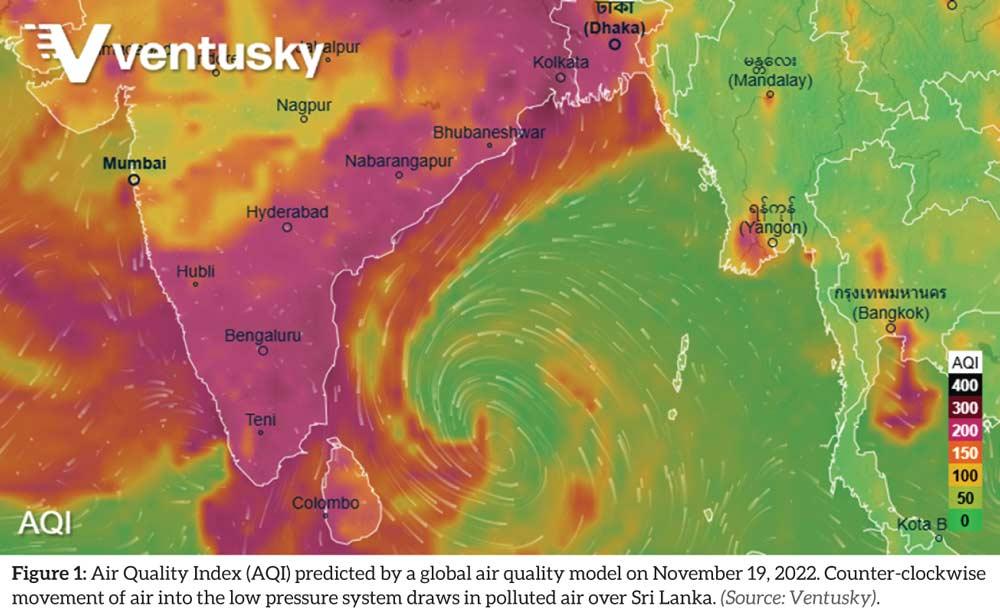
Between January 2019 and now, fine particle pollution levels in Colombo have been “Unhealthy” or worse about 5% of the time between the months of October and March. There were five instances where it happened on successive days and on one of those occasions, 3 days in a row (November 17-19, 2022). Were all these days influenced by transboundary pollution? The author conducted a qualitative assessment of weather patterns, air quality measurements around South and Southeast Asia, and satellite data products on such days, to identify common features of the most severe pollution events affecting us. The path that air travelled en-route to Colombo on each of those days was mapped with an air trajectory analysis tool.
In broad terms, the confluence of a large low-pressure system in the Bay of Bengal and lighter winds over the island during the northeast monsoon are most conducive for these high pollution events. Most often, polluted air masses of Indian origin hovering over the ocean act as a large reservoir of additional pollution that “leaks” in our direction when winds line up correctly. The specifics are important, as not all low-pressure systems cause this behaviour. If winds are strong enough, both distant and local pollution would be diluted. Sometimes air travelling over northern India, Bangladesh, Myanmar or Thailand gets mixed in, but more distant source regions usually contribute less to our pollution, since air has more time to get diluted. In one instance, air rotated clockwise around a giant high-pressure system over India, only to get caught up in the northeast monsoonal winds and take aim at Sri Lanka.
There have undoubtedly been days where air quality was not as bad, but transboundary pollution still played a role. However, it is extremely challenging to determine how much additional pollution regional countries would have contributed to our own locally generated pollution on a given day. Though the above-mentioned tools can confirm if air travelled through polluted regions, they do not shed light on exactly when or how much extra pollution the air picked up along the way. Answering such quantitative questions is a much more involving technical exercise.
We don’t have the luxury of dismissing this as scientific mumbo-jumbo. Even if we did, we still have to breathe the same polluted air as everyone else. Billing big brother for damages is just an entertaining political stunt that will get us nowhere. We can try, but our complaints alone aren’t going to motivate any of our neighbours to clean up any faster. Until such time, as efforts to reduce transboundary pollution come to fruition and air pollution in South Asia is reduced substantially, we will have to co-exist with these high pollution episodes. Here are a few ideas for taking the edge off such events:
17 Jun 2026 5 minute ago
17 Jun 2026 17 minute ago
17 Jun 2026 19 minute ago
17 Jun 2026 50 minute ago
17 Jun 2026 1 hours ago


 In broad terms, the confluence of a large low-pressure system in the Bay of Bengal and lighter winds over the island during the northeast monsoon are most conducive for these high pollution events