11 Mar 2025 - {{hitsCtrl.values.hits}}
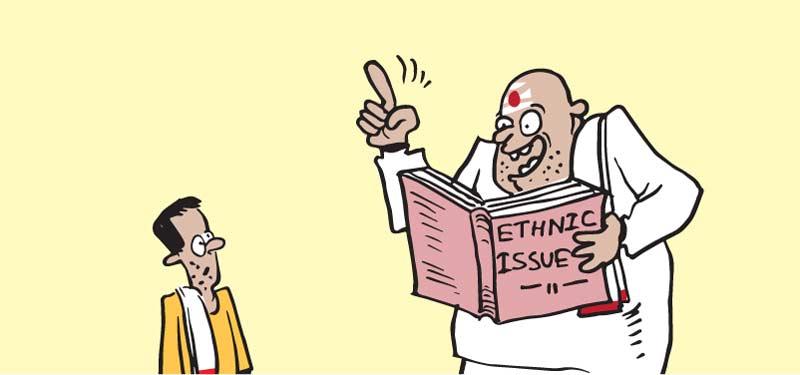
 Tamil politics in this context is highly fragmented, ideologically as well as organizationally Tamil politics in this context is highly fragmented, ideologically as well as organizationally |
The ethnic problem seems to have been forgotten even by the Tamils of Northern and Eastern Provinces. Tamils have apparently been left to themselves. Political disunity seems to have been the order of the day.
There was a time when they had a strong bargaining power, the armed struggle of the Liberation Tigers of Tamil Eelam (LTTE) that sometimes ran their own administration directly in some areas and indirectly in others, despite depriving the political rights of other Tamil political entities.
The LTTE had their own administration, courts of law with their own laws independent of the Justice Ministry of the central government. They ran banks independent of the Central Bank in Colombo. Tamil media had given an impression to the Tamils in the north and the east that an independent Tamil state is around the corner. The outfit is no more and the revival of it seems to be out of the question.
Also, the LTTE and the Tamil demands had a strong backing then from the international community and especially from India and Tamil Nadu. The LTTE leader Velupillai Prabakaran is still being called in Tamil Nadu as ‘Theisiath Thalaivar’ – National leader. The peace talks between the Sri Lankan government and the LTTE which was commenced in 2002 attracted support from dozens of powerful countries.
The Tokyo Conference convened under the aegis of the Co-Chairs of the Sri Lanka peace process, the European Union, United States, Japan and Norway was attended by high-profile representatives from 32 countries and 20 multi-lateral donor agencies including the World Bank and the International Monetary Fund. However, everything was ruined by the intransigence and war mongering on the part of the LTTE.
Even after the end of the war which followed the decimation of LTTE, India backed the Tamil demands. The United Nations Human Rights Council (UNHRC) strongly stood behind their demand for post-conflict justice or justice for those whose human rights were violated.
However, these two support bases for the Tamils, after losing their prime bargaining power, are fast waning. India has clearly evinced that it stood thus far for its own interests, rather than the interests of the Sri Lankan Tamils. It has been gradually abandoning its brainchild, the Indo-Sri Lanka peace accord, commonly known as Indo- Lanka Accord of 1987. Its leaders openly stated in 2017 that they no longer insist on the merger of Northern and Eastern Provinces. The joint statements issued by Indian Prime Minister Narendra Modi with former President Ranil Wickremesinghe in July, 2023 and current President Anura Kumara Dissanayake in December 16, last year had totally dropped the 13th Amendment to the Constitution which was a direct upshot of the Indo-Lanka Accord.
Similarly, the UNHRC is also dragging its feet in respect of Sri Lanka’s accountability process. No significant progress seems to have been made after 2021 when the World’s Human Rights body passed a resolution to set up a database for the collection and analysis of evidence about human rights violations and war crimes allegedly taken place in Sri Lanka to use in future litigation in member countries against human rights violators.
In fact, the rationality of the process seems to be questionable in light of the long delay in meting out justice to the victims, as evidences are prone to natural and/or manmade destruction. There is a possibility that even restorative justice might not be meted out, leave alone retributory justice that has been long demanded by the Tamil leaders.
Tamil politics in this context is highly fragmented, ideologically as well as organizationally. Rivalry among political parties is so intense that no agreement could be arrived at on any issue pertaining to the ethnic issue. For instance, some parties prefer federalism without labelling whereas others insist on the label. And economic issues faced by the people are always eclipsed by party politics. The role played by the Northern Provincial Council was a good case in point. Political parties must be prudent and pragmatic enough to formulate slogans and action plans that would incorporate development of the region, without waiting for a political solution which might drag on for decades.
15 Jun 2026 6 minute ago
15 Jun 2026 9 minute ago
15 Jun 2026 27 minute ago
15 Jun 2026 35 minute ago
15 Jun 2026 39 minute ago