17 Apr 2025 - {{hitsCtrl.values.hits}}
 The criteria for GSP+ are very clear: national reconciliation, respect of human rights, the rule of law and good governance principles, as well as sustainable economic development
It was no surprise to see the Trump Administration raising tariffs. What no one expected was how big and how irrational they would be. Countries with zero tariffs on imports such as Singapore and Switzerland were being slapped with tariffs. Territories with no inhabitants were subjected to punitive tariffs on their non-existent exports based on an irrational formula that has nothing to do with tariffs, designed solely to reduce bilateral trade deficits.
 Shortly after the US Presidential election in November, I casually asked a senior official of the Foreign Ministry what was being done to face the oncoming storm. Little or nothing, I found. The apparel exporters were studying options, I was told.
“Phenomenal” concessions?
 There is no point in blaming the government at this stage. What’s past is past. In any case, rational, evidence-based arguments carry no weight in Washington these days. If the issue was really about Sri Lanka’s tariffs and para-tariffs, reducing them would make sense. But the formula used to derive the 44 percent tariff indicates that the objective is not the tariff reduction, but the reduction of the US trade deficit with Sri Lanka. This requires a seven-fold increase in imports from the US.
What President Trump wants are “phenomenal” concessions. A phenomenal offer would be to scrap our plans to increase the use of renewable energy and build an LNG terminal to unload expensive LNG shipped across the world from the US (this was the midnight deal with Fortress worked up by the Rajapaksas that all reviled). That may not quite give the desired trade surplus to the US, but if packaged with the rejection of wind and solar, it may qualify as phenomenal. But few would see the above as anything other than servile submission to extortion.
The government then wrote to President Trump, requesting the US to lower the punitive and arbitrary tariffs. Amidst protests and concerns from countries around the world, President Trump announced a 90-day pause on the proposed tariff hike. According to media reports the White House has said the change of course was all part of the president’s plan to leverage for negotiations. However, the US should lower tariffs and remove para-tariffs applied to imports without violating the fundamental Most Favoured Nation (MFN) rule because it is in Sri Lanka’s long-term interest. In the short term, it should put all its energies into preempting threats to the market access that Sri Lankan exporters have developed in parts of the world governed by rationality, starting with the European Union, the second largest export destination.
Saving GSP+
The criteria for GSP+ are very clear: national reconciliation, respect of human rights, the rule of law and good governance principles, as well as sustainable economic development. We lost GSP+ in 2010 because the Mahinda Rajapaksa government refused to adhere to these criteria despite multiple opportunities given to meet the conditions. GSP+ was restored in 2017 because the then government promised good governance, specifically including counter-terrorism legislation compatible with international human rights conventions.
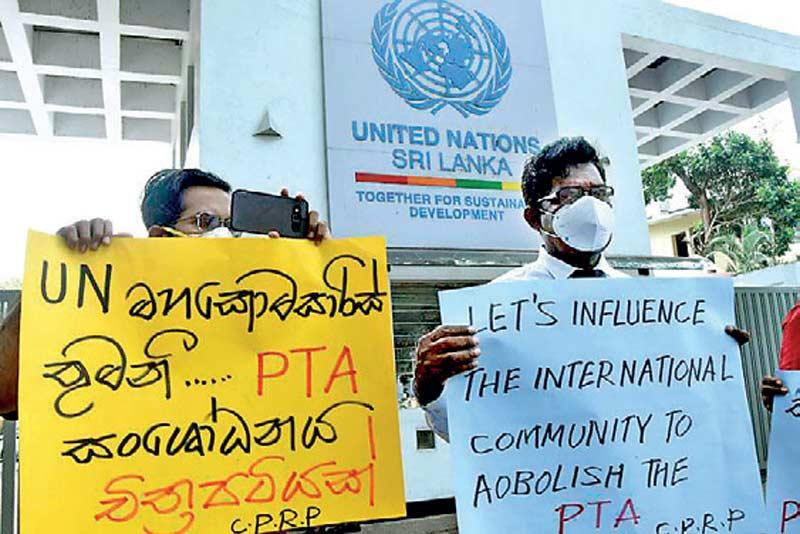
Now, almost a decade later, the Prevention of Terrorism Act is still on the books. It was then, and it is now, incompatible with international human rights conventions. Many promises made in the heady early Yahapalana days got washed out by the squabbling that created the ground for the anti-constitutional coup of 2018 and the Easter Bombing. Sri Lanka has little to show in terms of specific legislative actions when the EU mission arrives shortly.
The EU is more civilised than the US when it comes to changing trade rules. They go through a sequence of steps before withdrawing GSP+ privileges. But it would be good to have something solid to discuss with the monitoring mission.
This should not be difficult. The NPP was unequivocal in its manifesto about rescinding the current Prevention of Terrorism Act (PTA), describing it as “oppressive.” Implementation is easy. Just a few sections saying the Prevention of Terrorism (Temporary Provisions) Act, No. 48 of 1978, as amended, is hereby repealed will suffice. This Act did not create any organization that has to be wound up in an orderly manner.
The only significant questions are what to do about the persons currently in detention without charges, and with those who are serving prison sentences after having been convicted under its provisions. Prior practice was that when a law that deviated significantly from the basic legal norms is repealed, those punished under those laws (including Rohana Wijeweera) were set free.
At the minimum, the government must stop issuing detention orders for trivial matters such as pasting stickers protesting the situation in Gaza and ordinary criminal investigations that have nothing to do with terrorism. Here, its behaviour is worse than that of its predecessor.
By the repeal, the government would have clearly communicated its good faith efforts to keep the promises made when GSP+ was restored in 2017. No one will be able to accuse the government of not addressing a clear and present danger to our economy as they are doing now.
05 Jun 2026 10 minute ago
05 Jun 2026 23 minute ago
05 Jun 2026 45 minute ago
05 Jun 2026 1 hours ago
05 Jun 2026 1 hours ago