25 Apr 2025 - {{hitsCtrl.values.hits}}
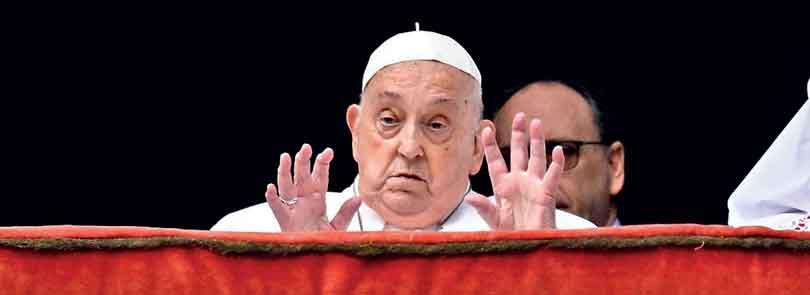
Pope Francis at the main balcony of St Peter’s basilica during the Urbi et Orbi message and blessing to the city and the world as part of Easter celebrations in the Vatican.
 As the world’s 1.4 billion Catholics mourn and tens of thousands of people queue to say their last goodbyes to Pope Francis at St Peter’s Basilica in Vatican City, orphaned are the many causes that the pontiff championed throughout his papal mission.
He was the father figure of the poor and the marginalised. He emphasised the need to address global poverty and inequality in the distribution of global wealth.
As the true son of Mother Earth, he wept over the harm greedy capitalism was inflicting on her. In his encyclical Laudato Si’, titled after the famous Praise be to God poem penned by Saint Francis of Assisi, Pope Francis shook the conscience of humanity, saying it was the moral obligation of every citizen of the Earth to combat climate change and protect the planet.
He was a defender of immigrants. Whether they flee political persecution or seek an escape from economic hardships, he showered his love for the refugees and opposed any move to criminalise migration.
A strong advocate for interfaith dialogue, Pope Francis emphasised the importance of building bridges between religions to foster peace, mutual respect, and understanding.
A great champion of global peace and justice, Pope Francis detested wars and condemned the arms trade. None of his major speeches went without mentioning the need for world peace. Gaza, Ukraine, Sudan, and South Sudan: the world’s trouble spots were in his prayers. His servant leadership for world peace was so exemplary that he would bend and kiss the feet of those who came to talk peace, as was seen during the South Sudan peace process.
And he truly wept for the people of Gaza and the suffering Israel is inflicting on them, showing scant regard for the pontiff’s plea to halt the attacks and give peace a chance. Not a night passed without the pontiff calling Gaza’s tiny Catholic community.
As Israeli bombs reduce to rubble Gaza’s historic mosques and churches, he inquired about the people’s safety. He wept silently over the suffering they were going through without food, proper drinking water, electricity and cooking gas. He encouraged Gaza’s Catholics to open the church doors to those who came in search of shelter. The Catholic church in Gaza hosts 300 Palestinians, young and old, sharing with them whatever little resources they are left with.
“He used to call us at 7 p.m. every night. No matter how busy he was, no matter where he was, he always called,” George Anton, spokesperson for the Church of the Holy Family in Gaza, told the United States-based National Public Radio.
“He would ask us, how we were, what did we eat; did we have clean water, and was anyone injured?” Anton says. “It was never diplomatic or a matter of obligation. It was the questions a father would ask.”
The Holy Family congregation was often terrified, but the pope, during his calls, “drove fear from our hearts,” Anton says. “Today we feel like we are orphans.” He continued this habit even when he was hospitalised. His final call was on Saturday. Francis told them he was praying for them and said he needed their prayers.
Reverend Munther Isaac, Christian theologian and Palestinian pastor, in an interview with Democracy Now, sees Pope Francis’s position on Palestine as an extension of his theology and pastoral care in general, caring for the marginalised and victims of injustice.
“What he has done and exhibited and said throughout the world on Palestine was not the first time he spoke for the plight of Palestinians. I think no Palestinian will ever forget when Pope Francis, in 2014, stopped his car, went down, stepped down and prayed at the separation wall separating Jerusalem from Bethlehem — a moment that touched all of us and continued to speak to us for years.”
Even in his Easter message this Sunday, hours before he passed away, Pope Francis did not forget Gaza. He pleaded for a ceasefire. In many of his messages after Israel’s barbaric war on Gaza people began, the Pope condemned the indiscriminate bombardment and called it terrorism. “Unarmed civilians are subjected to bombings and shootings. It is terrorism.”
On December 22, 2024, in his weekly Angelus prayer, the Pope doubled down on his condemnation of Israel and said, “And with pain I think of Gaza, of so much cruelty, of the children being machine-gunned, of the bombings of schools and hospitals. What cruelty.”
Here was the spiritual leader of the world’s 1.4 billion Catholics, representing one fifth of the world’s population, condemning the cruelty of war, yet the United States’ then-President, Joe Biden, a Catholic, armed Israel with 2,000-pound bombs and supplied it with other destructive weapons. While Catholic nations Ireland and Spain stood on the right side of history and supported the Palestinian cause, Biden became complicit in Israel’s genocide, which the pontiff condemned from the word go.
Power politics stinks when world leaders disregard the wisdom of the saintly and spiritually inclined. Why is there no respect for the pontiff’s pleas for Gaza peace based on justice? Why have the Western political leaders, who are now speaking the good of the Holy Father, failed to see the Gaza war the way he saw it?
The papal tears for Gaza highlight the powerless status the papacy has withdrawn itself into. What a powerful institution the papacy was during the Middle Ages!
The papacy began on a high spiritual note based on Matthew 16:18-19, where Jesus says, “You are Peter, and on this rock I will build my church... I will give you the keys of the kingdom of heaven.” Peter was regarded as the first pope of Christianity. In the beginning, it was the spiritual kingdom the papacy yearned for.
Then over the centuries, the authority enshrined in the institution manifested as political power, leading to shenanigans and corruption that rose to shocking levels. Its power was such that during the controversy over lay investiture (the king appointing bishops) in the early 11th century, Pope Gregory VII excommunicated Henry IV and stripped him of his royal authority. Forced to undertake a penitent pilgrimage, Henry arrived at the Pope’s Canossa Castle in Italy. Pope Gregory made Henry wait for three days outside the castle and beg forgiveness in biting winter. The symbolic humiliation was to stress the point that an emperor must submit to the Church, a sovereign entity with its own laws, troops and taxes. It had the power to remove the Holy Roman Emperor and the authority to declare holy war.
But today, after rebellions, rifts, rivalries and reforms over centuries, the papal institution is shining as the moral voice of the global poor, the oppressed and the deprived. It is the epitome of Christian values. However, the papacy lacks the political clout. It can hope for peace but cannot impose it. This probably explains why Pope Francis was unable to stop the Gaza genocide.
At the United Nations, the Holy See holds observer status. Its power is largely limited to advocacy against morally reprehensible issues, including war and genocide. Pope Francis did what he could to bring about a morality-based political order. His death is a great loss to all those who hope for world peace with justice.
17 Jun 2026 33 minute ago
17 Jun 2026 1 hours ago
17 Jun 2026 1 hours ago
17 Jun 2026 2 hours ago
17 Jun 2026 2 hours ago