10 Apr 2025 - {{hitsCtrl.values.hits}}
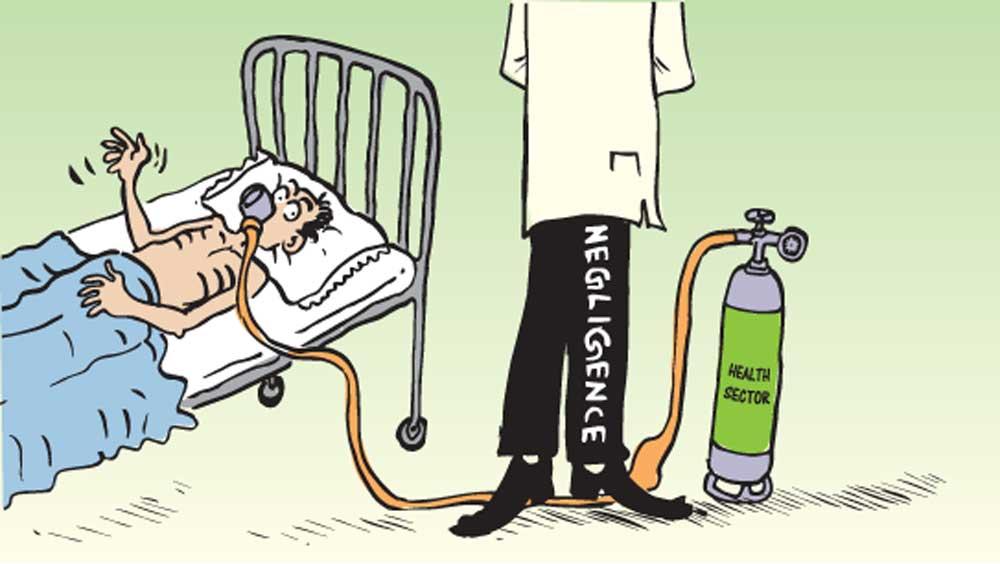
Even though pre-litigation options exist, involving departmental inquiries, warnings, transfers, and reporting to the SLMC, patients and aggrieved parties are not familiar with the process
The recent death of a Grade 1 student who was admitted to the Ratnapura District Hospital adds to the list of innocent lives that have succumbed to medical negligence in the recent past. Taking to social media, the father of the deceased described the events that unfolded after taking the child to the hospital due to a high fever. The doctor in question had requested the father to purchase a tablet from a pharmacy, and the child had subsequently been admitted to the hospital. Thereafter, the nurses obtained blood twice and conducted an X-ray. The child had been given saline in addition to Panadol and the tablet that was purchased from the pharmacy. However, later that night, the parents had been informed that the child’s condition was critical and she was immediately transferred to the Lady Ridgeway Hospital. But time was running out for the innocent life who was later pronounced dead the following day, despite numerous attempts by doctors to save her.
This isn’t the first case of medical negligence that has been reported in the recent past. In December 2022, three-year-old Hamdi Fazleem was admitted to the Lady Ridgeway Hospital for a kidney surgery. His left kidney wasn’t functioning well, but scan reports taken prior to the surgery indicated that his right kidney was functioning normally. But post-surgery, the child’s condition had turned critical, and when the parents questioned the medics, they had responded by saying that the child’s kidney was, in fact, a horseshoe kidney and that both kidneys were ‘mistakenly’ removed during the surgery. The doctors had failed to show the kidneys that were removed, adding to the trauma. However, little Hamdi’s condition turned critical, and he breathed his last in July 2023.
Parents of little Hamdi haven’t given up their fight to seek justice for their youngest son. During the recent court hearing in March, Colombo Magistrate Harshana Kekulawala ordered the Police to arrest all perpetrators responsible for the death of little Hamdi. Following the incident, the Sri Lanka Medical Council (SLMC) suspended the consultant judicial medical officer’s registration number for eight months. However, the doctor who performed the surgery migrated to Australia following the incident, and during queries made by this paper, the doctor revealed that the reports linking him with the death of little Hamdi are baseless and that he had been preparing to migrate to Australia sometime prior to the incident.
At this point, rather than deciding about who is right or wrong, what victims of medical negligence require is a system in which medical practitioners accused of medical negligence and malpractice would be brought to book. A mechanism to hold them accountable is a priority. Even though pre-litigation options exist, involving departmental inquiries, warnings, transfers, and reporting to the SLMC, patients and aggrieved parties are not familiar with the process. However, complaints to the SLMC may lead to temporary suspension or complete erasure from the medical register. Alternatively, conflict resolution avenues like mediation offer non-litigious paths to resolution, fostering mutually-agreed conditions.
Even though patients have the option to file formal complaints with the ombudsman for a non-threatening, cost-effective process, aggrieved parties are usually from underprivileged or rural communities who don’t have the necessary finances to file a case. What is concerning is the fact that laws related to medical negligence are primarily governed by the Roman-Dutch law, which is outdated. As in Hamdi’s case, medical practitioners in question have room to escape in the event a medical misadventure happens.
A former Health Minister accused of purchasing substandard medicines is facing a legal battle at present. But it is the duty of medical practitioners to protect the lives of patients who seek medical interventions for various illnesses. The Western medicine system surpassed the Ayurveda system due to various myths developed by the former. But more people are now inclined to visit a local medical practitioner or simply take rest at home and recover from an illness as they are fast losing their trust in the country’s primary healthcare sector. Such is the plight of a country that was once acclaimed locally and internationally for its primary healthcare system.
‘Your Thought’ is a space, a right of the readers to support or contradict and discuss the issues highlighted in the editorial and other articles in the editorial and op-ed pages. Designed as the reader’s editorial; our readers can send in their writings, with a word count not exceeding 200, to ‘Your Thought’, Daily Mirror Political Features Desk, No 8, Hunupitiya Cross Road, Colombo 2 or email to [email protected]
05 Jun 2026 17 minute ago
05 Jun 2026 44 minute ago
05 Jun 2026 50 minute ago
05 Jun 2026 53 minute ago
05 Jun 2026 2 hours ago