29 Apr 2025 - {{hitsCtrl.values.hits}}
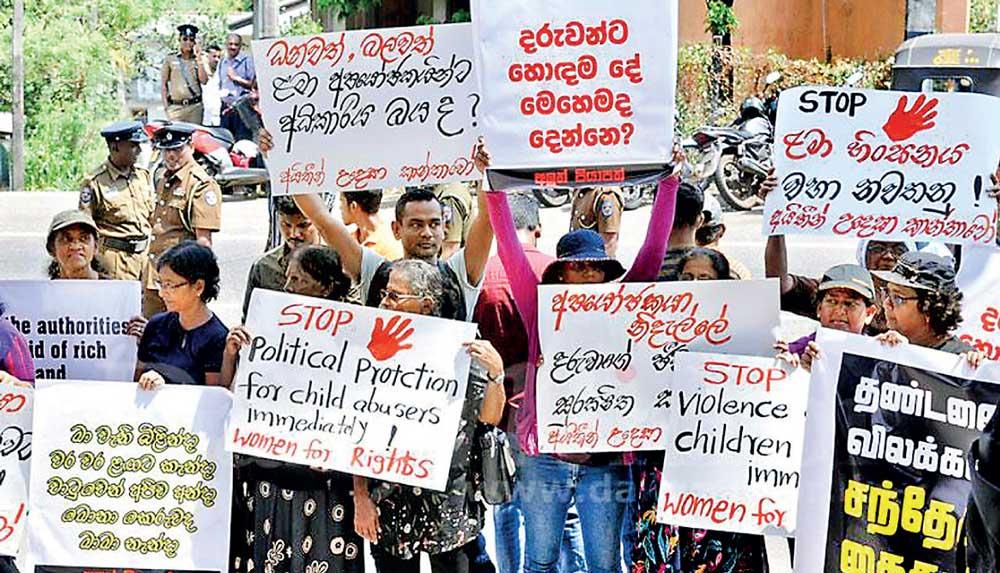
 A large number of Civil Society Organisations (CSO) and experts have appealed to President Anura Kumara Dissanayake to prioritise child welfare, especially in expediting the backlog of 40,000 cases of child abuse. The appeal was collaborated by Law and Society Trust and Child Protection Alliance with 28 CSOs and 28 experts endorsing it.
By 2023, Sri Lanka’s population was 22,037,000 out of which 6,642,331 (30.14%) of the total population were children under 18 years of age according to the definition of the United Nations.
Child protection is a national crisis in Sri Lanka. Child abuse has risen as the sixth grave crime as per the 2023 Annual Grave Crimes Report of Sri Lanka Police. The National Child Protection Authority
(NCPA) data reveals an alarming 30% rise in complaints received over the past decade with cruelty (Penal Code 308A) or physical abuse in other words being the most common form of child abuse recorded with a staggering 2238 cases reported in 2023 and 1950 cases reported in 2024, respectively. The Auditor General’s Annual Report of 2022 shows that 39,000+ cases of child abuse are backlogged at NCPA with less than 50% of cases referred to the Attorney General (AG). The Annual Performance Report of Attorney General’s Department reveals a backlog of 3455 cases of child abuse in 2023.
 However, Sri Lanka ratified the UN Convention on the Rights of the Child (CRC) in 1991.
The National Child Protection Authority (NCPA) was established via Parliament Act No. 50 of 1998. The Child Protection Unit (CPU) of the Attorney General’s Department was established in 2004 with World Bank funding in 2004. Files in the CPU Unit are required to be attended to on a priority basis and supervised according to an internal circular issued by the Attorney General, in order to expedite the conclusion of such cases.
The policy document of the National Peoples Power (NPP) assures the following: Section 2.4 - A safeworld for children; A creative future generation acknowledges the fact that “the judicial process for children who fall victim to crimes often drags on for excessively long periods, sometimes extending even 6 to 10 years.”
It also mentions the following;
Reviewing, amending, or repealing outdated laws such as the Children and Young Persons
Ordinance, Adoption of Children Ordinance, Vagrants Ordinance, and Orphanages Ordinance.
Establishing specialized high courts dedicated solely to handling cases involving children.
Setting up a more efficient mechanism for collecting child victims’ testimonies and improving the current investigative process to minimize their re-victimization.
Establish a robust mechanism for early identification and intervention of at-risk children, including children with disabilities, street children and out-of-school children.
Educational reforms in line with international standards aimed at fostering life skills and knowledge in a child-friendly educational environment.
The appeal to the President reminds him of the promise given during a political rally in London in June 2024, when Anura Kumara Dissanayake who was Presidential candidate was questioned specifically on how he would prioritise to resolve the child protection crisis if he was elected as the President and if the NPP was elected into government. He promised to “establish a separate Police Unit to expedite the legal process to seek justice for the child victims who have been lamenting for decades.”
On 13 September 2024, the Cabinet approved the Bill on Penal Code reforms to unequivocally abolish corporal punishment, L.D.O. 41/2024 ‘An Act to Amend the Penal Code (Chapter 19)’, an obligation that Sri Lanka is long overdue since ratifying UNCRC in 1991. All that is left is to implement the gazette notification and submit the Bill to parliament. Ironically, this process has been stalled by the appointment of the new NPP government. During the first Global Ministerial Conference on Ending Violence against Children on 7-8 November 2024, the Government of Sri Lanka pledged to “complete the legislative process to ban corporal punishment in all settings by mid-2025.”
The appeal reiterates that “the struggle to protect child rights has been left to organisations committed to protecting the rights and welfare of children. But we, the undersigned who are a part of a broader group of human rights activists urge the recognition that children’s rights are human rights and in solidarity support the activism of Child Rights organisations.”
The CSO’s and experts urge President to implement the following forthwith:
Expedite the 39,000+ cases backlogged at NCPA as per Act of NCPA Sections 14 (g) and (h). The evidence for this is in Auditor General’s Report.
Expedite the 3000+ cases backlogged at AG’s department by following the internal circular regarding concluding investigations within 3 months.
Expedite the passing of the Bill on Penal Code Reforms to abolish corporal punishment as cruelty against children is the most common form of child abuse contributing to the cases. This is as a preventive measure.
Implement the National Partnership to End Violence Against Children (NPEVAC), which Sri Lanka agreed to in 2017 as the only South Asian country committed to achieve Sustainable Development Goal (SDG) 16.2.
As many as 28 organisations including Alliance for Minorities, Centre for Equality and Justice, Avanka Lanka Foundation, Community Welfare and Development Fund and individuals such as Dr. Jayampathy Wickramaratne PC, Dr. Vinya Ariyaratne, Specialist in Community Medicine, Ramani Muttettuwegama, Attorney-at- Law and Rosanna Flamer-Caldera have endorsed the appeal.
The writer is the Chairperson of Stop Child Cruelty Trust and Co-convener of Child Protection Alliance.
05 Jun 2026 14 minute ago
05 Jun 2026 20 minute ago
05 Jun 2026 25 minute ago
05 Jun 2026 32 minute ago