22 Apr 2026 - {{hitsCtrl.values.hits}}
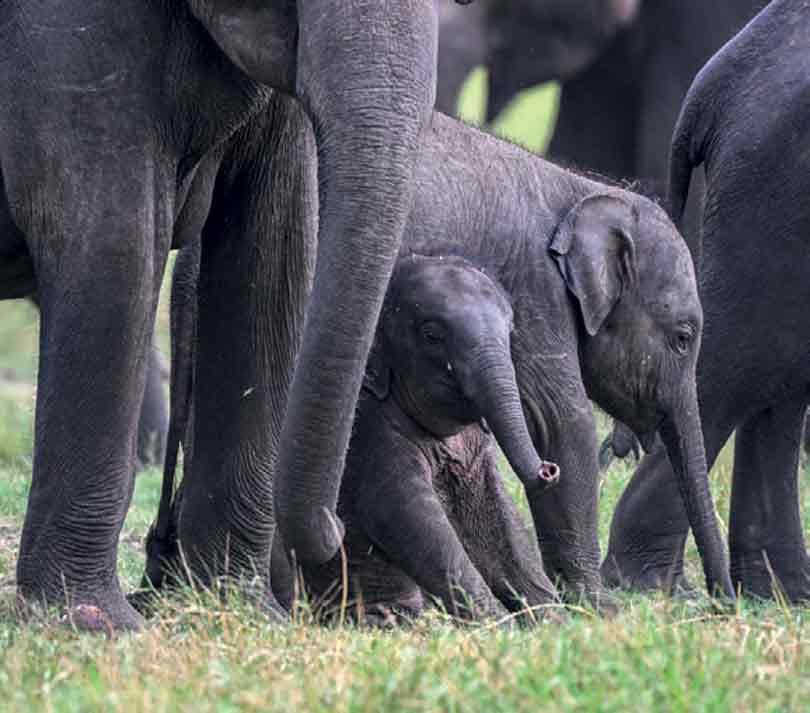
Holding grounds are considered ‘prisons’ because they detain elephants in areas that restrict ranging space
Photo courtesy Mikal Knight Kim
Sri Lanka is spending hundreds of millions of rupees on elephant management strategies that scientists, affected communities, and Sri Lanka’s own National Action Plan (NAP) all acknowledge is making the problem worse. Two approaches dominate: long-distance drives that push herds into protected areas (PAs) and translocation of problem males into National Parks and elephant holding grounds (EHGs). Both intensify the conflict they are meant to resolve. Neither approach accounts for the carrying capacity of PAs and holding grounds into which elephants are forced, nor for elephant behaviour: these animals maintain strong fidelity to their home range and grow more aggressive when repeatedly harassed.
Villager surveys by the Centre for Conservation and Research, Sri Lanka (CCRSL) confirm that drives worsen human-elephant conflict (HEC) with the increased aggression of elephants. Radio collaring data show that translocation is futile, resulting in higher human and elephant mortality rates at the new locations. As we argued in the first instalment of this series, the government’s approach rests on unscientific assumptions and ignores NAP.
Long-distance elephant drives: a dead-end road
Mega-drives aim to permanently move elephants near agricultural and irrigation projects to Department of Wildlife Conservation (DWC) PAs. These drives are expensive and prolonged. Herds and calves are harassed with firecrackers, and many elephants starve after being driven into PAs that cannot sustain them. Not only do many elephants starve in these inadequate spaces, but the drives themselves tend to capture herds instead of the problem males causing trouble.
Staggering costs
Political and societal pressure rather than scientific rationale usually motivates drives. Two examples of the many catastrophic drives are the Walawe Left Bank Development Project (2005-2006) and Oya Maduwa (December 2024). The Walawe drive pushed elephants from the Hambantota district to Lunugamvehera National Park. Approximately 95% of elephants driven were herds with females and calves, and most of these starved. In a subsequent CCRSL survey, 71% of locals stated that HEC remained the same or worse, and 98% noted that crop-raiding elephants had not been removed. The drive cost a staggering Rs.62 million.
The more recent 2024 Oya Maduwa drive was another fiasco. Communities pressured the current government to drive elephants from villages in the Anuradhapura district to Wilpattu National Park (WNP). Elephants refused to move beyond the Oya Maduwa Livestock Development Board Farm. Oya Maduwa farmers objected to continuing this drive as it was during the paddy cultivation season, and elephants destroyed crops.
This episode points to two important aspects of HEC. First, the drive simply displaced the problem and the political backlash from Anuradhapura farmers to their counterparts in Oya Maduwa. Second, authorities continue to disregard carrying capacity when ordering drives. The habitat in WNP has a low carrying capacity, and drives would result in starvation for moved as well as resident elephants. NAP recommended that long-distance drives be immediately discontinued. However, with the failure to continue implementing this Plan, policy makers have disregarded this recommendation.
Translocation of elephants: a prison sentence
Translocation attempts to reduce HEC by capturing and relocating problem elephants into PAs and EHGs. This strategy clearly fails. Radio-collar tracking by CCRSL tells its own story: of 17 translocated elephants, only two stayed in protected forests.
Three returned to their original capture site; the remaining 12 ended up in developed areas — bringing the conflict with them. These translocations also led to five human and five elephant deaths, clearly demonstrating that both elephants and the problem were translocated.
Holding grounds are considered ‘prisons’ because they detain elephants in areas that restrict ranging space. The habitat of the Horowpothana EHG cannot support a high density of elephants, resulting in insufficient food and water, starvation and high mortality rates.
The abysmal performance of this EHG is an example of failed strategies. The Auditor General’s 2019 report on this holding ground concluded that HEC intensified in the local area. Only nine of the 52 elephants retained in this space remained, and 12 died. The high cost of this experiment makes this outcome even more inexcusable: over Rs. 300 million was spent on construction.
Intense pressure
NAP recognises that holding grounds do not work. However, DWC is under intense political and community pressure to translocate elephants into EHGs, and field staff have even been physically assaulted for not doing so. This, coupled with incomplete data from DWC, prompted NAP’s recommendation to maintain the Horowpothana holding ground for the time being. NAP also recommended that monitoring and further data collection and analysis be done immediately to assess this EHG and the effectiveness of translocation.
In sum, long-distance elephant drives and translocation have backfired. NAP’s science-based recommendations and not politics must dictate policy. Politicians are rarely held accountable for strategies that worsen HEC and are a waste of public funds. Every failed drive and abandoned holding ground represents public money spent exacerbating the crisis. Until NAP is revived and these debunked strategies retired, both Sri Lanka’s elephants and its farmers will continue to pay the price.
Dr. Sumith Pilapitiya previously served as the Chairman of the Presidential Committee appointed to facilitate, oversee and monitor the implementation of the National Action Plan on HEC Mitigation. Dr. Malathy Knight is an economist and a Research Fellow at Verité Research.
This is the second op-ed in a five-part series on Sri Lanka’s HEC. The first op-ed in the series was published in the Daily Mirror on 27 November 2025 and argued that a National Action Plan (NAP) must be launched immediately to effectively address HEC. Future instalments will examine the promise of community fencing, the importance of raising community awareness, and the economic potential of eco-tourism.
16 Jun 2026 6 minute ago
16 Jun 2026 10 minute ago
16 Jun 2026 13 minute ago
16 Jun 2026 15 minute ago
16 Jun 2026 17 minute ago