05 Dec 2025 - {{hitsCtrl.values.hits}}
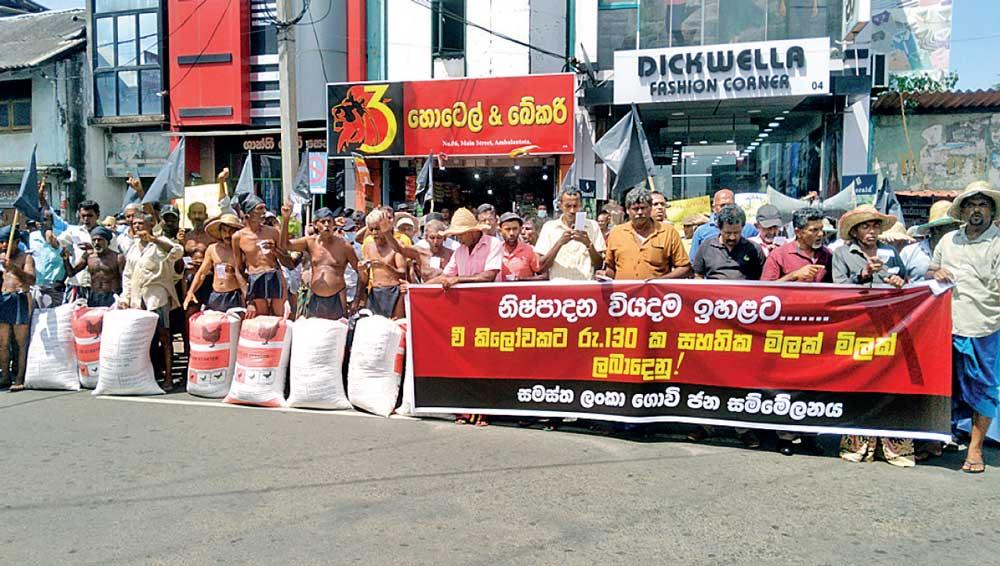
Members of a farmers collective participate in an agitation campaign where they are demanding a minimum purchase price of Rs 130 for a kilogram of their paddy
 Sri Lanka’s rice industry is similar to Yo-yo dieting; sometimes it gains and it equally loses. Hence a close look at Sri Lanka’s rice industry merits an in-depth analysis, especially during adverse weather conditions experienced at present.
Unlike any other regular product that we consume, people are so concerned when there is a rice scarcity in the market. This is because we consume rice at least twice a day and use the wheat for other purposes. Right now the present flood situation in the country threatens to destabilize the paddy industry. There’s panic buying in the market and ‘rice’ is one of the fastest moving items in super markets and grocery stores. At this rate, supermarkets will not have rice for sale.
Rice eating Sri Lankans love to dig into their past and boast of the kings who made the island self-sufficient in rice. But do we take a moment and compare Sri Lanka’s present rice situation with other rice eating and paddy producing countries?
Take for example one of Sri Lanka’s present closest allies, China. The Chinese are one of the largest producers and consumers of rice. They use all their output for domestic consumption and retain large stocks for food security. Sri Lanka has much to learn about food security. Just see the mentality of a middle-income earner who recently purchased ten packs of yoghurt (each pack contains six yoghurts) for his family comprising his wife and three-year-old daughter. I was next in the queue and had a quick glance at one of the yoghurts that fell out of one pack; the information on the back of the product stated that the yoghurts would expire the next day. How many yoghurts could they possibly eat in a single day? Such a mentality will not help a country work towards strengthening food security.
Authorities here in Sri Lanka must control the excessive buying powers of consumers during a catastrophe. Last Friday (November 28) some customers swarmed supermarkets and in Thalahena, Malabe areas and purchased the bulk of the vegetables available. It came to be known that most of these customers were people who are operating restaurants.
The other top Asian rice producing country is India. The Indian rice industry is thriving due to reasons like favourable government policies, ideal paddy growing conditions in regions like Ganga and Mahanadi River Basins and the large subsidized agriculture sector.
Recently my wife bought a few kilograms of Ponni Samba made in India. These wheat grains when boiled and eaten filled our bellies and didn’t make us hungry for a good six hours or more!
We Sri Lankans are constantly teaching our children through textbooks at school that our ancient kings made this island self-sufficient in rice. These lessons paint the picture in children’s minds that Sri Lanka never became self-sufficient in rice after the period of the monarch rule in the island. This is not true. The last occasion that Sri Lanka was self-sufficient in rice was during the 2023-2024 cultivation season (Government statistics). Sri Lanka has been (in-between breaks due to natural disasters and flawed government thinking) a self-sufficient rice producer and global exporter thanks to an extensive irrigation system, embracing on farm/off farm water management methods and following agro-meteorological advisories.
During the previous regime, we heard of caretaker president Ranil Wickremesinghe instructing the Agriculture Ministry to take necessary steps to double paddy cultivation within the next six cropping seasons to make Sri Lanka self-sufficient in rice. Wickremesinghe doesn’t wield any political clout now and that goal he set might not appeal to the present rulers of this nation. When one reflects on that goal, it’s essential that this government sticks to agriculture policies like price control, rice import tariffs and providing relief to farmers during challenging times.
One factor that influences the rice market is climate variability. Regimes must plan ahead and be alert because the rice market is highly sensitive.
For the record, in Sri Lanka, over one million hectares of paddy fields are cultivated annually and account for 37% of the country’s land use.
Any government fears agitation by the country’s workforce. A workforce, if organized, can cripple a government. Right now, even before cyclone Ditwah lashed Sri Lanka, farmers were agitating. They maintain that they cannot cover production costs at the present government stipulated minimum purchase price (Which is between Rs 120-132 for wheat depending on the variety).There is a saying that the Agri farmer who washes off mud from his body is fit to be a king. Still we can find very intelligent elderly farmers who contribute to the food sector and economy of this country.
The village elders who engage in farming have both brain and brawn. In the good old days, farmers returned to their homes and dedicated time to hone their literary skills. This is a community that the regime mustn’t mess with. A farmer once wrote ‘if you make rice kanji and drink it occasionally, you can say ‘goodbye’ to illnesses’. Don’t push these farmers to the wall, because very soon they are going to say ‘goodbye’ to this government.
19 Jun 2026 29 minute ago
19 Jun 2026 38 minute ago
19 Jun 2026 41 minute ago
19 Jun 2026 47 minute ago
19 Jun 2026 51 minute ago