11 Apr 2025 - {{hitsCtrl.values.hits}}
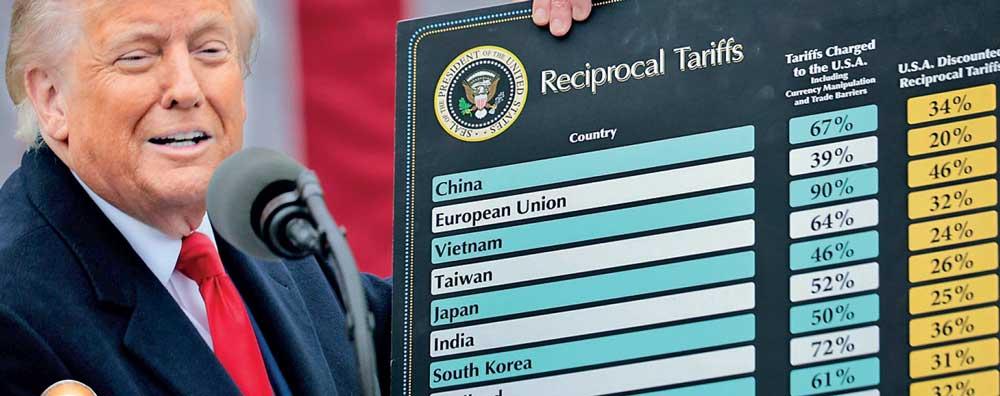
President Donald Trump making an announcement about reciprocal tariffs at the White House in early April
About 23% of the island nation’s exports are U.S.-bound, with 55% of that figure generated by the apparel sector alone
 When U.S. President Donald Trump announced his sweeping “Liberation Day” tariffs, the world economy braced for seismic aftershocks. In a bold and controversial return to economic nationalism, Trump invoked the International Emergency Economic Powers Act of 1977 to impose a baseline 10% duty on all imports, with significantly higher tariffs on nations with which the U.S. maintains the largest trade imbalances. Sri Lanka, already reeling from its 2022 economic collapse, has been hit with a staggering 44% tariff on its exports to the U.S.—one of the highest rates announced—posing a near-existential threat to its export economy, especially the vital apparel industry.
A Global Shockwave with Local Fallout
The policy’s global repercussions were immediate: stock markets plunged, currencies wavered, and analysts warned of a possible worldwide recession. JP Morgan placed the likelihood of a global economic downturn at 60% by year’s end. Japan’s Nikkei index suffered a sharp drop, underscoring the global market’s vulnerability to American policy shifts. The United States, long the standard-bearer of free trade, had abruptly pivoted to protectionism.
For Sri Lanka, the fallout has been devastatingly direct. About 23% of the island nation’s exports are U.S.-bound, with 55% of that figure generated by the apparel sector alone. That industry supports the livelihoods of roughly 710,000 people. Now, with an almost punitive 44% tariff in place, factories face closure, unemployment is expected to rise sharply, and the already fragile economy risks further contraction.
Economic analyst Dr. Kenneth De Zilva has flagged the unequal burden Sri Lanka now bears. While the U.S. justifies the tariff as “reciprocal” against what it deems an 88% trade barrier on its exports to Sri Lanka, such a comparison fails to account for the massive asymmetry in economic scale and capacity between the two nations. Furthermore, neighbouring competitors fare significantly better—Bangladesh faces a 37% tariff, and India only 26%—making Sri Lankan exports markedly less competitive. The local response to this economic storm has been swift, if not uniformly coordinated. President Dissanayake, in an effort to signal urgency and diplomacy, wrote a personal letter to President Trump requesting tariff relief—an appeal that has garnered significant media attention. The NPP government remains cautiously optimistic, though few dare predict Trump’s next move.
Opposition Leader Sajith Premadasa has urged the immediate appointment of a national trade representative and an expert advisory panel to negotiate with Washington. He was blunt in his warnings: “Around 200,000 people are expected to lose their jobs. The Sri Lankan apparel sector, which was nurtured by late President R. Premadasa, is in danger.” In a more pointed critique, Premadasa lamented the nation’s longstanding reluctance to embrace globalisation and trade liberalisation: “This is a wake-up call.”
Interestingly, even traditionally adversarial voices have united under the economic threat. SLPP MP Namal Rajapaksa called for cross-party unity, stating, “It is time for all political parties to work together and support the affected sectors.” His call was echoed by entrepreneur-turned-politician Dilith Jayaweera, who has offered his expertise to the government free of charge in this time of crisis.
A Contradiction in American Policy
The contradiction at the heart of Trump’s tariff strategy has not gone unnoticed. For decades, the U.S. positioned itself as the principal architect of the rules-based international trading system, advocating for liberal economic policies across the globe. The “Liberation Day” tariffs, however, mark a dramatic reversal that threatens to alienate long-time partners and undermine America’s economic credibility. As one Sri Lankan commentator observed, “These excessively protectionist measures could undermine America’s global dominance, driving smaller nations to seek more favourable terms from its rivals.” Already, there are signs of this shift. Russia has reportedly offered assistance to Sri Lanka’s export sector—an early signal that the U.S.’s trade policies could have unintended geopolitical consequences.
According to U.S. Ambassador Julie Chung, the Trump administration may be willing to consider tariff reductions—on conditions. At a recent meeting with former minister Mano Ganeshan, Chung reportedly suggested that Sri Lanka should consider sourcing cotton fabric and other inputs from the U.S., thus creating demand for American goods in return. But such a move would raise production costs considerably, eroding the cost competitiveness of Sri Lankan apparels, especially against regional competitors.
Lessons from Abroad and the Case for Strategic Realignment
Other affected nations are already pivoting. India, for instance, is seeking to secure new trade deals, diversify its export markets, and mitigate the shock through broader economic diplomacy. Indian Finance Minister Nirmala Sitharaman highlighted the urgency of such efforts, warning that trade disruptions may persist for the foreseeable future. Sri Lanka would do well to learn from these proactive approaches. Premadasa has proposed an “Asia-centric trade strategy,” suggesting stronger ties with India, ASEAN members, and Bangladesh. Economist Dr. De Zilva also supports this approach, arguing that the country must diversify its export base and adapt quickly to shifting global trade dynamics.
Prof. C. A. Saliya, a senior banker-turned-academic, put it succinctly in his latest column: emerging economies must transform this disruption into opportunity. Diversification, technological upgrades, and structural reform are the way forward if Sri Lanka hopes to enhance economic resilience.
A United National Strategy
But such strategic realignment requires more than diplomatic finesse. It demands cohesive, inclusive policymaking. As Prof. Saliya argues, any strategy to navigate the new U.S. trade regime must be developed through a tripartite process involving the government, industrialists, and workers.
Trade unions, in particular, must shift their traditional focus from demand-driven activism to a more collaborative role in preserving Sri Lanka’s industrial competitiveness. Meanwhile, the government must support exporters by streamlining regulatory processes, easing tax burdens, and ensuring access to affordable inputs. Exporters, for their part, must embrace innovation, seek new markets, and reduce reliance on a single trading partner. According to World Bank modelling using the SMART partial equilibrium approach, Sri Lanka’s apparel exports to the U.S. are projected to decline by about 20%, amounting to a revenue loss of over USD 300 million. For an economy still recovering from a devastating crisis, this is no small blow. Yet in crisis lies opportunity—if the country can muster the political will and strategic clarity to adapt.
Between Hope and Hard Choices
President Trump’s tariff blitz is more than a mere policy shift—it is a declaration of a new, unpredictable era in global trade. For Sri Lanka, the impact is acute, and the path forward uncertain. While optimism surrounding a possible reversal of the tariffs is not unfounded, it is essential that the nation prepare for protracted hardship.
Sri Lanka’s response must go beyond diplomacy. It must engage in pragmatic, forward-looking policymaking, backed by political consensus and collective resolve. The island has weathered many storms before. Whether it can transform this latest challenge into an opportunity for renewal depends on how swiftly and wisely it acts now.
[email protected]
13 Jun 2026 1 hours ago
13 Jun 2026 10 minute ago
13 Jun 2026 23 minute ago
13 Jun 2026 44 minute ago
13 Jun 2026 53 minute ago