21 Apr 2025 - {{hitsCtrl.values.hits}}
The excitement around Sri Lanka’s World Cup victory in March 1996 that created overwhelming interest in cricket. The great Aragalaya protests in July 2022, when hundreds of thousands of people on the streets of Colombo chased away an authoritarian president.
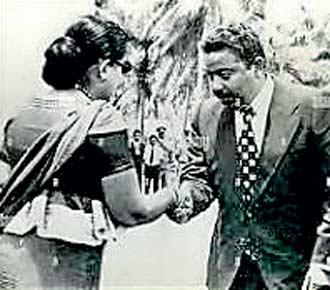
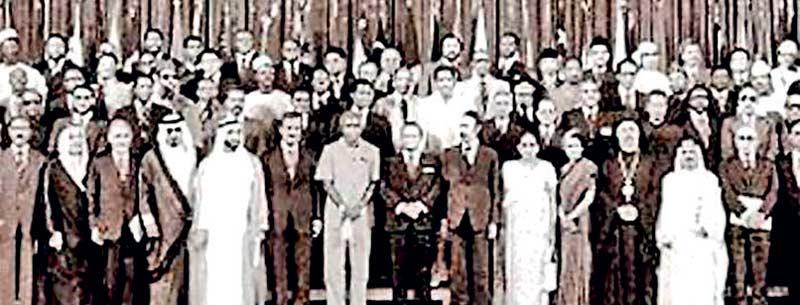
 Speaking of Sri Lanka’s international relevance, I can’t think of a more important moment than when Sri Lanka hosted the Non-Aligned Movement (NAM) Conference in August 1976. The excitement of so many Third World leaders arriving in Colombo are still etched as one of my early childhood memories. My father, a history lecturer and avid follower of international developments, would be glued to his shortwave radio late into the night, and narrated stories of faraway places and peoples. Palestine, Vietnam and Cuba suddenly became closer, and eclipsed my world in the weeks surrounding the NAM Conference.
We then lived in a flat in Colombo, where kids played all day on the friendly lane of mixed communities; I was nicknamed Andy Roberts after the West Indian fast bowler because of my curly hair. The talk of NAM with its great leaders led me to ask a challenging question, which some of my former neighbours laughingly remind me to this day. Much to the horror of my mother, a devout Christian, I ran up and down the street and asked, if Jesus and Castro had a fight, who would win?
|
PM Sirima Bandaranaike greeting a visiting dignitary |
Back then in Colombo and in the broader Third World, we knew much more about each other. I also realise now that those were ideologically potent and hopeful times. But it was also the twilight of an era that began with the Bandung Conference in 1955 and ended with the NAM Conference in Colombo. Numerous assassinations and regime changes by the CIA and other Western agencies had already by then crippled many Third World Countries.
A counter-revolution was already underway with debt crises and a turn towards a neoliberal order. Sri Lanka too, less than a year later in the elections of July 1977, moved drastically to the Right.
J. R. Jayewardane would take the country away from non-alignment, and into the orbit of the United States with his open economy reforms; Sri Lanka became the first country in South Asia to liberalise its economy.
We live in a very different world today. We hardly dare to imagine a different future. Trump, the blatant bully, is threatening the world with a trade war to make every country grovel before Washington. But we have no movement, and not even a powerful ideology, to unite the global South.
In this context, the 2020s like the 1930s are proving to be a time of great turmoil, when new ideologies and movements could emerge. Last week was the seventieth anniversary of the Bandung Conference, where formerly colonised peoples and those that continued to be ravaged by colonialism dreamt of equality and freedom. What can we draw from the Bandung spirit and NAM in our time of crisis?
Capitalism, Colonialism and Imperialism
In my teens, my father told me about Archie Singham. Of how Singham as a young man was denied a scholarship to study in the US as it was given to a relative of a politician, and that his protest led to another scholarship. Singham stayed on in the US, and he became an important figure in the Black movement and did much political work in the Caribbean.
During my own studies in the US, I was curious about Singham, partly because he was a Sri Lankan who had taught at the City University of New York where I did my PhD, and more because I found that he had systematically documented the proceedings of the NAM conferences.
Singham wrote a fascinating account of the NAM conference in Colombo a few months later. He claimed that it was ideologically the most important NAM conference to date. Among the participants were leaders from newly independent Vietnam and the Secretary General of the United Nations.
The proceedings gained significance as they forthrightly took up the economic issues that ravaged the Third World. The calls for a New International Economic Order enshrined in a document in 1974 by the United Nations Conference on Trade and Development (UNCTAD), led by its Secretary General, another Sri Lankan of repute, Gamini Corea, was extensively discussed at the conference.
In this context, Singham focused on the larger issues of global political economy that were at stake for NAM:
“It is most important that we understand this aspect of the movement, namely, its anti-colonialist and consciously anti-capitalist character. It is important that we make a distinction between anti-colonialism and anti-imperialism. Until the end of World War II, the political form of imperialist exploitation was colonialism in that it sought outright control over the subject peoples of Asia, Africa, and the Americas. This exploitation of the world by Western European powers placed them in the forefront of the attack by colonial peoples when they sought their independence.
“This political exploitation, it should be remembered, resulted in the growth and consolidation of industrial capitalism in the west. World War II, however, resulted in the great awakening of colonial peoples who proceeded to demand and obtain political independence for their countries. However, this political victory, namely, the obtaining of independence, did not resolve the question of imperialism. The end of colonial rule did not negate imperialism.
“While one saw the decline of the colonial powers in Europe, one also saw the emergence of a newly reconstructed capitalism led by the United States. The confusion in the Non-Aligned Movement, if there is one, partially lies in the fact that some of its participants are consciously anti-colonial but not necessarily anti-imperialist.
“Many of the nations of the world, and indeed even the capitalist nations, opposed colonialism (but very few of the capitalist nations would oppose imperialism).”
(A. W. Singham (1976) The Fifth Summit Conference of the Non-Aligned Movement, The Black Scholar: Journal of Black Studies and Research, 8:3, 2-9).
I quote Singham above at length, to give both a flavour of his writing and the relevance of his analysis today. As we watch the genocide in Gaza, and the brazen threats and attacks by Trump,
we are confronted with the brutal logic of imperialism. However, few leaders around the world today, certainly much less than in 1976, are willing to call a spade a spade, and oppose US imperialism for what it is and has been for over a century.
Self-Reliance and Solidarity
In reading about the Colombo Conference in 1976, there is much that could inspire the work to be done today. Indeed, the issues of debt and trade figured prominently in the discussions.
In the face of mounting debt crises, the idea of a “Third World Bank” was floated. Trade, particularly, the declining terms of trade for the developing world highlighted the need for South-South trade. The Economic Declaration of the Colombo Conference dated 19 August 1976 stated the following:
“The Heads of State or Government of the Non-Aligned Countries are of the firm belief that only a confident spirit of collective self-reliance on the part of the developing countries can guarantee the emergence of the New International Economic Order. Self-reliance implies a firm determination on the part of the developing nations to secure their legitimate economic rights in international dealings through the use of their collective bargaining strength. It also involves preparedness on their part to follow internally the discipline required of them by the process of economic development with justice. And, most importantly, it means willingness to explore and pursue the immense possibilities of co-operation among themselves in financial, technical, trade, industrial and other fields.”
After close to five decades, we have a progressive government that at least in word is opposed to neoliberalism. Yet the NPP government is shackled by the ongoing IMF programme, and still lacks the confidence to break free. Seventy years later and amidst our times of global turmoil, will the NPP government take up the Bandung spirit of self-reliance and provide leadership for South-South solidarity?
17 Jun 2026 4 hours ago
17 Jun 2026 4 hours ago
17 Jun 2026 5 hours ago
17 Jun 2026 5 hours ago
17 Jun 2026 6 hours ago