18 Jan 2025 - {{hitsCtrl.values.hits}}
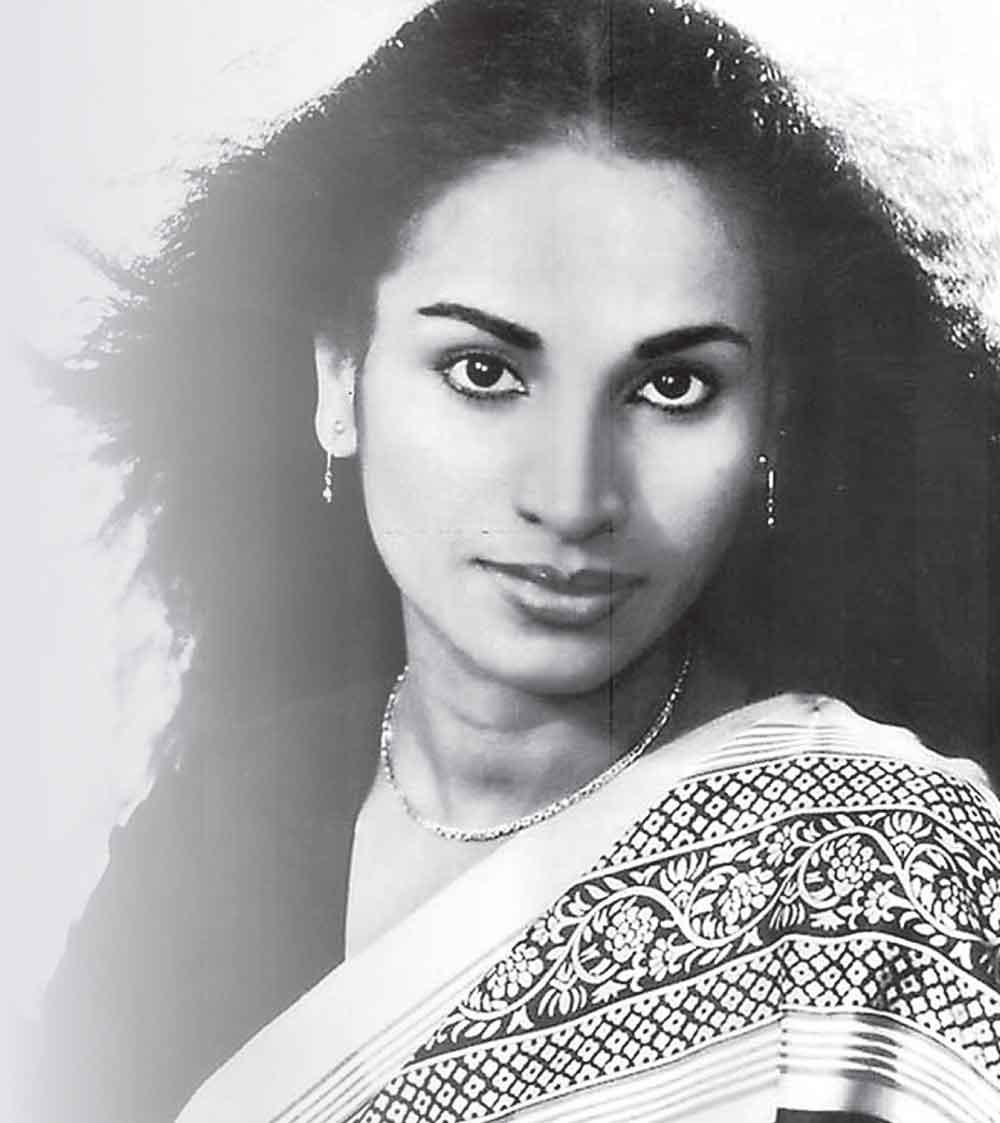
As the author notes; instead of becoming a film star playing stereotype characters, Swarna became the spectator’s ‘female other’ in a variety of roles
Swarna may have somehow absorbed that quality not from any cinema academy but from that working class school in Grand Pass where she was educated
Our actresses were expected to be voluptuous full figures and skinniness in women, whether in films or in the real world, was certainly not a virtue
 There was a time when film criticism was alive and well in this country. From Jayawilal Wilegoda from the 1960s to Gamini Weragama and Tissa Premasiri from the 1980s (in Sinhala papers) to Reggie Siriwardena, Ajith Samaranayake and Prof. A. J. Gunawardhana in the English newspapers, there was regular commentary and lively debate on the pros and cons of the hundreds of films which the studios and independent filmmakers kept turning out till the first decade of the new millennium.
Though the number of films made in this country declined since the 1980s, there seems to be a revival now (in quantity though not in quality). But the critics have disappeared. The print media 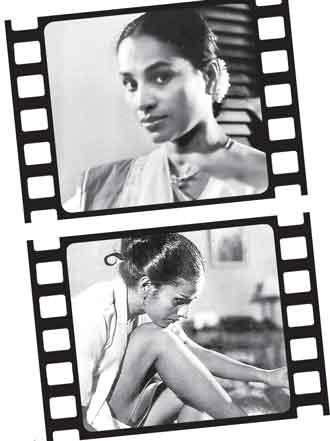 stream of criticism has become marginalised with no prominent film critics. Social media has stepped in. Some of it is all right but most of it is junk, and there is no popular Lankan social media film critics’ forum such as Rotten Tomatoes.
In this context, it was interesting to come across a critical essay on actress Swarna Mallawarachchi in ‘Kalaawa Soya Yema’ (In Search of Art), a book of essays on art by prominent writer and critic Eric Illayapparachchi.
It isn’t just nostalgia. What is euphemistically known as ‘the golden age’ of Sinhala cinema is in need of more critical analysis. What was written back then as the films made their debut is just a foundation that needs to be built upon and expanded.
Eric Illayapparachchi starts his essay (titled ‘The Last Face: Swarna Mallawaarachchi’) with a quote from Roland Barthes (French literary theorist, essayist, critic and philosopher) – Greta Garbo was able to function in a Hollywood milieu where actresses the calibre of Audrey Hepburn, Ingrid Bergman, and Catherine Hepburn reigned because it was an era when the face was supreme; it acted as a hypnotic device and a magic potion (designed to win the heart of a woman) on the spectator.
With his penchant for historical analysis, the writer mentions that such magic potions were widely used in Medieval Europe. One can find many such stories in Medieval literature and operas written at a later time. These magic potions were taken as drinks mixed with wine, plant juices and water. Such potions were also an antidote for the poison that Socrates was given to drink as his death sentence, adding that while Red Indians (indigenous Americans) used the testicles of Beavers to make such potions, and aboriginal Australians used kangaroo testes, sugar was used in Sri Lanka for this purpose (as Eric Illyaparachchi was told by an art teacher from Ratnapura). If one wants a literary reference from Sri Lanka, Martin Wickremasinghe wrote in Gamperaliya that Piyal used a magic potion to win the love of Nanda.
Getting back to films, the ‘face epoch’ in Lankan cinema begins with Rukmani Devi and ends with Swarna Mallawaarachchi. The author says bitterly that television reduced the cinema’s alluring, hypnotic face to a disposable item, a dummy and a colourful commercial wrapping.
 He says that Swarna’s face was a phenomenon parallel to the advent of our quality cinema in the 1950s and 60s. ‘Kalathmaka sinemawa’ should be translated as ‘art cinema’ but that could give the wrong impression, something like the arthouse cinema which existed in Europe and US back then. Our ‘artistic cinema’ (Lester James Pieris, Siri Gunasinha, G. D. L. Perera, Sugathapala Senarath Yapa, Dharmasiri Bandaranayake, Dharmasena Pathiraja) was actually mainstream cinema, but with a limited audience).
Eric Illayapparachchi compares the appearance of Swarna’s larger-than-life face in films such as ‘Nimwalalla’ (Ranjith Lal), ‘Sath Samudura’, ‘Hanthane Kathawa’ and ‘Ahas Gawwa’ to the open star cluster Pleiades (part of the constellation Taurus, called ‘Hathdinnath Tharu’ in Sinhala). The ‘hypnotic’ or ‘magic potion’ stage of Sinhala cinema thus passed concurrently with the golden age of Swarna Mallawaarachchi’s film stardom.
As the author notes; instead of becoming a film star playing stereotype characters, Swarna became the spectator’s ‘female other’ in a variety of roles. In Dharmasiri Bandaranayake’s ‘Hansa Wilak’, she’s the maligned other woman who breaks up a marriage. In ‘Suddilage Kathawa’, she is a poverty-stricken rural woman who uses her sexuality to survive, practicing the art of sheer survival like the concert player in Roman Polanski’s ‘The Pianist’. In Vasantha Obeysekera’s ‘Dadayama’ (based loosely on the real life murder of Adelene Witharana) she attempts revenge on the fickle lover, only to be slaughtered like ‘Pier Pasolini (the film maker) on a seashore in Rome’.
‘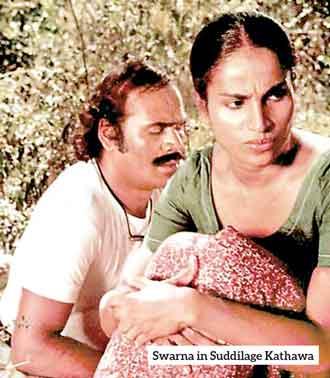 She emphasises in these roles that she’s someone who lives inside social realities, hence not the typical popular film star. Starting her acting career in an age of Structuralism, she quits the rhetoric of youthful feminine beauty to become the floating signifier in films such as ‘Hansa Wilak’, and begins to portray the bitter reality of women rendered helpless within a capitalist socio-political milieu….instead of the old emotional rhetoric, she begins to employ an enraged, accursed and unclean rhetoric. Thereafter, she becomes the ‘second’ Swarna Mallawaarachchi, an actress who devours her own youthful being which comes naturally to a young woman to become the tragic post-structuralist signifier in her later films’.
The writer further points out that the roots of her acting technique can be traced to the skeletal, repulsive figures we find in Gothic art. Swarna Mallawaarachchi the actress was born by discarding the voluptuous female figure of conventional cinematic beauty. ‘She doesn’t become Nagina because she was somehow subject to that non-orientalist realism which nurtured actresses such as Sophia Loren in the Italian neorealist cinema. Swarna may have somehow absorbed that quality not from any cinema academy but from that working class school in Grand Pass where she was educated.’
It’s interesting that Eric Illyaparachchi compares her very thin figure when she first appeared in films to Gothic art. After seeing Sathischandra Edirisingha’s ‘Mathara Aachchi’, one of her earliest films, I remember people commenting negatively on her skinniness. Our actresses were expected to be voluptuous full figures and skinniness in women, whether in films or in the real world, was certainly not a virtue. Today, we have come a negative full circle with films and teledramas featuring a new generation of actresses with the same voluptuousness so highly appreciated in the Jeevarani Kurukulasuriya-Vijitha Mallika and Rukmani Devi era.
11 Jun 2026 3 minute ago
11 Jun 2026 8 minute ago
11 Jun 2026 15 minute ago
11 Jun 2026 2 hours ago
10 Jun 2026 9 hours ago