31 Dec 2025 - {{hitsCtrl.values.hits}}
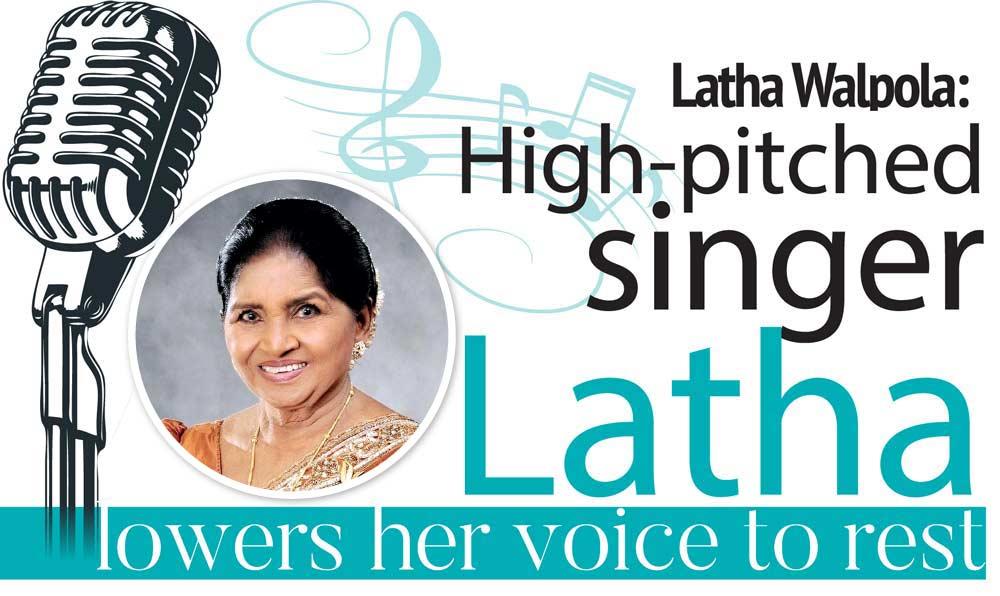
| Renowned artiste Latha Walpola bid adieu to the music industry, but memories of this great playback singer will flash in our minds whenever her songs are replayed |
 The remains of the Late artiste Latha Walpola will be placed at Independence Square on December 31 (Wednesday) at 2pm for religious observances and there after final rites will take place at the Borella Public Cemetery
If we look at the Latha-Dharmadasa partnership and listen to any of their duets, we notice something remarkable about the dynamics
 Music plays a defining part in a nation’s history. There are those singers who become representative of a given country’s musical culture. Latha Walpola, alongside great contemporaries such as Rukmani Devi, Sunil Shantha, C.T. Fernando, Sujatha Aththanayake, H.R. Jothipala, Milton Perera, Mohideen Baig, W. D. Amaradeva, Milton Mallawaarachchi, Haroon Lanthra, Indrani Perera, and Latha’s late husband Dharmadasa Walpola, was a towering figure who defined the playback song in Sinhala film music for half a century, together with her great rival the late Angelene Gunathilake.
It’s very sad that almost the entire generation of singers, musicians and composers we grew up with are now gone. But we have the music, films and the songs to listen to, watch and discuss.
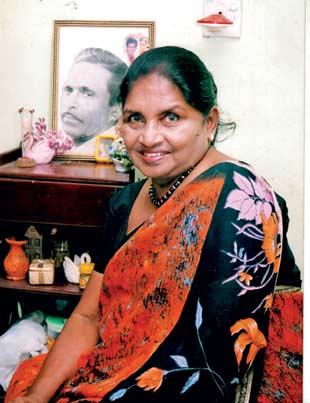 Latha Walpola (nee Rita Genevieve Fernando) was born in Bambalapitiya in 1933 to a Catholic family. Her mother, a Convent school teacher, recognised her daughter’s genius and helped her all along. Like many of our singers from Christian backgrounds, she had the benefit of church music/choir singing as a child. But, as far as we know, she had no formal training in music.
This fact is remarkable. She did not come from the Eastern Baathkande music tradition which nurtured many of these pioneer singers (against which Sunil Shantha rebelled alone as a radio artiste, and was penalised for that audacity). It maybe that the historical necessity of a newly independent nation looking for its cultural identity dictated this narrative of raw talent fashioned by inner discipline and pure instinct, and created a voice that was exactly right for what needed to be done.
This was too, the era of great singer partnerships – Sisira and Indrani Senaratne, P.L.A. and Chithra Somapala, Latha and Dharmadasa and, later, Rukmani-Neville Fernando. If we look at the Latha-Dharmadasa partnership which lasted three decades until his untimely death in 1983, and listen to any of their duets, we notice something remarkable about the dynamics.
Latha, like almost all our leading singers of the era, sings low-key (with exceptions like C.T. Fernando). This doesn’t mean they couldn’t sing at higher pitches. But this ‘mandra swara’ as such low notes are called in Eastern music (derived from our traditions based on North Indian Ragadhari music) became the standard for Sarala Gi, (simple songs) as the radio classified these songs. Composers of film songs and playback music must have made this requirement because our first generation film actors, too, (Aruna Shanthi, Herbert M. Seneviratne, Prem Jayanth) too, delivered their dialogues with such soft modulation (not to be confused with Gamini Fonseka’s deliberate low murmuring voice, modelled on Dilip Kumar and Marlon Brando). This was in keeping with their gentlemanly image as screen heroes. Gentlemen do not (or did not) speak in loud, vulgar tones as villains do.
Female playback singers, apparently, did not have such a problem. Rukmani Devi with her naturally high-pitched voice is an obvious example. Actresses had to raise their voices before the camera (when lambasting fickle lovers or running away from villains). Let’s not forget that Latha acted in several films and she was in demand for voice dubbing for Hindi films screened in Sri Lanka such as ‘Angulimala.’
In her duets with her husband, or with Susil Premaratne, this disparity in voice levels becomes obvious. It was natural, not deliberate, and became the standard – Latha’s voice, as sharp as a bell, is always above her partner’s. The dynamic balancing required to maintain the independence and clarity of each line came naturally when they sang together. Even when she sang with C.T., his voice sounds lower than hers, even when she deliberately keeps her voice low, as she often did.
We notice this in Hindustani film music, too. If we take a Latha Mangeskar-Mohammed Rafi duet, Latha’s voice is sharper and higher than Rafi’s, and not because Rafi couldn’t sing at higher pitches. This was the standard requirement in film. The story goes that it was Susil Premaratne who suggested ‘Latha’ as a suitable name for Latha Walpola. He must have been struck by the similar technical virtuosity in both voices.
Latha’s voice was always irrepressible, impatient to get out and be heard, and held back with great discipline. It sounds so resonant that you imagine the recording engineer didn’t have much to do. In the recording studio, the sound engineer adds reverb to voice, and EQ or equalisation is added to lift the voice above instruments. If we can find any of those sound engineers who recorded Latha’s songs (and some would be still around as she sang well into the new millennium), I’m sure they’d agree they had little to do when recording her voice!
When new generation singers sing Latha’s songs, very few can match the quality of Latha’s voice. They are very well trained, pitch properly, but the brilliance and feeling is often lacking.
But, as I noticed when I met her, Latha’s normal speaking voice wasn’t high or shrill. Very often, the singing voice is different from the singer’s normal speaking tones. There is an anecdote about H. R. Jothipala. It’s well known that his speech was rapid, almost incoherent, at times. He was once introduced to a foreign visitor who was keen on meeting the man reputed to be the country’s most popular male singer. After meeting Jothipala, he is supposed to have said: “This is your best known singer? He can’t even talk properly!”
After listening to Jothi’s songs, he changed his mind and apologised.
Invited to Pakistan, she sang Urdu songs with a fluency which astonished her hosts. If they had taken different routes, both she and Rukmani could have been opera singers. An average singer has a range of about two octaves. Exceptional singers can go up to four octaves or more. I once met a female singer from Batticaloa trained in the Karnatik tradition who could manage four octaves. But singers must work in commercial environments, which imposes limitations on them. What is remarkable is what was achieved within those limitations. Latha’s first recorded solo came in 1947. She was already famous when she married Dharmadasa in 1959. Together, they became a tour de force. Films simply wouldn’t run without those hit songs, some sung with others, but mostly with her husband -- Parama Ramani Ape Ale, Jeevana Gamana Sansare, Pem Mala Gotha, Wasanawantha Kala laba, Jeevana Ganga Ivure Api, Yuropaye Hima Vatena Kaale, Sal Malen Upanna, Po dina paya tharum, Katharagame devige bime, etc. “Ron Soya” is a later hit and one of her best.
The continuous re-mixing of these songs is testimony to their staying power and durability. Even if Latha and her co-singers are gone, they come alive each time we hear them.
07 Jun 2026 28 minute ago
07 Jun 2026 36 minute ago
07 Jun 2026 41 minute ago
07 Jun 2026 1 hours ago
07 Jun 2026 2 hours ago