28 Aug 2025 - {{hitsCtrl.values.hits}}
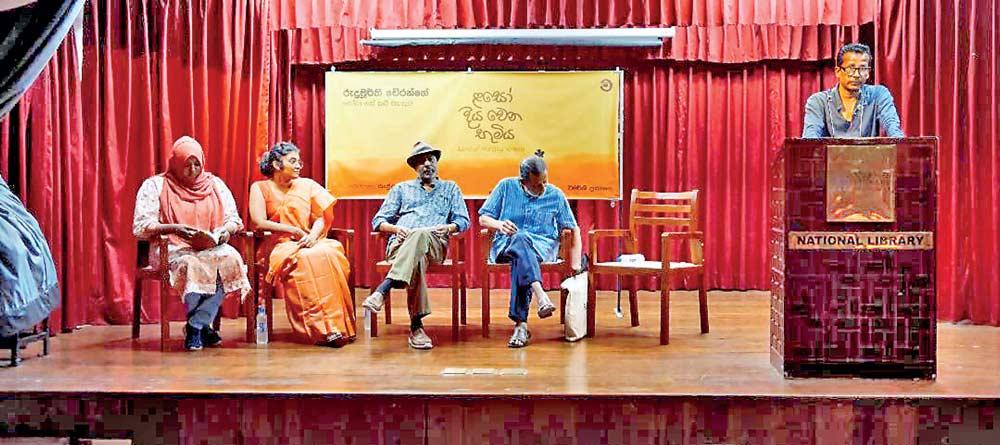
At the launch of ‘Laso Diyawena Boomiya’ (Land of the Melting Sorrow): Fathima Rikza, lawyer and translator, Sanjula Pietersz, Prof. Rudhramoorthy Cheran, Dr. Kumudu Kusum Kumara, and Sampath Samarakoon
 The 26-year-long conflict between the Liberation Tigers of Tamil Eelam and the state security forces has left an indelible mark on Sri Lanka’s history. The literature produced in this period is a testimony to the collective experience and memory of those who faced the war. In this creative enterprise, the articulation of pain, suffering and violence, through both prose and poetry, has been a noticeable feature.
|
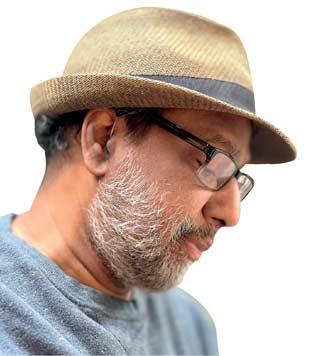
Poet Cheran |
In light of these events, the Sinhala translation of a volume of selected poems written by Tamil Canadian academic, poet, playwright, and journalist Dr. Rudhramoorthy Cheran, was launched on August 12, 2025, at the National Library auditorium in Colombo.
Dr. Cheran is a professor at the University of Windsor in Canada. He is the author of 15 books in Tamil, and his poetry and essays have been translated into more than 20 languages worldwide. He has engaged deeply with themes of revolution and human rights. His poetry in Tamil is ample proof how one can bear witness to violence and oppression and put that experience into a creative form like poetry.
Translated into Sinhala by lawyer and translator from Sri Lanka, Sanjula Pietersz, the book is titled ‘Laso Diyawena Boomiya’ (Land of Melting Sorrow) and the book is published by Vimarshee publications.
As the keynote speaker of the event Dr. Kumudu Kusum Kumara said, Cheran is a Tamil poet whom the Sinhalese can be proud of. She reminded attendees that Cheran’s poetry is reminiscent of his deep connection to the land (Jaffna) and its people.
Poetry as resistance
Addressing the audience, Dr. Cheran said: “I have been waiting for this moment for a very long time. I am glad, finally, my selected poems are available in Sinhala. I believe translation is an act of creative solidarity with the Tamil people and their resistance. I am very pleased that a new and younger generation of Sinhala writers, artists and activists are engaged in acts of political and creative solidarity.”
Voices of the oppressed
Elaborating on the book of poetry, Ms. Pietersz said: “This book includes poems that cover significant periods in Sri Lanka’s ethnic issue, including state violence against Tamils culminating in 2009 and the criminal involvement of the Indian peacekeeping force in the Sri Lankan conflict in the later part of 1980s.” According to Ms. Pietersz, Dr. Cheran is widely regarded as one of the most influential Tamil poets, writing poetry since 1975. A few of his poems were translated into Sinhala and published in alternative newspapers during the 1990s. “However, this is the first time his work has been published as a full book in Sinhala. It’s a significant milestone, especially as 2025 marks 50 years of his poetry,” she noted.
Ms. Pietersz said: “Cheran grew up during a time of severe state repression against Tamils. He has said that his poetry took a political turn after the burning of the Jaffna Library by the government in 1981.His poems are shaped by both his personal experiences as well as those of his friends, relatives, and acquaintances. She said his poems were deeply rooted in the pain and struggles of his people.”
She further said that Cheran had written more than 500 poems across a wide range of themes, and had published 11 collections. “The selected poems in Laso Diya Wena Bhoomiya do not capture the full range of his work over five decades,” she added.
Explaining the importance of her translated work, Ms. Pietersz said that it was very rare for Tamil literary works that offered a political perspective on Sri Lanka’s ethnic issue and conflict to be translated into Sinhala. “In that context, this translation is important as it offers a political lens to understand the ethnic issue in Sri Lanka. This translation does not intend to build pseudo reconciliation bridges. It aims to bring the voices of the oppressed into Sinhala society, fostering meaningful political solidarity,” she said.
Books can be purchased online via KBOOKS (www.kbooks.lk)
Photos by Vartharajan Mathumegalan
08 Jun 2026 1 hours ago
08 Jun 2026 2 hours ago
08 Jun 2026 2 hours ago
08 Jun 2026 3 hours ago
08 Jun 2026 3 hours ago