13 Feb 2026 - {{hitsCtrl.values.hits}}
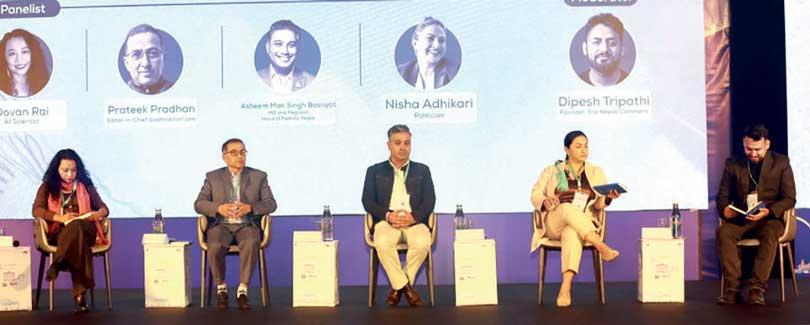
Panel discussion titled ‘Public Discourse in the Age of Algorithms’
|
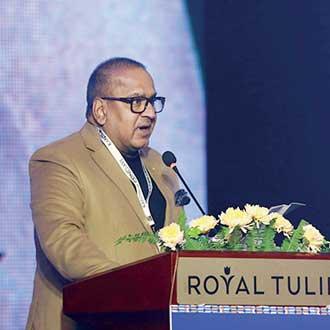
Chairman of Kantipur Media Group Kailash Sirohiya
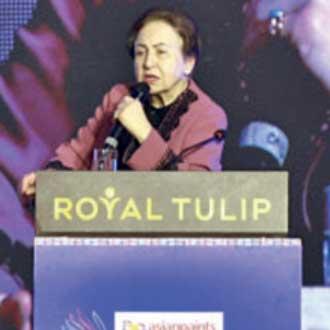
Nobel Peace Prize laureate Dr. Shirin Ebadi |
The 5th edition of the Kantipur Conclave brought together policymakers, journalists, political leaders, entrepreneurs and young activists from Nepal and overseas to identify core societal issues and discuss shared solution. The two-day forum organized by the Kantipur Media Group witnessed the participation of over 52 speakers sharing their experiences and ideas on various topics.
In his opening remarks, Kantipur Media Group’s chairman Kailash Sirohiya reflected on the climate of political instability and public dissatisfaction in the aftermath of Nepal’s Gen Z protests. He said that the real strength of democracy lies not only in the ballot box but in informed citizens, debate and dialogue.
One of the highlights of the event was the keynote speech delivered by Iranian Nobel Peace Prize laureate, writer, jurist and teacher Dr. Shirin Ebadi. In her speech she said that the framework of democracy is based on the principles of human rights such as freedom of speech for instance. “In other words a political party that comes to power does not have a right to trample upon the rights of a minority because it has the majority vote. It has to respect, listen and uphold the rights of minorities in society,” she said.
Dr. Ebadi, being a political activist for around 50 years, has been teaching and fighting for democracy. She said that democracy is about protecting and defending the rights of those who have lost in the election. “We have reached a stage of civilisation, thanks to democracy. People have come to realise that old mentalities have to give way to new demands; for the realisation of people’s rights. Governments should not be ruled from certain ideologies. My country, the Islamic Republic of Iran is a theocracy. It has established laws that are based on a religion it has chosen to follow or believe. For over four decades people have been protesting against the theocratic principles of the country. They want their voices to be heard and they are fighting for democracy,” Dr. Ebadi further said.
She then spoke about the Nepal protests in September 2025 and expressed her condolences to those who were killed during the protests. “Thankfully the voices of youth in Nepal have been heard and there was a change in government. In a few days there will be an election. I have every respect for Gen Z protestors in Nepal,” she added.
As a piece of advice Dr. Ebadi said that in addition to protesting, the Gen Z should also bring about their own solutions. “It is not enough to just say that you are frustrated with the political system. Just raising your voices won’t bring tangible results. Gen Z needs to be a part of the change rather than standing on the margins and raising their voices. Without youth activism there will be no future,” she underscored.
The first panel explored the nature of global protest movements such as the Tunisian revolution, student protests in Bangladesh, youth protests in Nepal and the 2022 people’s revolution in Sri Lanka. Panelists discussed the similarities and differences between protest movements in respective countries while brainstorming solutions and how protests have contributed to change. Many of the panels on day one focused on Nepal’s history of protests and how Gen Z is becoming part of a political revolution. The second day opened with a discussion on ‘Public Discourse in the age of Algorithms,’ examining the intersections of digital platforms and public discussions. The session titled ‘Nepal in Multipolar Cross-hairs’ featured experts from China, India and the US to discuss Nepal’s geopolitical situation.
The Kantipur Conclave 2026 served as a platform to discuss Nepal’s current political situation, role of Gen Z in bringing about change, role of algorithms, discussions with political leaders and entrepreneurs and discussions on leadership transition and political culture among young political leaders.
Image courtesy – Dipin Shrestha/The Kathmandu Post
08 Jun 2026 25 minute ago
08 Jun 2026 29 minute ago
08 Jun 2026 38 minute ago
08 Jun 2026 40 minute ago
08 Jun 2026 43 minute ago