11 Nov 2025 - {{hitsCtrl.values.hits}}
 Says no relief for SMEs or freelancers, govt continues to tax digital service exporters who bring in foreign income
Says President is now taking credit for the very achievements his party protested
Accuses govt. of agreeing secretly with IMF to introduce a new property tax in early 2027
By Dr. Harsha de Silva, MP
After listening to the 2026 budget speech, one thing became clear: this Government has no plan for economic growth.
I acknowledge that the macroeconomic stability achieved by the previous administration has been maintained. But this stability was a hard-won foundation with sacrifices by the people, not the final destination. The most important question—what comes next?—was left unanswered.
The reason for this failure is a deep ideological confusion at the heart of the Government. They are paralysed, trapped between the open, liberal, reform-based economy the 21st century demands, and their old, failed dogma of a closed, state-controlled production economy. This budget is not a “system change”; it is a document of contradiction and confusion.
First, consider the hypocrisy. The President is now taking credit for the very achievements his party protested. The previous administration, through painful but necessary reforms, crushed inflation from over 70% to -1% and stabilised the rupee from 370 to 294. Turned loss-making SOEs profitable via cost-reflective pricing: the CEB went from a 298 billion loss in 2022 to a 144 billion profit in 2024, and the CPC from a 617 billion loss in 2022 to a 33 billion profit by 2024.
This Government inherited this stability. They are now following the IMF programme they took to the streets to oppose. They are benefiting from key legislations that brought fiscal prudence, such as the Public Debt Management Act, Public Finance Management Act, and the Central Bank Independence Act, all of which they fought against. They are not reformers; they are reluctant followers.
This hypocrisy is made worse by the Government’s own numbers. While some may see the one trillion rupee cash surplus in state banks that I highlighted as a sign the Government is ‘doing well’, however, it is a sign of failure. Failure to extend the benefits to the people and failure to spend allocated capital expenditure. This surplus–primarily from massive, unexpected vehicle import taxes–is not being translated into relief for the common man by reducing his exorbitant taxes. Instead of providing relief, the Government is doing the opposite. In fact, they have secretly agreed with the IMF to implement a new property tax starting in the first quarter of 2027.
This confusion and betrayal is most obvious in the budget’s “joke” allocations, which betray the trust of the very people who voted for them. The Government’s housing plan allocates 10.2 billion rupees for 70,000 houses. My calculation showed this is roughly one million rupees per house, enough to build a 100-square-foot room, not a home. Their concessional loan for 1.4 million state workers has a 500 million rupee pot, enough for only 4,166 “lucky winners.” This isn’t policy; it’s a lottery.
While they present these absurd numbers, they ignore the real solution. They won’t remove the crippling taxes on vehicles so a middle-class family can afford a car, or on building materials, which stand at 49% for cement, 60% on tiles, and 92% for PVC pipes, so a young person can build a house. Instead, they’ve widened the indirect-tax net with the crippling 18% VAT, lowering the threshold from 60 million to 36 million rupees, meaning any business earning over 100,000 rupees a day is now liable. This has a direct impact on our youth and middle class, who want to go out to eat or watch a movie with their family.
This is a betrayal of the youth’s “five simple dreams”: 1) A stable job or business with a good salary, 2) The ability to buy a small vehicle, 3) A path to owning a home, 4) The capacity to care for their parents, and 5) The financial security to start a family.
Instead of raising the PAYE tax-free income threshold to 200,000 rupees as promised, they have continued to target our most promising entrepreneurs, online freelancers, and digital service exporters that bring vital forex, who previously paid 0%, with the 15% tax. They talk about a new economy while punishing it. There was no relief for SMEs mentioned in the speech either. Worse, the President failed to mention that his government has agreed with the IMF to stop the interest subsidy for senior citizens’ fixed deposits by the end of this year, a betrayal of our most vulnerable.
This lack of vision extends to our farmers and the entire agricultural sector. The budget offers no real solutions beyond the old, failed cycle of price controls or allowing imports, which destabilises local farmers. There is no vision for a modern agricultural economy: no mention of agri-tech, no plan for temperature-controlled warehouses or cold chain logistics to reduce post-harvest loss, and critically, no strategy to empower SME paddy millers to finally break the rice oligopoly. They talk about entrepreneurs while leaving them at the mercy of a handful.
Simultaneously, their “closed economy” instincts are crippling our existing economic engines. While they talk about global trade, our exporters, the lifeblood of our economy, are in a cash-flow crisis because the 45-day SVAT refund system is only a promise. There was no mention of phasing out para-tariffs, which is critical for our export sector that imports many intermediaries. How can we effectively initiate trade agreements if we continue to be a closed economy via high tariff walls? Phasing out began last year, but the Government has stopped its implementation.
It remains to be seen whether the Government will even implement the Economic Transformation Bill, which they once rejected and took to the Supreme Court. That bill is the clear next step in our recovery, but they are confused.
The President’s silence on crucial trade agreements was deafening. There was not one word on the Regional Comprehensive Economic Partnership (RCEP), though they have spoken highly of it previously. We need to connect with our regional neighbours that are excelling in global production networks. Not one word on the Economic and Technology Cooperation Agreement (ETCA) with India. The Prime Minister went to India and made big statements, but there was no follow-up on ECTA or cooperation with at least the five southern states in India that are growing at a rapid pace. I thoroughly believe we must integrate with South India’s production networks to benefit from their expansion. After 14 rounds of negotiations, this vital path to growth is stalled. Talk is cheap. This Government has no political will to walk the talk.
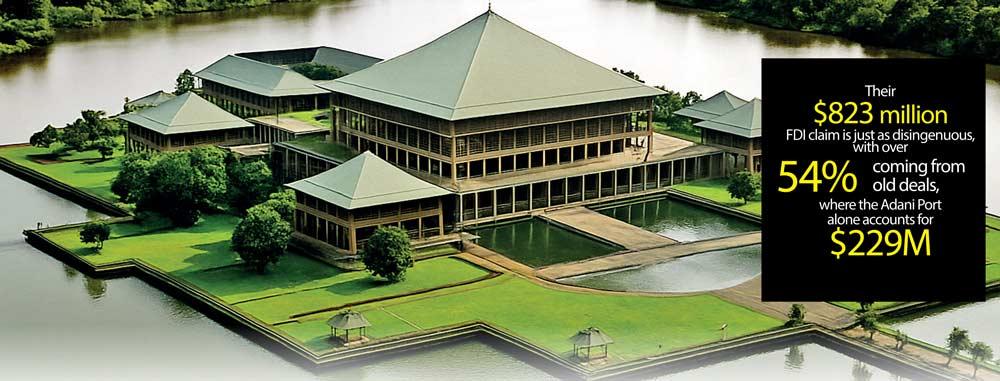
Their $823 million FDI claim is just as disingenuous, with over 54% coming from old deals, where the Adani Port alone accounts for $229M. And while they talk about anti-corruption, they push a highly irregular tender for 1,775 double-cabs, cutting the tender period from 42 days to 12. There was no word on the sugar scam or the VFS scam.
This is the same old thing—a staggering 3.8 trillion rupees in new borrowing, with no plan for the growth required to pay it back.
A Government this confused cannot lead our country to prosperity.
17 Jun 2026 6 hours ago
17 Jun 2026 6 hours ago
17 Jun 2026 7 hours ago
17 Jun 2026 7 hours ago
17 Jun 2026 8 hours ago