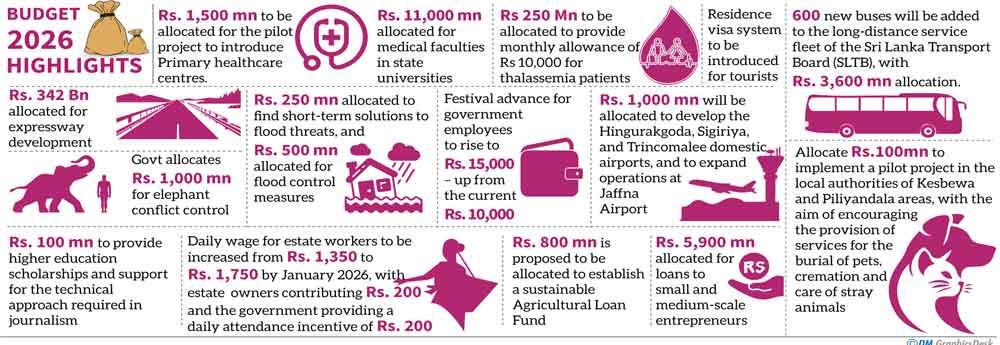
- Rs. 1,500 million to be allocated for the pilot project to introduce Primary healthcare centres
- Hope to restructure Sri Lankan Airlines debt of USD 210 billion before this December
- Rs. 250 million more to be allocated to the Export Development Board to promote and facilitate exports
- The government expects to gradually reduce direct and indirect tax ratio from 25:75 to 40:60
- Rs. 800 million proposed to be allocated to
- establish a sustainable Agricultural Loan Fund
- Two IT zones are planned in Digana and Nuwara Eliya under the BOI
- Rs. 250 million more to be allocated to the Export Development Board to promote and facilitate exports
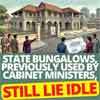
- State bungalows to be turned into profitable ventures under Public Private Partnership. 900 such buildings identified
- Rs.1,000 million to be allocated to develop Hingurakgoda, Sigiriya, Trincomalee domestic airports and expand operations of the Jaffna international airport
- All government payments to be brought under digital payment system. No service charge will be imposed for online payments
- Rs. 6,500 million allocated to Clean Sri Lanka Initiative
- The first digital ID card to be issued by March 2026
- Rs. 2,000 million to be allocated to expedite prison operations including upgrading open prisons and directing inmates to civil activities
- Virtual economic zone will be established to promote investments
- Expect to appoint an expert committee to draft a code of ethics for judicial service
- Hope to maintain debt-to-GDP ratio by 87 per cent by 2030
- Plan to maintain inflation under 5 per cent
- Rs. 50 million to be allocated to provide Rs. 5,000 for differently-abled children for their educational purposes
- Rs. 11,000 million allocated for medical faculties in state universities
- Mahapola Scholarship to be increased by Rs. 2,500
- Rs. 200 million allocated for the initial work to establish a National Cardiology Hospital in Colombo
- Rs. 1,000 million allocated to relocate Dambulla and Deniyaya Divisional Hospitals
- Rs. 24,000 million allocated to construct rural roads and Rs. 2,500 million for rural bridges
- Rs. 2,000 million of the Foreign Employment Bureau will be allocated to introduce a contributory pension scheme for migrant workers in 2026
- Rs. 300 million will be allocated for electric fences
- Rs. 100 million to be allocated for higher education scholarships for journalists and for equipment. Houses at the China-funded housing complex to be granted to journalists
- Rs. 600 million allocated for the Jaffna coconut triangle
- Rs. 3,600 million allocated to purchase 600 SLTB buses to be added to the fleet of long-distance services
- Rs. 1,000 million allocated to complete the land acquisition of the proposed Kurunegala-Dambulla expressway
- An additional Rs. 1,000 million to be allocated for the implementation of a comprehensive road safety programme
- 75,000 people will be recruited under a proper system. This includes positions such as technical officers, law enforcement officers, revenue officers, etc. required to maintain essential public services
- Proposal to allocate Rs. 250 million to increase the minimum allowance currently paid to railway gatekeepers from Rs. 7,500 to Rs. 15,000 per month for an eight-hour shift
- Proposal to grant permanent appointments to all employees currently employed in various institutions for more than six months who have fulfilled the qualifications under Public Administration Circular 25/2014 and Public Administration Circular 29/2019
- Proposal to remove the Special Commodity Levy on imported coconut oil and palm oil and instead implement the general tax structure including Value Added Tax from April 2026.
- The social security contribution levy is proposed to be charged at the time of import or manufacture and sale of vehicles, and exempt this tax at the time of after-sales. This is expected to be implemented effective from April 2026.
- The government has decided to purchase a number of vehicles and machinery essential for government institutions, as well as vehicles to be provided on the basis of return after the end of the parliamentary members’ term. For this purpose, Rs. 12,500 million has been allocated as the primary requirement.
- Rs. 4,290 million allocated with the assistance of Government of India, for the construction of 2,000 houses to upgrade the housing and infrastructure facilities of the Malayagam Estate workers living in Central, Uva, Sabaragamuwa, North Western and Southern Provinces
- Rs. 900 million allocated for the implementation of solid waste management to provide vehicles and equipment for the systematic disposal of solid waste and maintenance.
- Rs. 2,000 million have been allocated to commence preliminary work to identify the feasibility of 10 identified cities across the island, including Jaffna, Eheliyagoda, Batticaloa, Chilaw, and Matara, to establish an efficient, sustainable, tourist and investment-attractive city network.
- Rs. 34,200 million allocated for road development, including Rs. 10,500 million for the construction of the Central Expressway from Potuhera to Galagedara.
- Rs. 250 million allocated to find short-term solutions to flood threats, and Rs. 500 million allocated for flood control measures.
- Rs. 100Mn to be allocated for providing life-saving equipment to fishermen
- Rs. 350Mn allocated for the development of the Valaichchenai Fishing Harbour.
- Rs. 3,000 million allocated for the renovation of the Badalgama ‘Milco’ factory.
- Rs. 1,000 million allocated for cattle and swine breeding programmes.
- A national programme to be launched with the goal of meeting 75% of the country’s milk demand locally by 2030
- Rs. 250Mn allocated for the installation of a solar panel system at the Dambulla cold storage facility
- Rs. 800Mn allocated for the promotion of sports culture
- Daily wage for estate workers to be increased from Rs. 1,350 to Rs. 1,750 by January 2026, with state workers contributing Rs. 200 and the government providing a daily attendance incentive of Rs. 200
- Rs. 4.2 bn allocated for Suwa Seriya Ambulance Service
- Rs 250Mn to be allocated to provide monthly allowance of Rs 10,000 for thalassemia patients
- Rs 8,000 million to be allocated to promote vocational training
- Rs. 2,000 million allocated for the National Operation against drugs
- Three per cent of government recruitment to be reserved for persons with disabilities
- Broadband internet voucher cards for children of low-income families.
- Service fees will be waived for transactions below Rs. 5,000 made through QR codes.
- A five-year tax concession will be granted for digital communication towers.
- The Bandaranaike International Airport expansion project will commence next year.
- A sum of Rs. 2,500 million has been proposed to develop Beira Lake and transform it into an attractive location in Colombo.
- Rs. 5,900 million allocated for loans to small and medium-scale entrepreneurs.
- Rs. 2,500Mn allocated for the establishment of a National Single Window.
- Rs. 100Mn allocated for the establishment of a central digital system containing land information.
- Rs. 1,000 million allocated for the development of services related to investment zones
- A residential visa scheme for foreign investors bringing in investments
- Colombo Port City Economic Commission Act to be amended
President sounds optimistic over macroeconomic stability
The 2026 budget, presented to Parliament by President Anura Kumara Dissanayake, is a continuation of the government’s reform path without immediate benefits to people in terms of tax cuts and price slashes.
The President arrived in Parliament last afternoon and read out his budget speech with a note of optimism on macroeconomic stability achieved during the past year under the current reform agenda, which is in line with the IMF programme.
The President said the economy grew by 4.8 per cent in the first half of 2025, driven by strong growth across all sectors, surpassing the forecasts of multilateral organisations. According to his speech, inflation has now turned positive. The financial sector has stabilised with the reduction in the Treasury Bill interest rate. The exchange rate has also stabilised. The external sector, including imports and exports, has strengthened even amidst global shocks. Due to the increase in exports, tourism, and foreign remittance inflows, the gross official reserves have exceeded US $ 6 billion. It is expected that this year, after almost two decades since 2006, the Government revenue will be able to reach 16 per cent of GDP. It is also expected that the highest primary surplus as a percentage of GDP in its history will be recorded this year, significantly exceeding the target value of 2.3 per cent, according to the President.
The government appeared to have focused more on reforms that yield gradual rather than instant gains. That is to build on current macroeconomic stability to achieve economic transformation for the benefit of people in the long run.
The continuous increase in this primary surplus will contribute to a significant reduction in the central Government debt as a percentage of GDP from 114.2 per cent in 2022 to 96.8 per cent by 2026. “Furthermore, we expect to achieve that figure at a level of about 87.0 per cent by 2030. These results have paved the way for our desired exit from the debt crisis,” he said.
“Our debt restructuring process is nearly completed. Sri Lanka has been placed on a sustainable fiscal path and the confidence of both domestic and international investors has been further strengthened. These remarkable achievements have led to the country’s sovereign ratings being upgraded by international rating agencies; Fitch Ratings, Moody’s, and S&P to CCC+, Caa1, and CCC+, respectively. These new ratings further reflect investment confidence in Sri Lanka,” he said.
The budget is focused on the attraction of Foreign Direct Investments (FDIs) required for long term development of the country. The government is trying to rebrand itself as investment friendly. In this regard, one of the most important steps is the planned legal and regulatory initiatives such as the investment protection law, public-private partnerships (PPPs), and public asset management are in the pipeline. The President pledged to amend the Strategic Development Projects Act and the Port City Act to ensure that tax concessions are granted under transparent, rule-based criteria. It is an attempt to send a clear message to both local and foreign investors.
Most of the reforms envisaged in the current budget have been spoken of extensively even in the past. The need for restructuring state institutions with the involvement of the private sector is one of them. The President has proposed to revive the proposal to construct the Kurunegala-Dambulla stretch of the central expressway, a project mooted years back to improve access to the northern part of the country.
In the overall context, it is clearly designed for the consolidation of fiscal gains and boosting investor confidence. It is a reformist, continuity-focused. It is a departure from populist attempts at times in the past. It relies on the premise that sustained macroeconomic stability, strengthened institutions, and clearer investment rules will lay the foundation for a more resilient economy in the years ahead. It naturally takes time for people to feel dividends.