07 Jul 2025 - {{hitsCtrl.values.hits}}
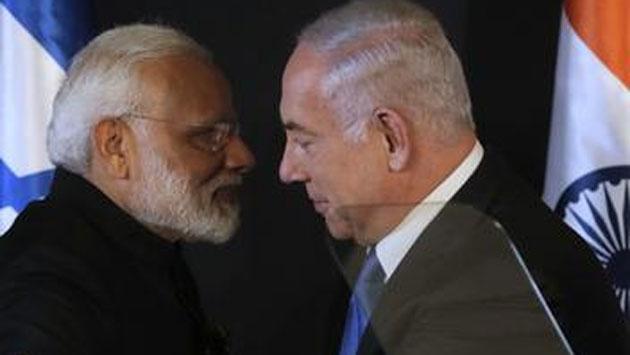 India’s foreign policy has seen a marked shift over the past decade. Once a vocal supporter of the Palestinian cause and a leading voice of the Non-Aligned Movement, India is now increasingly aligned with Israel—a development that is straining its historic relationships with the Muslim world, particularly Iran.
For much of its post-independence history, India positioned itself as a champion of anti-colonial struggles. It delayed establishing full diplomatic ties with Israel until 1992 and consistently supported Palestinian self-determination at the United Nations. However, since Prime Minister Narendra Modi came to power in 2014, India’s posture has changed sharply. Modi became the first Indian Prime Minister to visit Israel in 2017, ending a long-standing policy of keeping ties with Tel Aviv low-profile.
This shift has gone beyond symbolism. Defense, cyber, and intelligence cooperation between India and Israel has grown rapidly. Israeli surveillance tools and counterinsurgency tactics are now visibly influencing India’s approach in Kashmir, especially since the revocation of Article 370 in 2019. The ideological overlap between Israel’s Zionist nationalism and India’s Hindutva-driven politics has further deepened the relationship.
But this closer alignment with Israel is coming at a cost. Iran, once a key regional partner, has grown increasingly wary of India’s foreign policy choices. Tehran, which worked with New Delhi on strategic projects like the Chabahar Port and energy trade, has signaled frustration with India’s neutral stance on recent Israeli military actions targeting Iranian infrastructure.
In June 2025, after Israeli airstrikes on sites near Isfahan, the Shanghai Cooperation Organization condemned the attacks. India declined to support the resolution, citing a preference for dialogue. Tehran viewed the move as silent complicity. Iranian officials publicly expressed disappointment, and the Chabahar-Zahedan railway project has since slowed, with Iranian media questioning India’s reliability as a partner.
India's decision to stop importing Iranian oil—initially due to U.S. sanctions, but not resumed even after partial sanction relief—has further soured relations. New Delhi has instead increased its energy ties with Saudi Arabia and the UAE, moves seen in Iran as politically motivated and aligned with India’s new strategic orientation.
The fallout isn’t limited to Iran. Across the Muslim world, there’s growing discomfort with India’s silence on Israeli military operations in Gaza and its deepening military ties with Tel Aviv. In Indonesia, Malaysia, and Turkey, protests have erupted against what many see as a de facto India-Israel alliance. Reports of Indian-made Israeli drones being used in Gaza have only intensified criticism.
Even in Gulf states where India maintains strong economic ties, such as the UAE and Saudi Arabia, public sentiment is shifting. While leadership in these countries continues to work with New Delhi, domestic pressure—particularly on the Palestine issue—could create friction if India’s pro-Israel tilt continues.
Deepening defence ties with Israel
India is now among Israel’s most trusted defence partners. Over the past two decades, India has imported between $4–5 billion worth of Israeli military equipment, including drones, radar systems, missiles, and surveillance technologies. This defence cooperation is not merely transactional—it is strategic and ideologically driven. India co-produces advanced drones such as the Hermes 900 through a joint venture between Adani and Israel’s Elbit Systems. In a controversial move that drew criticism from Indian civil society and opposition politicians, reports confirmed that Indian-manufactured Hermes drones were deployed by Israel in its recent airstrikes on Gaza and Iranian targets.
In addition, India’s military has incorporated Israeli Heron drones, Harop loitering munitions, and Barak-8 missile defense systems into its arsenal, especially in its confrontations with Pakistan.
Most notably, in April 2025, after a deadly attack in Jammu and Kashmir killed 26 civilians, the Indian military reportedly retaliated with Israeli-made drones against alleged militant positions near the Pakistan border. These tactical exchanges highlight how Israeli technology is now integrated into India’s regional security operations—effectively linking the two states through shared military doctrines and strategic thinking. Indian companies such as Munitions India and Premier Explosives are also known to supply ammunition to Israel, intensifying bilateral defense cooperation at a time when many Western nations are reconsidering arms sales to Tel Aviv due to its actions in Gaza.
India's neutral stance on Israel-Iran conflict
While much of the world condemned Israel’s June 2025 airstrikes on Iranian nuclear facilities—including China, Russia, and members of the Shanghai Cooperation Organization (SCO)—India chose not to sign the SCO’s resolution against Israel. This break with consensus was a clear diplomatic signal: India is unwilling to jeopardize its alliance with Israel, even at the cost of antagonizing long-standing partners like Iran and Russia. Indian officials later described their position as “neutral,” calling for restraint on all sides and emphasizing dialogue. However, this neutrality has been widely interpreted as tacit support for Israel.
India’s non-alignment in this context marks a significant departure from its historical foreign policy. Where New Delhi once championed sovereignty, anti-colonialism, and South-South solidarity, it now appears more inclined toward selective partnerships based on military and economic interests. Iran, a fellow SCO member and a nation vital to India’s connectivity strategy in Central Asia, was left disappointed by India’s silence. The Iranian press and diplomatic corps voiced concern about India’s perceived alignment with Israel and the West, casting doubts on New Delhi’s reliability as a regional partner.
Longstanding India-Iran relations at risk
India’s growing closeness with Israel could have far-reaching consequences for its relationship with Iran—a nation central to India’s West Asian strategy. Iran provides India with access to Afghanistan and Central Asia through the Chabahar Port, a project New Delhi has heavily invested in as a counterbalance to China’s involvement in Pakistan’s Gwadar Port. Moreover, Iran controls the Strait of Hormuz, through which nearly 70% of India’s oil imports pass. A rupture in India-Iran relations could expose India to serious energy security risks.
Iran has long served as a geopolitical bridge for India in the volatile region. However, Israeli intelligence and cyber operations targeting Iranian infrastructure—some of which are reportedly facilitated by Indian logistics and tech companies—have sparked backlash in Tehran. Indian cooperation with Israel’s Mossad for intelligence gathering across the Middle East, especially using cyber tools developed jointly by Indian and Israeli firms, has raised suspicions in the Iranian political establishment. These developments, coupled with India’s refusal to condemn Israeli strikes, are fueling a sense of betrayal in Iran and may prompt it to recalibrate its ties with China and Pakistan at India’s expense.
India’s alliance with Israel is also endangering its standing in the broader Muslim world. In countries like Saudi Arabia, the UAE, Qatar, and Indonesia, public sentiment has turned sharply against Israel due to its actions in Gaza and Lebanon. India’s refusal to condemn Israeli aggression has drawn scrutiny from the Islamic world, which had in recent years expanded trade, energy, and diplomatic ties with India. While Gulf governments may continue engaging India for pragmatic reasons, the perception of India as a pro-Israel actor is eroding its soft power among Muslim-majority states.
At home, these foreign policy moves have triggered domestic criticism as well. Opposition leaders such as Sharad Pawar have publicly urged the Modi government to return to India’s traditional stance of non-alignment and regional harmony. Indian civil society organizations, students, and religious groups have staged protests against India’s arms exports to Israel, especially as visuals of destruction from Gaza surface on global media. The backlash risks creating social tension within India’s own large Muslim population, who feel increasingly alienated by the government’s foreign and domestic policies.
Risks to India's relations with the Muslim world and Iran
India’s pivot toward Israel—and its relative silence on the suffering of Palestinians and Iranian civilians—poses a broader challenge to its claim as a voice for the Global South. At a time when countries across Africa, Latin America, and Southeast Asia are demanding reforms in global governance and equitable development, India’s perceived hypocrisy on issues like human rights and military aggression may weaken its moral authority. This is particularly ironic given that India seeks a permanent seat on the UN Security Council by portraying itself as the champion of developing nations.
The shift also has an ideological undertone. Many analysts see parallels between Israel’s Zionist project and the BJP’s Hindutva ideology. Both prioritize ethno-religious nationalism, emphasize strong borders, suppress dissent in occupied territories (Palestine and Kashmir), and deploy surveillance and military technologies to control restive populations. The Modi government’s admiration for Israel is not just strategic—it is ideological. This convergence could make India's foreign policy more rigid and less responsive to multilateral pressure, thereby weakening its traditional balancing act.
India’s closer ties with Israel may bring tactical military advantages and technological benefits, but they come with significant diplomatic costs. New Delhi’s unwillingness to criticize Israeli actions—even in multilateral forums—sends troubling signals to Iran and the Muslim world. With Iran increasingly viewing India as unreliable, and Gulf countries facing domestic pressures to distance themselves from pro-Israel actors, India may find its regional influence curtailed. Furthermore, by sacrificing its long-held principles of non-alignment and South-South solidarity, India risks undermining its credibility as a global leader committed to justice and multilateralism.
India’s traditional role as a balancing force in the Middle East, and as a leader of the Global South, is now under question. Its growing alignment with Israel may strengthen ties with the West and deliver defense and tech benefits, but it risks weakening its influence in the Muslim world. The most visible casualty so far is Iran, a country that once played a central role in India’s regional ambitions. Whether this shift proves strategically sound in the long run remains to be seen.
30 Jun 2026 3 hours ago
30 Jun 2026 3 hours ago
30 Jun 2026 3 hours ago
30 Jun 2026 3 hours ago
30 Jun 2026 3 hours ago