02 Apr 2025 - {{hitsCtrl.values.hits}}
A video on the state-owned Chinese contractor’s Douyin account boasted soaring drone shots of the more than 30-storey building in Bangkok, set to a frantic music score. The skyscraper bore a red banner emblazoned with Chinese characters marking the “auspicious” occasion of the tower’s “topping out”, a construction milestone referring to the completion of a building’s structural framework.
On its official WeChat public account, the company detailed technical features of the 137m-tall structure, along with photos of beaming officials in white uniforms and wearing hard hats, posing behind yet another red banner.
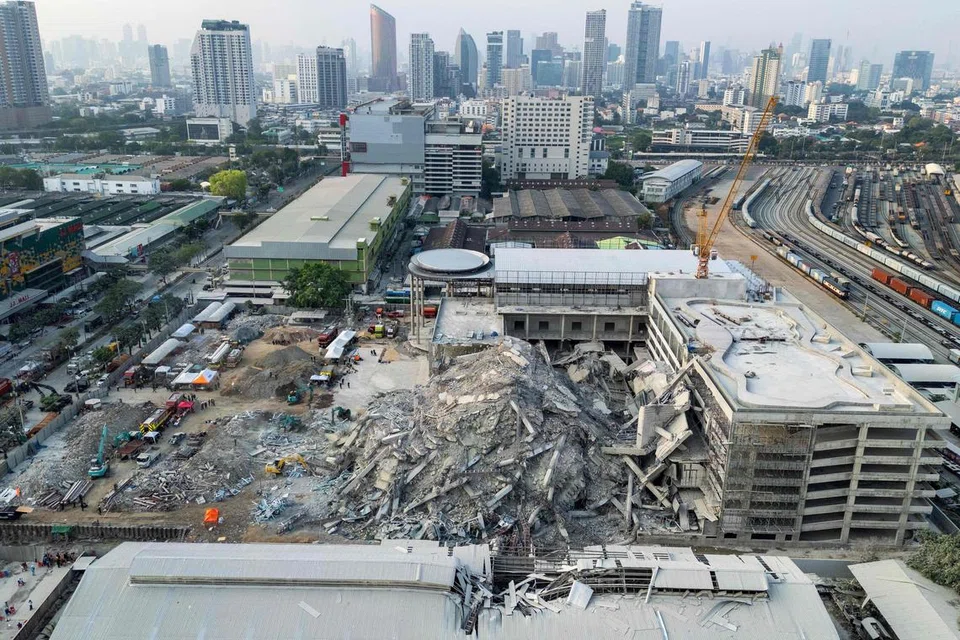
On March 28, the unfinished building, intended to house the Thai government’s state audit office, collapsed after a 7.7-magnitude earthquake. More than 100 people are estimated to have been working on the structure at the time.
Later that day, the promotional posts were no longer found on China Railway’s accounts.
Despite the significantly more catastrophic devastation at the earthquake’s epicentre in neighbouring Myanmar, where the death toll exceeded 2,000 around three days later, the Bangkok building collapse has become one of the disaster’s defining images – its location just across the bustling Chatuchak Market ensured dramatic footage of the destruction was captured from multiple angles and circulated widely online.
The building has also drawn attention for being the only one in the metropolis to entirely collapse, triggering online anger and questions in Thai national media over the building’s construction quality and due process in awarding major government contracts.
The site has accounted for 12 of the 19 confirmed deaths across Thailand so far. Emergency responders continue to conduct search and rescue operations at the site, where 75 people remain unaccounted for.
China Railway No. 10 is ostensibly the junior partner in the building, a joint venture with local developer Italian-Thai Development (ITD). The company derives its name from having an Italian co-founder when it was established in 1958 and helped develop Bangkok’s Suvarnabhumi International Airport, among other notable projects.
Yet, much of the public ire over the building’s collapse has fallen on China Railway No. 10, whose Thai subsidiary has a 49 per cent shareholding in the ITD-CREC (China Railway Engineering Corporation) joint venture, the maximum foreign business ownership generally allowable under Thai law, according to corporate filings.
It points to an undercurrent of disquiet over a surge in Chinese investment in Thailand and a string of major government projects whose contracts were won by Chinese companies, particularly under the previous administration led by General Prayut Chan-o-cha, who seized power in a military coup in 2014 and was prime minister until 2023.
China is the largest source of foreign direct investment in Thailand, accounting for a quarter of total investment in 2023, according to the Thai Board of Investment. Major projects include the Thai-Chinese Rayong industrial cluster and a high-speed rail connection being built as part of the Belt and Road Initiative.
The earthquake also occurred a month after Bangkok acquiesced to Chinese requests to deport 40 Uighurs in Thai detention, sparking criticism from human rights groups.
29 Jun 2026 1 hours ago
29 Jun 2026 2 hours ago
29 Jun 2026 4 hours ago
29 Jun 2026 4 hours ago
29 Jun 2026 6 hours ago