22 May 2025 - {{hitsCtrl.values.hits}}
The US downgrade amplifies global borrowing costs, adversely affecting Sri Lanka’s export-oriented industries, particularly apparel, a critical economic driver
By Vidula Wanigasekara from Lanka Rating Agency
This analysis is in response to Moody’s Ratings downgrade of the United States’ sovereign credit rating from Aaa to Aa1 on May 16, 2025, which is a one notch downgrade.
The Aaa rating is the highest attainable sovereign credit rating issued by Moody’s and this rating is no longer in effect for the US and the new rating given indicates that it is still high quality but subject to risk that is still low but higher than before.
This downgrade, following S&P’s action in 2011, stems from concerns over the US federal debt, projected to reach 134 percent of GDP by 2035, driven by persistent fiscal deficits, rising debt-servicing costs and political challenges to implementing reforms. Lankan Rating Agency (LRA) evaluates the consequences for Sri Lanka’s foreign exchange reserves and export sectors, urging strategic measures to address emerging risks.
US fiscal dynamics and global repercussions
The US debt-to-GDP ratio has risen to 109 percent in 2025, up from 98 percent in 2024, reflecting deepening fiscal pressures. Yields on the US five-year treasuries have increased from approximately 3.86 percent to 4.17 percent in recent months, indicating higher borrowing costs. In addition, Moody’s highlighted the tax cuts to also be a major contributor towards the sovereign downgrade, where the tax cuts contributed to persistent fiscal deficits, which rose from 6.4 percent of GDP in 2024 to a projected 9 percent by 2035.
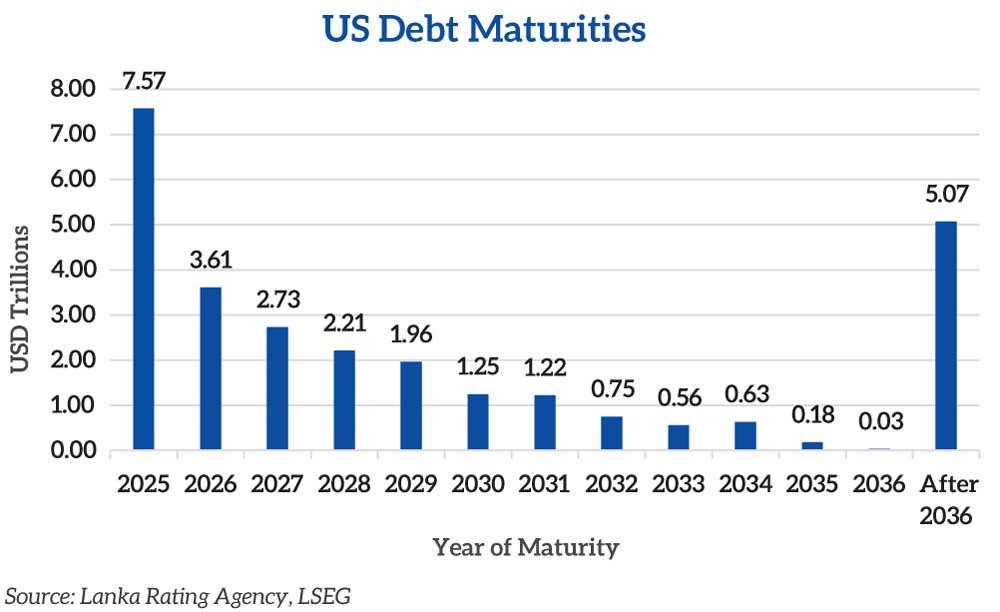
The chart shows a breakdown of the US debt by year of maturity. As displayed, approximately US $ 7.5 trillion of the US debt matures in 2025, which accounts for approximately 26.75 percent of US $ 28.2 trillion of debt. The high short-term obligations of the US have placed the economy in a difficult position in terms of managing short-term liquidity and certain maturity mismatch risks.
Therefore, with the high short-term debt obligations and despite the US dollar’s status as the global reserve currency, Moody’s stable outlook highlights growing uncertainties in financial markets, posing challenges for emerging economies like Sri Lanka.
Exposure of Sri Lanka’s reserves
Sri Lanka’s foreign exchange reserves, valued at US $ 6.326 billion as of end-March 2025, are heavily allocated to US treasuries. Rising treasury yields trigger mark-to-market losses, reducing the value of these assets. This depreciation weakens reserve adequacy, constraining Sri Lanka’s capacity to stabilise the rupee and service external debt.
It should be noted that there is a significant amount of US debt in the form of treasuries that is held by some of the largest economies in Asia. There is a possibility of the condition turning out to be worse if it comes to a point when these large economies sell off their holdings in US treasuries, as this could trigger and drastically impact the final value of the foreign assets held by some of the emerging economies like Sri Lanka who are overly reliant on US reserves. This therefore will be a global market sentiment-driven interest rate change rather than a monetary adjusted, which could have a much more negative effect on the value of US treasuries.
As such, lack of diversification in reserves can have damaging effects on the economy, particularly the balance sheets of emerging economies, which hold US treasuries. Therefore, it is of vital importance to have proactive reserve management in Sri Lanka to mitigate these vulnerabilities, especially by way of diversification.
Pressure on Sri Lanka’s exporters
The US downgrade amplifies global borrowing costs, adversely affecting Sri Lanka’s export-oriented industries, particularly apparel, a critical economic driver. Elevated financing costs, combined with limited ability to secure premium pricing in risk-averse markets, compress profit margins and undermine export competitiveness. This threatens economic growth, requiring urgent policy support to sustain the sector’s viability, most importantly in its export-linked working capital requirements.
To delve further, it should not be ignored that with the rising borrowing costs, particularly interest rate spreads of US treasuries, majority of the US-based exporters would find it difficult to maintain the same levels of margins and profits. This could lead to downscaling of businesses and most importantly, there will be downsides to local (Sri Lankan) importers from high import costs when there is an increase in overall borrowing costs and cost of production, as now the US exporters will pass down the increased cost in the form of high prices. This can be very damaging to the local exporters who depend on certain imports from the US that are used to manufacture the value-added products, which are exported back to global markets.
It is therefore of great importance to implement correct fiscal policies to support the local exporters, especially giving special consideration to the working capital requirements.
Why should Sri Lanka be concerned?
The Moody’s downgrade of the US sovereign credit rating from Aaa to Aa1 highlights growing fiscal risks in the world’s largest economy, with significant implications for Sri Lanka. Given Sri Lanka’s substantial holdings in US treasuries, rising yields reduce the value of its foreign reserves, weakening its ability to stabilise the rupee and service external debt.
Additionally, higher global borrowing costs threaten Sri Lanka’s export sector – particularly apparel – by squeezing profit margins and limiting access to affordable financing. This could lead to reduced competitiveness and slower economic growth. The increased cost of US imports may also raise production costs for local businesses.
This situation underscores the critical need for Sri Lanka to diversify its reserve portfolio and implement strategic policies to strengthen export resilience and manage external vulnerabilities. Proactive measures are essential to safeguard economic stability amid heightened global financial uncertainty.
(Vidula Wanigasekara is Research Analyst at LRA)
13 Jul 2026 4 minute ago
13 Jul 2026 24 minute ago
13 Jul 2026 33 minute ago
13 Jul 2026 1 hours ago
13 Jul 2026 1 hours ago