30 Oct 2025 - {{hitsCtrl.values.hits}}
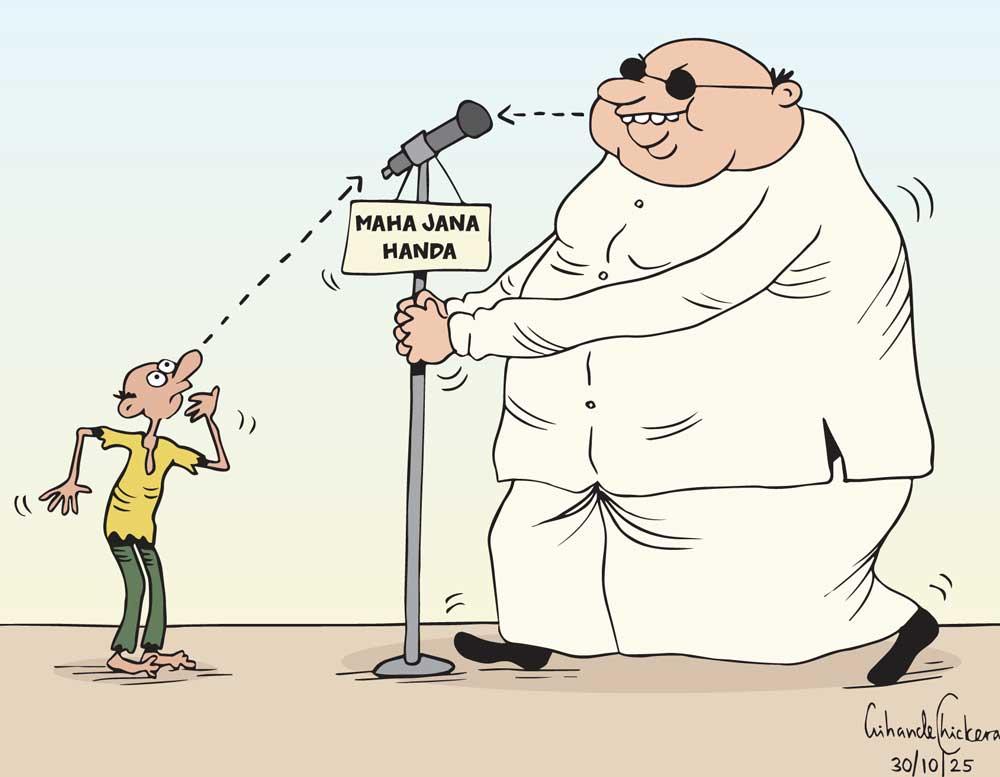
This cartoon delivers a sharp yet subtle commentary on the distortion of democracy — the growing distance between the people’s voice and those who claim to represent it. The artwork captures a powerful contrast: a small, frail man, representing the ordinary citizen, looks up at a large, well-fed politician holding a microphone labeled “Maha Jana Handa” — “The Great Voice of the People.”
At first glance, it seems like a moment of communication — but the composition reveals the irony. The microphone, supposedly the medium for the people’s voice, is firmly in the grip of the politician. The poor man’s gaze and gesture suggest confusion or perhaps a desperate attempt to speak — yet he stands far below, his words unable to reach the mic. The politician, by contrast, looms large, smiling confidently, as though he himself is the people’s voice.
The cartoon’s brilliance lies in its physical exaggeration. The size difference between the two figures isn’t merely about wealth or status — it represents power imbalance. The small man symbolizes the average citizen: voiceless, marginalized, and stripped of agency. The corpulent figure embodies the political elite, who dominate public platforms and define narratives under the guise of serving the masses.
The label “Maha Jana Handa” becomes deeply ironic — what should amplify public sentiment instead echoes the rhetoric of those already in power. It’s a biting observation of how the “voice of the people” is often appropriated, manipulated, or monopolized by politicians. The very tool meant to democratize speech becomes an instrument of control.
The cartoon also raises questions about representation and authenticity. In many democracies, leaders claim to speak for the people — but rarely with them. The poor man’s empty expression and tattered clothes emphasize that he has little more than a vote, while the politician has the platform, the resources, and the narrative. The distance between them — both physical and symbolic — reveals how public discourse is dominated by those who are furthest removed from the everyday struggles of citizens.
Ultimately, this image is not just political satire — it’s a reflection on the erosion of democratic participation. When the people’s voice is filtered, amplified, and reshaped by those in power, democracy becomes performance rather than dialogue.
The cartoon’s closing question lingers in silence: when the “Great Voice of the People” no longer belongs to the people, whose voice are we really hearing?
15 Jun 2026 4 minute ago
15 Jun 2026 17 minute ago
15 Jun 2026 22 minute ago
15 Jun 2026 26 minute ago
15 Jun 2026 46 minute ago