20 Oct 2025 - {{hitsCtrl.values.hits}}
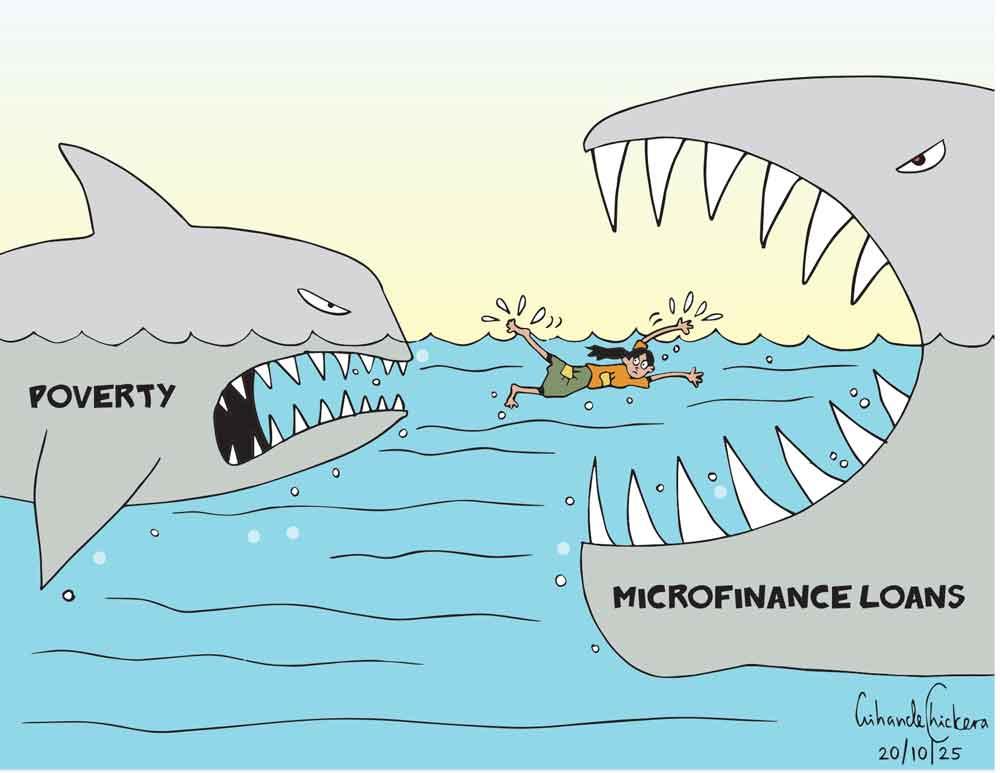
In this haunting cartoon, a woman swims desperately away from a shark labeled “Poverty” — only to plunge straight into the gaping jaws of an even larger predator: “Microfinance Loans.” The message is devastatingly clear — what is often sold as a lifeline for the poor has, in many cases, become a new form of economic entrapment.
The sea of debt, painted here as the inescapable environment of survival, reflects the lived reality of millions who turn to microfinance institutions (MFIs) as a last resort. The promise was noble: empower the poor, especially women, with small loans to start small businesses and gain financial independence. But the reality — much like the cartoon — has proven darker. Instead of being a bridge out of poverty, microfinance has often become a transfer of vulnerability — from destitution to indebtedness.
The sharks are a powerful metaphor. Poverty is an obvious predator, but at least it is visible. The microfinance shark, however, is deceptive — it wears the guise of salvation, offering a smile before biting harder. Its jaws represent predatory interest rates, coercive collection practices, and the psychological toll of debt that never ends. Across South Asia, Africa, and Latin America, there have been countless stories of borrowers driven to despair — even suicide — over unpayable microloans.
The woman’s outstretched arms capture a universal truth: the poor are not reckless — they are cornered. When systemic inequality, lack of education, and absence of state welfare leave no safety net, any offer of help seems worth taking. Yet, as this cartoon reminds us, not all help is humane.
At its heart, the image exposes a brutal irony — poverty was once the problem, but now debt has become the business model. The sharks feed not just on the poor’s desperation, but on their dreams.
Perhaps the most piercing question the cartoon poses is this: when survival itself becomes collateral, can any system that profits from the poor truly claim to be a solution?
15 Jun 2026 45 minute ago
15 Jun 2026 1 hours ago
15 Jun 2026 1 hours ago
15 Jun 2026 1 hours ago
15 Jun 2026 2 hours ago