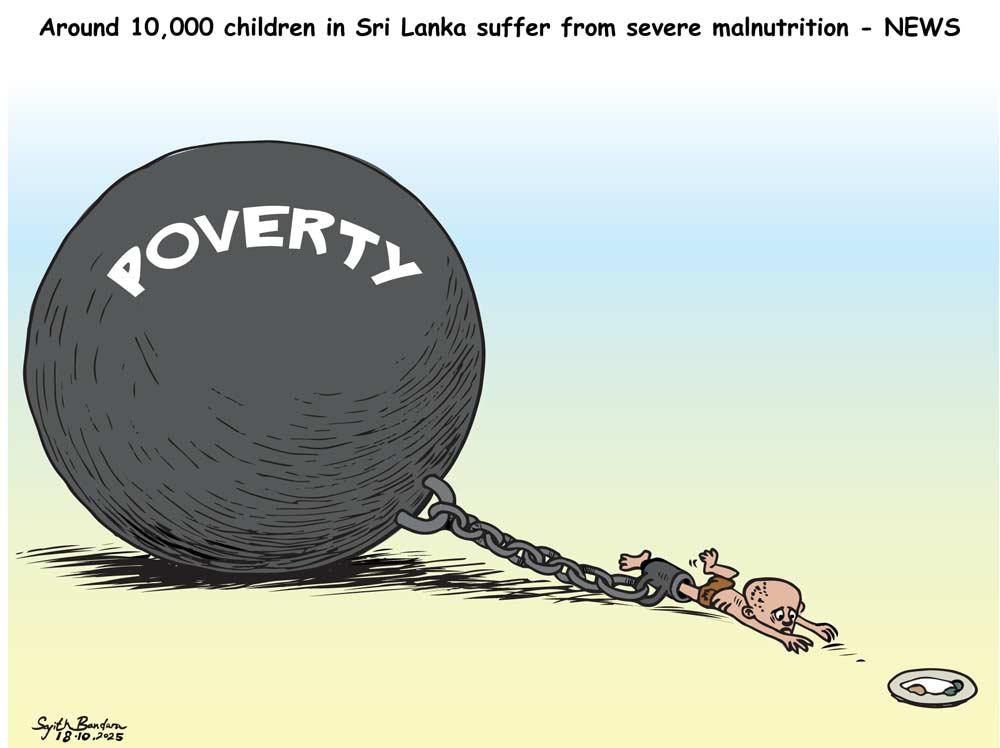
In this searing cartoon, a skeletal child lies chained to a massive iron ball labeled “POVERTY.” Just inches away lies a nearly empty plate — a tragic symbol of both physical hunger and systemic neglect. The child stretches forward, desperate to reach the food, yet the chain that binds him ensures he never will.
The image, though simple, carries immense emotional weight. The ball and chain — long a metaphor for imprisonment — here represent the inescapable bondage of poverty, a force so heavy that even the most basic human act — eating — becomes unreachable. It is not merely hunger depicted here; it is the institutionalization of hunger. Poverty, in this context, is not an accident — it is a structure designed to keep the weakest from breaking free.
The caption above — “Around 10,000 children in Sri Lanka suffer from severe malnutrition” — transforms this from a cartoon into a mirror reflecting a national tragedy. The numbers are not abstract statistics; they are small, fragile lives shackled by the failures of governance, economic inequality, and political apathy.
The child’s outstretched hand encapsulates a cruel paradox: the food is visible, yet inaccessible. This reflects how aid, resources, and development programs often exist in theory but rarely reach those who need them most. The plate — meager and distant — could just as easily symbolize broken welfare systems or the indifference of policymakers who debate hunger from abundance.
At a deeper level, the cartoon is an indictment of society’s moral hierarchy. When poverty becomes so normalized that starving children become routine news, it is not only a failure of policy — it is a failure of empathy.
The heavy ball of poverty is not born by the child alone. It is forged by corruption, global inequality, inflation, and debt — forces far beyond a child’s control. Yet the smallest shoulders bear the heaviest load.
In the end, this image forces a difficult question: how can a nation dream of progress when its children must crawl toward survival?