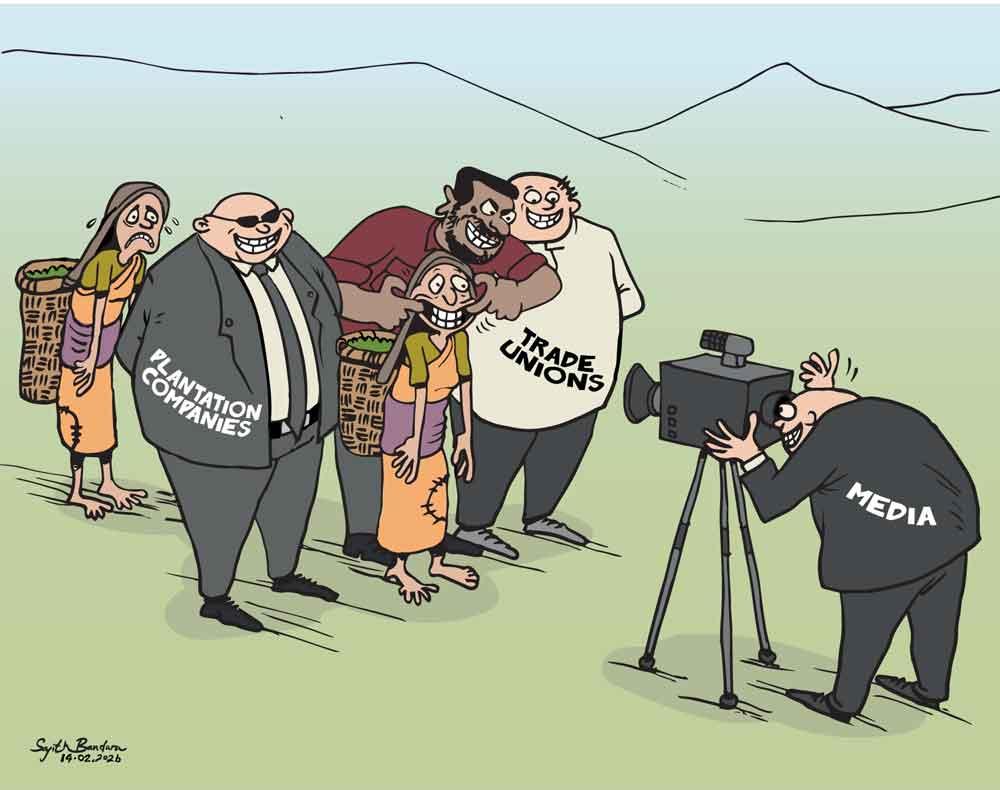
The cartoon shows a staged scene in which several well-dressed figures labeled “Plantation Companies” and “Trade Unions” stand smiling confidently in front of a camera operated by a figure labeled “Media.” In front of them, positioned prominently for the shot, is a plantation worker holding a basket, also smiling broadly. Behind this staged grouping, however, another worker stands slightly apart, appearing distressed and visibly worn, contrasting sharply with the cheerful expressions presented to the camera.
The composition suggests a deliberate arrangement for public display. The powerful stakeholders stand close together, projecting unity and satisfaction, while the worker at the center appears to be part of the performance. The presence of a second worker in the background—unacknowledged and anxious—introduces tension, implying that the image being broadcast may not reflect the full reality. The camera acts as a framing device, literally shaping what the audience will see.
Viewers may interpret the cartoon as commentary on how labor issues are represented in public discourse. Some may see it as criticism of corporate, union, and media collaboration in presenting a polished narrative that overlooks ongoing hardship. Others may read it more broadly as a reflection on how selective storytelling can simplify complex workplace dynamics. Rather than naming a single party as solely responsible, the cartoon invites reflection on how power, messaging, and lived experience can diverge in public representation.