12 Mar 2026 - {{hitsCtrl.values.hits}}
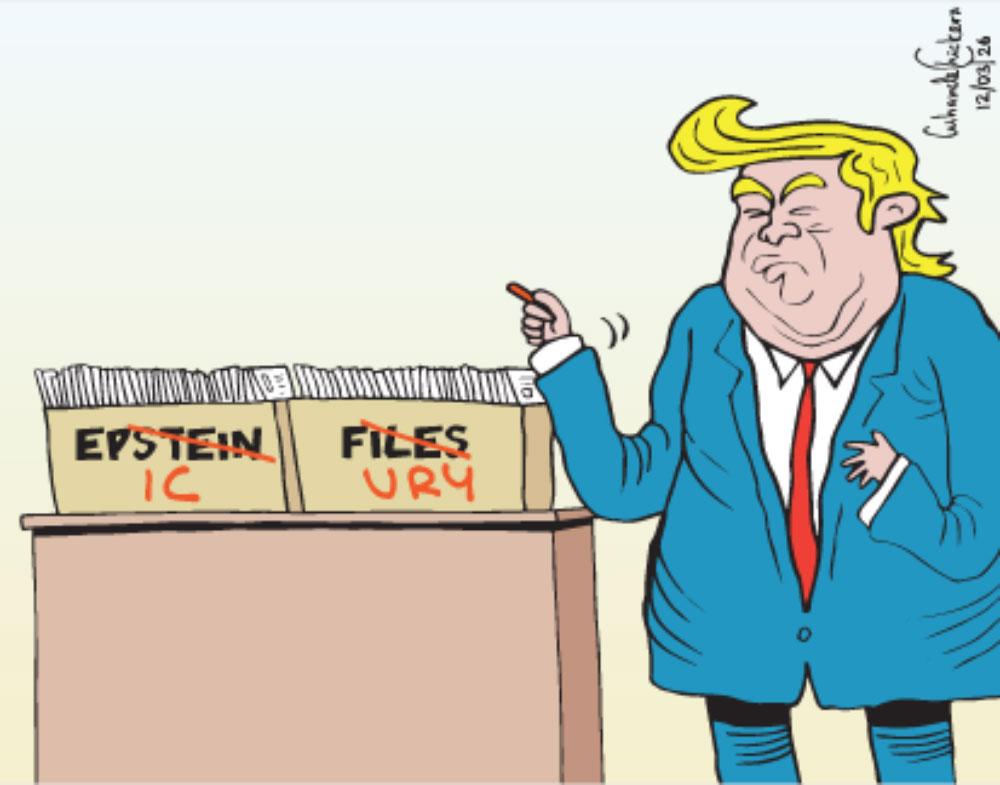
The cartoon shows a figure resembling former U.S. President Donald Trump standing beside two large folders filled with documents labeled “Epstein Files.” The folders are packed with papers, suggesting a large volume of information. With a red marker in hand, the figure has crossed out the letters “IC” from “EPSTEIN” and “URY” from “FILES,” leaving the visible words altered.
The act of striking through parts of the labels visually transforms the meaning of the text, implying selective editing or reframing of information. The red pen and the deliberate crossing-out gesture emphasize an attempt to control how the files are presented or understood. The large stack of documents reinforces the sense that the underlying material is extensive, even as its labeling is being changed.
Viewers may interpret the cartoon in different ways. Some may see it as commentary on attempts by political figures to reshape narratives surrounding controversial investigations or records. Others may read it more broadly as a critique of how information can be rebranded or selectively altered in public discourse. Rather than presenting a detailed argument, the cartoon highlights the tension between the existence of records and the way they may be presented or interpreted.
The cartoon shows a figure resembling former U.S. President Donald Trump standing beside two large folders filled with documents labeled “Epstein Files.” The folders are packed with papers, suggesting a large volume of information. With a red marker in hand, the figure has crossed out the letters “IC” from “EPSTEIN” and “URY” from “FILES,” leaving the visible words altered.
The act of striking through parts of the labels visually transforms the meaning of the text, implying selective editing or reframing of information. The red pen and the deliberate crossing-out gesture emphasize an attempt to control how the files are presented or understood. The large stack of documents reinforces the sense that the underlying material is extensive, even as its labeling is being changed.
Viewers may interpret the cartoon in different ways. Some may see it as commentary on attempts by political figures to reshape narratives surrounding controversial investigations or records. Others may read it more broadly as a critique of how information can be rebranded or selectively altered in public discourse. Rather than presenting a detailed argument, the cartoon highlights the tension between the existence of records and the way they may be presented or interpreted.
17 Jun 2026 9 minute ago
17 Jun 2026 17 minute ago
17 Jun 2026 26 minute ago
17 Jun 2026 33 minute ago
17 Jun 2026 51 minute ago