22 Dec 2025 - {{hitsCtrl.values.hits}}
By Srilal Miththapala
This is a follow-up to my article ‘Rebuild Sri Lanka: Are we fixing the damage or building better?’ in Daily Mirror of December 10 (https://www.dailymirror.lk/amp/business-news/Rebuild-Sri-Lanka-Are-we-fixing-the-damage-or-building-better/273-327388).
Based on what I wrote about earlier, I now explore the real impact of the cyclone on tourism. Are we really back to normal with all our tourism offerings? Or does Sri Lanka tourism need some short-term adjustments in the promotion and delivery of its tourism experiences? Post cyclone, is there a need for new itineraries and narratives for tourism in the short term?
Having been in the tourism industry for over 30 years now, I fully understand that the industry has to be revived from whatever setbacks that we experienced due to the recent disastrous cyclone. Yes, we need to show a sense of normalcy and get tourism back into operation as soon as possible. This is vital, particularly given the timing with the peak winter season just about to unfold. So, while wearing my ‘tourism cap’, I fully endorse and support all the efforts that are being done by all stakeholders to this end.
However, as some of my close friends will know, I am also an engineer (albeit a bit of a rusty one!). So, when I wear my ‘engineering cap’ and see the extensive infrastructure damage that has occurred, particularly to the transport network, I am concerned. Repairing such massive damage to railway lines, bridges and roadworks is by no means an easy task.
While certainly the repair work is going on at breakneck speed, it has to be done with proper professional engineering supervision and design (which I trust is being done). This type of repair work has to be done properly and safely and needs time.
For example, some of the stretches where the railway line was completely washed away, needs careful rebuilding. Soil and rubble have to be filled systematically, layer by layer, compacted and allowed to settle overtime. The strata have to built-up carefully and there are no shortcuts that can be taken, before a 500-tonne train (M6 class diesel electric locomotive and 10 carriages) can safely travel across the repaired line. In any event, even after a proper repair of this nature, traversing this stretch of repaired track will have to be done very slowly.
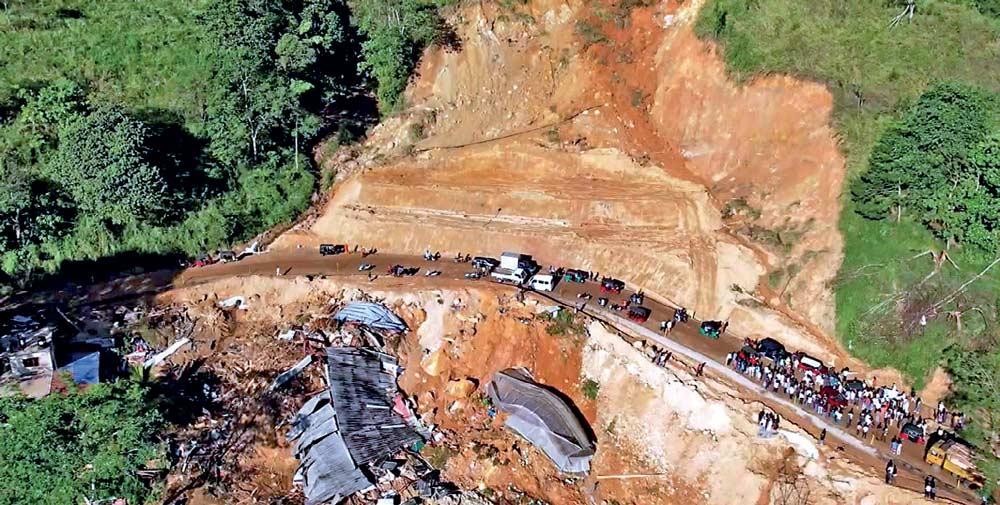
The same applies to the roads. Some areas have been completely washed away and it is difficult to fathom out the state of the strata deep down. Rebuilding roads washed away by landslides requires significant precautions that prioritise safety and long-term resilience against future disasters. This has to be based on proper geotechnical assessments, engineering solutions like improved drainage and retaining structures and environmentally-conscious land management.
Even after opening for traffic, travel will have to be at a slow pace, perhaps single file, moratorium on night time travel and with restrictions on heavy vehicular movements for several months. The railways estimate it will take six months to get all lines repaired. The NBRO estimates that some 30 percent of the entire country will be prone to landslide risks. This will result in travel times being much longer than before. Two days ago, it took over nine hours to travel to Jaffna from Colombo. That’s almost the same time that it takes to fly from Melbourne to Colombo!
Hence, my conclusion is that while we are rebuilding, repairing and restoring, travel, specially to the badly affected areas, is not going to be ‘perfectly normal’ for the next six to 12 months.
So, what is the message we should disseminate now to travellers?
I believe the current rallying call to visit Sri Lanka and that everything is ‘fine and normal’ may not be the best. Yes, almost all hotels, even in the badly affected hill country, are operating normally. But what about the surrounding landscapes and comfortable and speedy accessibility? What about the visitor experience when travelling on some of these access roads? What about the long travel times? Will some of the expectations of travellers fall short? Would we be falling into the age-old marketing mistake of ‘overpromising and underdelivering?’
If we continue marketing the pre-disaster product, expectations will be broken, reviews will suffer and new bookings may decline. Tourism damage will come months later, not immediately, which makes it more dangerous.
In the aftermath of a natural disaster, tourism does not collapse because of the event itself – it collapses because of uncertainty. Modern travellers are highly informed and risk-aware. They compare destinations, scan advisories, read forums and check multiple sources before booking. Travelers accept risk but they will not accept ambiguity.
What they need now is:
 Clear confirmation that most of the country is functioning normally
Honest disclosure that some areas are still recovering
Precise geographic clarity, not national generalisations
Over-reassurance damages credibility. Transparency builds trust. The marketing spin destroys it. Safety assurance must be evidence-based. “Everything is fine” is not reassurance.
To deliver on this, we need to rethink our short-term tourism narratives and itineraries. We cannot tread the familiar tourism ‘cow path’ circuits. We need to innovate and create new experiences that carefully avoid areas that are still under strain and shift to more multiple self-contained experiences.
Perhaps we need to reframe longer travel times as a feature and not a flaw. We need to shift to ‘slow tourism, stay longer and experience more’ with deeper immersion. This positioning resonates with high value low volume segments- which is the strategy many have been advocating for Sri Lanka.
Hence, this may be an opportunity that Sri Lanka tourism should grasp, perhaps to go back to the drawing board and come up with new innovative circuit tours with new and more authentic experiences.
21 Jun 2026 9 hours ago
21 Jun 2026 21 Jun 2026
21 Jun 2026 21 Jun 2026
21 Jun 2026 21 Jun 2026
21 Jun 2026 21 Jun 2026