28 Nov 2025 - {{hitsCtrl.values.hits}}
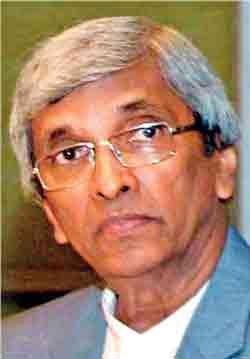 |
| Dr. Ranjith Mahindapala Pic by Pradeep Pathriana |
Past President of the National Academy of Sciences of Sri Lanka (NASSL) Dr. Ranjith Mahindapala called for a return to evidence-based policymaking in the plantation sector, highlighting that the 2020 ban on oil palm was driven by public sentiment rather than scientific data which now warrants a review.
Speaking at the recent Annual General Meeting of the Oil Palm Industry Association (OPIA), Dr. Mahindapala argued that relying on peer-reviewed evidence is critical as the country struggles with an annual edible oil import bill of US dollar 300 million.
He noted that the National Academy of Sciences is currently working with the government to establish a formal mechanism to ensure future agricultural policies are grounded in scientific fact rather than political reaction.
“How should the government develop policy? It must provide scientific evidence relying on peer review,” Dr. Mahindapala told the gathering. “The ministry is now very keen to set up a formal mechanism on how to develop this evidence.”
Industry experts at the forum pointed out that the 2020 prohibition was triggered by public complaints regarding water consumption and environmental concerns.
However, Dr. Mahindapala referenced a comprehensive study submitted to the government in 2022 which rebutted these allegations. The study showed that oil palm water usage is comparable to rubber in similar rainfall zones and that the crop requires minimal chemical application due to the absence of fungal diseases.
The veteran scientist highlighted the economic mismanagement of the current “coconut crisis,” where high-value coconuts are crushed for domestic oil instead of being utilised for lucrative exports. “We import USD 300 million worth of oil. Here we are short of 200 million coconuts. The little oil palm we have can supply significant requirements,” he said, noting that expanding oil palm to meet the local deficit would release coconut production for value-added industries like coconut milk and virgin oil.
Dr. Mahindapala used a vivid historical example to illustrate how science previously saved the industry. In the 1980s, plantations faced unsustainable costs due to manual pollination, where workers had to be wrapped in protective sacks to climb thorny trees. “I was amazed. I saw these people all wrapped in gunny bags... approximately 100 men and women wrapped in this garland because the trees are very thorny,” he recalled.
The introduction of the pollinating weevil Elaeidobius kamerunicus in 1986, a biological solution brought from the Commonwealth Institute of Biological Control, revolutionized the sector. “Within one year, the crop at Nakiyadeniya went up by 400 percent. The SPC never expected that kind of increment,” he said, adding that the biological intervention saved the state Rs. 2 million in labor costs at the time.
The industry’s trajectory has seen sharp policy reversals over the decades. While oil palm was introduced in the 1960s and saw yield breakthroughs in the late 1980s following the weevil introduction, modern policy has been inconsistent. In 2016, the government initiated a plan to expand cultivation to 20,000 hectares to substitute imports. However, this momentum was halted in 2018 when public dissatisfaction grew over alleged groundwater depletion and pollution.
Despite the industry’s attempts to address these concerns scientifically, the government enforced a total ban on cultivation in 2020, even ordering the uprooting of existing trees. The industry maintains that this decision ignored the economic reality and scientific evidence, a gap the National Academy of Sciences now hopes to bridge with its new evidence-based framework. (NF)
15 Jun 2026 4 minute ago
15 Jun 2026 24 minute ago
15 Jun 2026 27 minute ago
15 Jun 2026 35 minute ago
15 Jun 2026 40 minute ago