19 May 2026 - {{hitsCtrl.values.hits}}
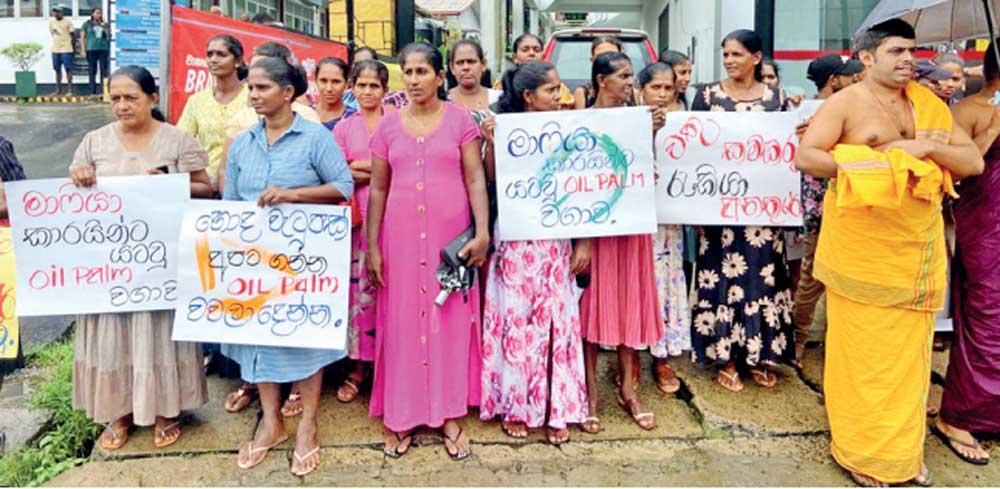
A silent march and awareness campaign took place in the Matugama town last week, with the plantation sector workers and local communities demanding the immediate removal of the arbitrary ban on oil palm cultivation.
The demonstration sought to draw attention to the severe economic implications of the ongoing restrictions on both the workforce and broader industrial sector.
Representing the plantation community, the protestors pointed out that Sri Lanka remains the only country globally to enforce a ban on oil palm, despite palm oil being an essential raw material for daily consumption.
They emphasised that while the local cultivation has been halted, the continuous importation of palm oil underscores the lack of viable alternatives for the dependent industries.
Furthermore, they noted that oil palm cultivation offers a solution to the prevailing labour shortage and climate change challenges while delivering the highest global oil yield, arguing that the prohibition has inflicted significant injustice upon the plantation workforce, downstream edible oil industries and consumers.
Addressing the gathering, Ven. Omanthe Punyasiri Thera stated that the plantation sector serves as the primary livelihood for the region’s populace. He explained that the sustainability of the Regional Plantation Companies ensures the survival of direct employees and thousands of indirectly dependent families.
The thera drew comparisons to countries like Indonesia and Malaysia, which earn substantial foreign exchange through oil palm,
expressing regret that Sri Lanka remains dependent on imports for its industrial needs despite possessing the ideal natural environment for the crop.
He advocated for introducing oil palm to abandoned rubber estates, currently unproductive due to the leaf disease and labour shortages, to ensure these designated plantation lands actively contribute to the national economy.
Consumer Protection Association President Asela Sampath addressed the economic fallout, noting that the local production is entirely insufficient to meet the domestic demand for palm oil, a critical ingredient for the bakery sector and various food manufacturing industries.
He revealed that Sri Lanka imported 280,576 metric tonnes of palm oil in 2025 alone, draining a massive amount of dollar reserves.
Attributing the current supply crisis to the unfounded demonisation of the crop, Sampath also raised concerns over the purity of the alternative oils currently in the market.
“There are emerging doubts about whether the coconut oil in the market is genuinely pure,” he stated.
“We need a background where standardised palm oil can be purchased as palm oil and genuine coconut oil as coconut oil. This can only be normalised by removing the barriers to the oil palm industry and correcting the myths surrounding palm oil.”
The protest brings renewed focus to the controversial policy enacted in April 2021, when the government banned the importation of palm oil and ordered a halt to new oil palm cultivation, citing environmental concerns. The directive also mandated the phased uprooting of the existing plantations to be replaced with rubber or other environmentally friendly crops.
However, the Regional Plantation Companies and industry experts have continuously lobbied against the prohibition, arguing that oil palm is highly lucrative and crucial for reducing the country’s massive edible oil import expenditure, which continues to cost the economy billions of rupees annually in foreign exchange.
With the local demand for edible oil far exceeding the domestic production capacity, the industry stakeholders warn that the continued ban will only exacerbate the costs for manufacturers while stifling the rural economic growth.
(NF)
27 Jun 2026 29 minute ago
27 Jun 2026 2 hours ago
27 Jun 2026 2 hours ago
27 Jun 2026 3 hours ago
27 Jun 2026 3 hours ago