27 Jan 2017 - {{hitsCtrl.values.hits}}
In an attempt to garner support for the coalition government’s plan to monetize some of the mega infrastructure projects built by the previous regime, Finance Minister Ravi Karunanayake yesterday urged the public to think rationally and not get swayed by the misleading remarks of Opposition politicians. 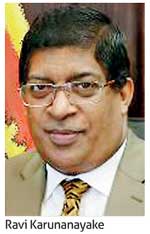
According to Karunanayake, Sri Lanka is embroiled in a gigantic debt trap and the main contributor to this perilous situation is the mega infrastructure projects undertaken on borrowed money, which haven’t yielded any return.
Further, he pointed out that the national revenue and the export earnings constantly came down during 2011-2014.
According to a Finance Ministry statement, Sri Lanka total debt stock went up 233 percent to Rs.7, 391 billion during the 2005-2014 period. The total debt burden of Sri Lanka in 2005 was Rs.2, 222 billion and, within 5 years, it increased up to Rs.4, 590 billion in 2010. In addition there is another Rs 2,000 billion debt obtained by public owned enterprises directly off the balance sheet.
Accordingly, the debt servicing (loan installments and the interest) to be paid by Sri Lanka to foreign financiers is also increasing constantly. The debt servicing of US$ 1,828 million paid in 2016 will be increased by more than double to US$3,992 million being the highest debt repayment to be paid by Sri Lanka in a year due to colossal borrowings by the previous government.
This could be considered as the highest sum of debt servicing to be repaid by Sri Lanka within a year.
The previous administration had also borrowed US$ 4.5 billion through international sovereign bonds during the period between 2010 and 2014. This sovereign bond should be repaid in full as US $ 1 billion per annum from its maturity in 2019. However, the repayment of all these project loans and bonds began after 2014. 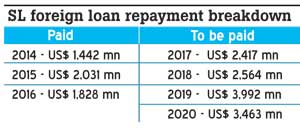
This debt repayment covers only the project loans and the International sovereign bond. The liability on the loan obtained from the International Monetary Fund and the investment by foreigners on the treasury bills and treasury bonds is to be paid separately.
Karunanyake said although the country or its people received no dividends from these mega infrastructure projects built on foreign loans by the previous regime, the current government has been compelled to repay installments and interest for such loans with effect from 2015 though these projects run at a loss.
According to Karunanayake only developed countries use their own resources to build mega size infrastructure facilities such as ports and airports. Developing countries tend to invite foreign investors to build such huge projects instead as their economies cannot afford the high cost of large scale projects.
Alternatively, foreign investors are invited to construct such infrastructure under Build, Operate and Transfer (BOT) basis or Build, Own and Operate (BOO) basis as in such an instance the developing countries need not bear the burden of debt repayment .
Sri Lanka, also in the past, developed telecommunication systems in the island on BOO/BOT bases.
Karunanayake said while this model enables investors to regain dividends for the investment during a given time and, simultaneously, it does not make developing countries to pass the burden of investment on its poor citizens.
According to him, before the launch mega projects, there were unsolicited proposals to build Hambantota port, Mattala airport and Southern Expressway, which could have been easily carried out on BOO/BOT basis during the previous regime.
But, unfortunately, the former regime opted to borrow unprecedentedly to build them. Consequently, Hambantota port and Mattala airport became loss making entities while leaving the country and people in an unbearable debt trap.
The previous government had obtained US$1,303 million for the Hambantota Port and the first phase of the credit of Rs.340 million was released on a 6 percent interest. In addition, 6 percent insurance premium should also be paid for the loan.
Karunanayake stressed that the current government is trying to convert these massive amounts of credit obtained into equity through public private partnerships (PPP) to relieve the people from the debt burden.
“While the government is taking untiring efforts to convert these white elephants into profit making institutions, and generate income and employment for the youth in the country, an Opposition group is engaged in sabotaging such efforts charging that the government is attempting to sell off national resources to foreigners,” Karunanayake charged. It is high time people thought rationally in response to such misleading remarks made by these rival groups,” he added.
17 Jun 2026 3 hours ago
17 Jun 2026 3 hours ago
17 Jun 2026 4 hours ago
17 Jun 2026 5 hours ago
17 Jun 2026 6 hours ago