29 Dec 2025 - {{hitsCtrl.values.hits}}
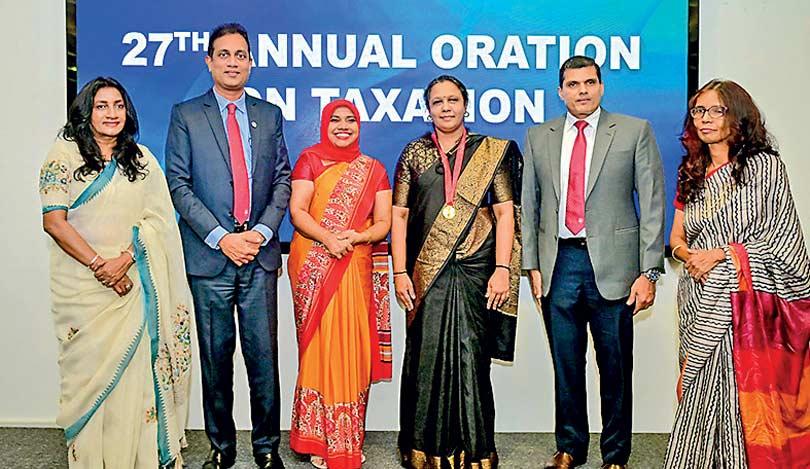 Orator with the medallion, an important tradition of the event since its inception
In a comprehensive assessment of Sri Lanka’s economic journey, Central Bank Director Economic Research Dr. Sujeetha Jegajeevan stated that the nation’s profound crisis was the culmination of decades-long structural weaknesses that were amplified by the combination of external shocks and domestic policy missteps.
However, decisive reforms supported by the current International Monetary Fund (IMF) programme and complementary measures from other multilateral agencies have established a foundation for recovery, with a credible chance that this could be Sri Lanka’s final IMF programme, if discipline is maintained during the programme and beyond.
Speaking at the 27th Annual Tax Oration organised by the Institute of Chartered Accountants of Sri Lanka (CA Sri Lanka) on the topic ‘From Crisis to Confidence: Reimagining Sri Lanka’s Economic Landscape’, Dr. Jegajeevan outlined the roots of the crisis, the ongoing stabilisation and the critical shift now required towards growth-oriented reforms.
The event was attended by a large number of Chartered Accountants, including President Heshana Kuruppu, Vice President Tishan Subasinghe, Taxation Faculty Chairperson Sarah Afker and Chief Executive Officer Lakmali Priyangika.
Dr. Jegajeevan identified the core causes of the crisis as persistent fiscal and external deficits over decades, leading to unsustainable borrowing.
“The debt burden became unmanageable not merely due to its size but due to the inability to service it,” she explained.
“Unlike in the past, the most difficult reforms were front-loaded, not postponed,” Dr. Jegajeevan emphasised.
“Strong legal reforms and a strengthened institutional framework now limit discretionary policy reversals and there is greater public acceptance of reforms due to the lived experience of the crisis.”
These actions have yielded clear results, she explained such as inflation has been tamed from a peak of around 70 percent to low single digits, exchange rate volatility is stabilised, primary budget balance has turned positive, debt restructuring has reduced near-term debt servicing pressures and improved market confidence is reflected in sovereign rating upgrades and compressed bond yields.
While acknowledging the hard-won stabilisation, Dr. Jegajeevan stressed that “stability alone is not enough”. Sri Lanka must grow faster now to recover lost output and catch up with its regional peers.
She outlined key priorities, ranging from short to medium term, focusing on boosting services exports (tourism, logistics), increasing female labour force participation, accelerating digitisation and AI adoption and enhancing trade facilitation for private sector-led growth. On the medium to long term, she highlighted the need to implement deep structural reforms in labour, land, education and capital markets, while fostering innovation, R&D, climate resilience and deeper global integration.
17 Jun 2026 6 hours ago
17 Jun 2026 7 hours ago
17 Jun 2026 8 hours ago
17 Jun 2026 8 hours ago
17 Jun 2026 9 hours ago