28 Nov 2025 - {{hitsCtrl.values.hits}}
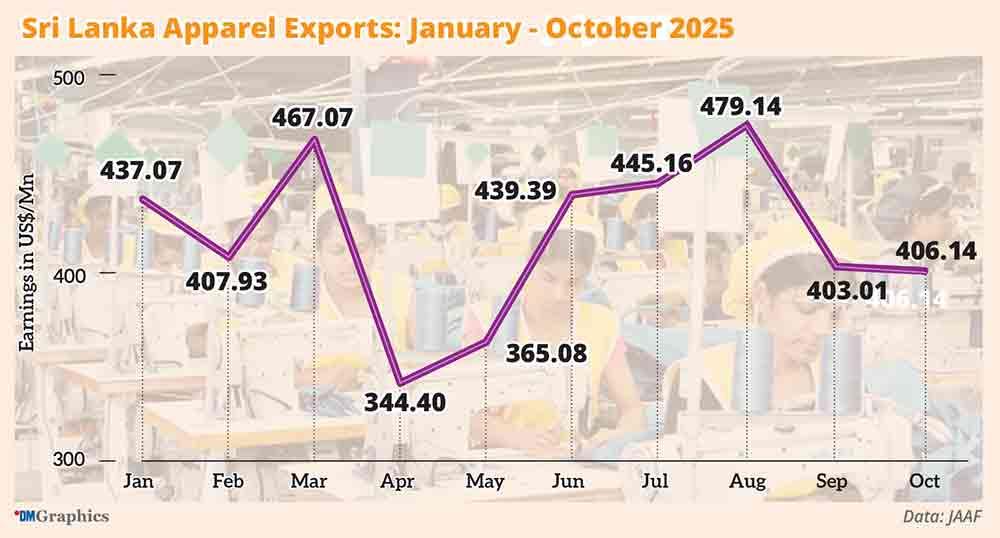
Sri Lanka’s apparel sector posted a broadly flat performance in October, with exports edging down 0.05 percent from a year earlier, even as the European Union drove a strong uptick in demand. The industry’s cumulative performance for the first 10 months of 2025, however, points to a firmer recovery, supported by improving orders across key markets.
Exports to the EU jumped 12.53 percent in October, offsetting declines in shipments to the United States, the UK and other destinations, which contracted by 1.92 percent, 11.99 percent and 9.84 percent respectively.
For January–October, total apparel exports rose 6.12 percent year-on-year, underpinned by a 14.05 percent surge in EU-bound shipments. Exports to the US expanded 1.37 percent, while the UK and other markets recorded increases of 0.98 percent and 8.31 percent over the same period in 2024.
The Joint Apparel Association Forum (JAAF) said the industry’s ability to maintain momentum reflects underlying strength despite a volatile global backdrop.
“Sri Lanka’s apparel sector continues to hold steady despite challenging global conditions. The strong growth in EU markets and the positive cumulative performance reflect the industry’s resilience, ongoing investments in competitiveness, and our commitment to meeting the needs of international buyers.
“Sustained market diversification and consistent policy support will be essential as we work to build on this momentum in the months ahead.”
Monthly export earnings for 2025 show a fluctuating but generally stabilising trend. After peaking at US$ 479.14 million in August, volumes eased to US$ 403.01 million in September before inching up to US$ 406.14 million in October.
Despite these month-to-month shifts, the first ten months reflect steady demand recovery.
The data highlights that while the sector continues to experience seasonal fluctuations and market-specific stress, cumulative growth signals that the worst of the downturn is easing, aided by diversification efforts and firmer demand from Europe.
15 Jun 2026 10 minute ago
15 Jun 2026 17 minute ago
15 Jun 2026 20 minute ago
15 Jun 2026 23 minute ago
15 Jun 2026 2 hours ago