01 Feb 2017 - {{hitsCtrl.values.hits}}
By Chandeepa Wettasinghe
Politicians are continuing to create unsound policies advocated by laymen to the field of agriculture in order to victimize the poverty-stricken farming population, which would result in an imminent derailment of the economy, scholars warned this week.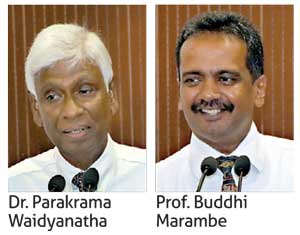
The government’s ‘toxin-free nation’ policy, aimed at reducing the reliance on agrochemicals and high-yielding rice varieties, is a response to a farmer’s drive to derive bigger yields and profits easily and to reduce the cost of labour. “Is that a crime? Mustn’t a farmer get bigger yields? Must he always live in drudgery and poverty?” Coconut Research Board Former Chairman Dr. Parakrama Waidyanatha questioned during a seminar titled ‘Future of Agriculture’ organized by the Marga Institute and the Gamini Corea Foundation.
University of Peradeniya Agriculture Faculty Crop Science Department Prof. Buddhi Marambe noted that in the 1940s, when Sri Lanka cultivated organic, traditional rice varieties, the yield had been less than 1 tonne per hectare, which has now increased to 5 tonnes per hectare through the use of agrochemicals, fertilizer and high-yield varieties.
He added that this yield needs to be increased by 0.76 tonnes per hectare by 2020 in order to feed Sri Lanka’s growing population. “Someone needs to convey the real information to the policymakers, because the derailment of the economy is imminent if we don’t address these issues,” Prof. Marambe said.
Dr. Waidyanatha said that personalities such as Member of Parliament Athuruliye Rathana Thero and State Enterprise Management Agency Chairman Asoka Abeygunawardana were involved in agriculture policy formulation with President Maithripala Sirisena.
“Who formulates these policies? I didn’t see Dr. Gerry Jayawardena’s face there in the picture of policy makers, nor do I see any agriculturist. There was no Buddhi Marambe, there was no Director General of Agriculture there. I see the Rathana Hamuduruwo and Asoka Abeygunawardena. I don’t see any agriculture professionals,” Dr. Waidyanatha said.
His comments bear resemblance to the sentiments of Economic Advisor to the President Dr. Sarath Rajapatirana, who had said that politicians are making decisions without proper research.
Advisor to the Agriculture Ministry Dr. Gerry Jayawardena noted that over 50 percent of the farmers in Sri Lanka are over 50 years of age, and most own less than 5 acres of land.
Currently, around 30 percent of Sri Lanka’s labour pool is in the agriculture sector, which accounts for 10 percent of the country’s gross domestic product.
Dr. Jayawardena stressed that such socioeconomic equations need to be changed in order to continue Sri Lanka’s agriculture sector.
“In America, farmers are 2 percent of the labour market. In Australia it’s 12 percent. Here, it needs to be 15 percent,” he said.
However, he added that the government has to introduce modern agriculture policies, which include systematic provision of subsidies in order to ensure that younger generations do not abandon agriculture.
“In America, farmers have MScs and earn more than professors. Here we need to pay them more, because a farmer’s son, who wears a T-shirt, jeans, shoes and goes around in a motorcycle and has a relationship with a girl working in factory, wouldn’t want to get dirty in the fields for so little. Or else, we’ll have to choose to produce computers and import food like Singapore and Taiwan,” he said.
Meanwhile, speaking on climate change, Prof. Marambe said that it bears striking resemblance to Sri Lanka’s policy changes which are unpredictable, human induced, and have detrimental impacts on agriculture.
He said that due to global warming, dry months will become drier while wet months will become wetter, and Sri Lankan politicians have to introduce ‘no regret options,’ which are adaptable for either scenario.
“We need no regret options. Not just ad-hoc policies or policies to make people happy,” he said.
Price controls on agriculture products and farmer subsidy schemes are commonplace in Sri Lanka during election times.
15 Jun 2026 18 minute ago
15 Jun 2026 26 minute ago
15 Jun 2026 33 minute ago
15 Jun 2026 36 minute ago
15 Jun 2026 39 minute ago