04 Apr 2025 - {{hitsCtrl.values.hits}}
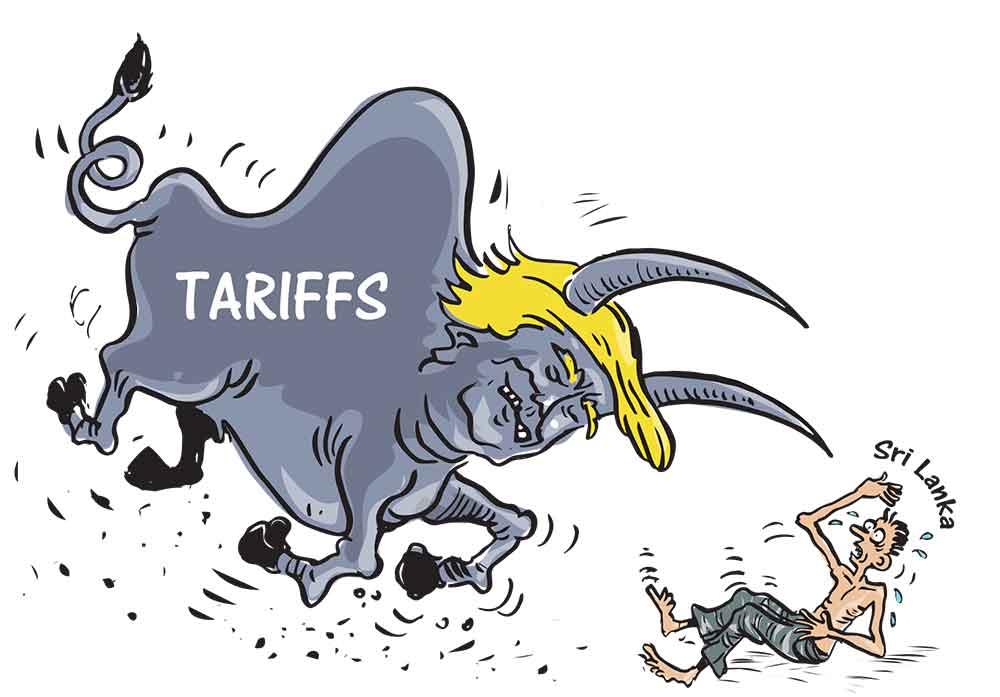
The United States has imposed a 44 percent reciprocal tariff on Sri Lankan exports, sending policymakers into panic mode as they scramble to assess the impact and seek relief for the trade-dependent nation.
As reported by Mirror Business yesterday, U.S. President Donald Trump announced a wave of tariffs, dubbed ‘reciprocal tariffs’, on all imports in two phases. The plan imposes higher levies on trade partners deemed “bad actors” with persistent trade surpluses with the U.S., while setting a 10 percent baseline tariff on all others.
The sweeping new tariffs, which were not a surprise, reverberated through global markets, sending global stocks lower and the U.S. dollar tumbling to its lowest levels for the year.
Sri Lanka’s All Share Price Index, which staged a rebound in the two previous sessions and was expected to rally, dropped 349.84 points, or 2.19 percent, to settle at 15,657.60. This pulled the index down from the 16,000 level it had climbed to a day earlier after 15 days.
In President Trump’s books, Sri Lanka is a “bad actor”. Sri Lanka exports roughly US$ 3.0 billion worth of goods to the U.S. but imports only about US$ 500 million worth of goods.
The reciprocal tariff is half of the 88 percent Sri Lanka has been taxing American imports, which also includes stringent import controls that have been in force at Sri Lankan borders against U.S. goods.
Hence, from the U.S. perspective, the reciprocal tariff is more than a fair tax on Sri Lanka.
The tariff is set to take effect on 9 April, while the 10 percent baseline tariff will be implemented from 5 April onwards.
The biggest casualty is expected to be Sri Lanka’s textiles and apparel sector, as 60 percent to 70 percent of total exports to the U.S. consist of apparel.
Based on 2024 data, Sri Lanka’s total merchandise exports amounted to US$12.77 billion, with roughly 23 percent coming from exports to the U.S. This reflects Sri Lanka’s notable reliance on the U.S. as a trading partner, particularly for its textiles and garments, which account for approximately 60 percent to 70 percent of exports.
Other exports to the U.S. include rubber products, chemical products such as activated carbon, as well as tea, coconut, and precious stones, which make up the remaining share.
While reciprocal tariffs apply universally, some analysts argue that the 44 percent rate puts Sri Lanka at a relative disadvantage compared to countries such as India and Bangladesh, which have been tariffed at 26 percent and 37 percent, respectively.
The reciprocal tariff was roughly calculated to be half of what these countries charge the U.S.
President Anura Dissanayake appointed a 10-member committee yesterday, consisting of the Central Bank Governor, the Chairman of the Sri Lanka Export Development Board, and the Chairman of the Board of Investment, to make recommendations regarding the new trade conditions following the imposition of reciprocal tariffs.
Meanwhile, Deputy Economic Development Minister Professor Anil Jayantha said the government expects to explore the possibility of securing some relief before April 9 through discussions.
21 Jul 2026 23 minute ago
21 Jul 2026 25 minute ago
21 Jul 2026 2 hours ago
21 Jul 2026 2 hours ago
21 Jul 2026 3 hours ago