06 Nov 2025 - {{hitsCtrl.values.hits}}
Colombo, Nov. 6 (Daily Mirror) - Sri Lanka continues to spend trillions of rupees importing products that could easily be cultivated or produced locally, a costly trend that has persisted for over a decade despite the country’s rich agricultural potential.
According to official data, the country spent Rs. 577.6 billion on food and beverage imports in 2024 alone. This marks a sharp rise from Rs. 173 billion in 2011 — more than a threefold increase over 13 years.
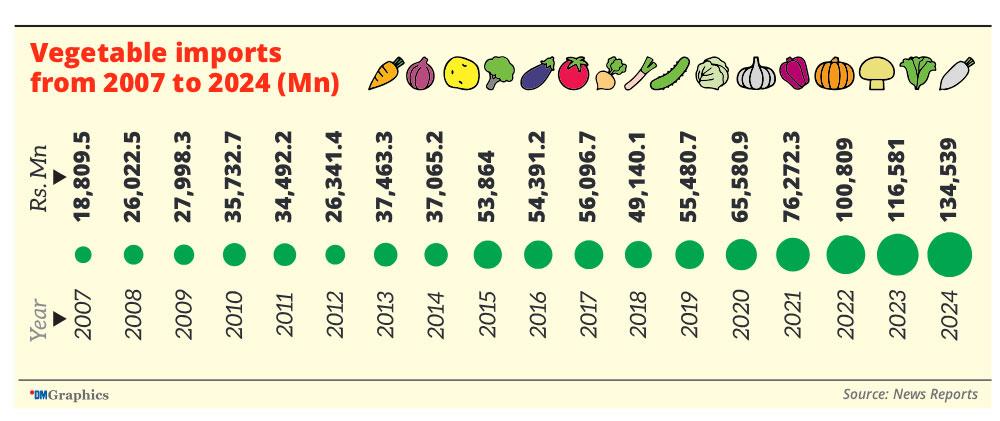
Among the most concerning figures is the country’s expenditure on vegetables, which jumped from Rs. 34.4 billion in 2011 to Rs. 177.6 billion in 2024 — a staggering fivefold increase. These are products that can be easily cultivated within Sri Lanka’s fertile soil and favourable climate conditions.
The import bill for dairy products has also soared, from Rs. 38 billion in 2011 to Rs. 84.6 billion in 2024, while sugar and confectionery imports rose from Rs. 47 billion to Rs. 117 billion during the same period.
Similarly, seafood imports, which could be sourced locally given Sri Lanka’s extensive coastline, have climbed from Rs. 16 billion in 2011 to Rs. 36.5 billion in 2024. Imports of spices, another area where the country has strong local potential, increased from Rs. 1.2 billion to Rs. 34.9 billion.
Overall consumer goods imports reached over Rs. 1 trillion (Rs. 1,045 billion) in 2024, compared to just Rs. 404 billion in 2011, showing a continuous dependence on foreign goods.
Going along with the trend, the latest data for the period from January to August 2025 indicate that the country has spent over Rs. 424 billion on the importation of food and beverages alone.
Of the spendings, Rs. 90 billion was spent on importing vegetables, Rs. 73 billion on sugars and sugar confectionery, Rs. 74 billion on dairy products, Rs. 70 billion on oils and fats, Rs. 27 billion on cereals and milling industry products, Rs. 22 billion on seafood, and Rs. 19 billion on spices.
Commenting on the trend, Professor Wasantha Athukorala, an Economics professor at the University of Peradeniya told Daily Mirror that “This growing import bill reflects structural weaknesses in domestic production, weak policy support for local farmers, and the absence of long-term strategies to boost agriculture and food processing industries.
“Sri Lanka has the land, the labour, and the climate. What we don’t have is a coordinated plan to support our farmers, ensure market access, and reduce dependence on imports,” he argued.
Furthermore, Prof Athukorala pointed out that the importation of items such as vegetables, seafood, and spices — all of which can be cultivated or sourced locally — reflects deep-rooted policy failures and a lack of long-term planning.
“The issue is not that we lack the capacity to produce. It’s that we have failed to create a sustainable system that supports local farmers, ensures market stability, and reduces dependence on imports,” the expert explained.
Instead of spending billions on importing items that can be grown domestically, Sri Lanka should be investing those funds in strengthening the country’s agriculture sector, improving storage and distribution networks, and encouraging farmers through subsidies and guaranteed prices.
If Sri Lanka focused on local cultivation, not only would it reduce import bills, but it would also generate employment, strengthen rural economies, and ensure food security.
In addition to food items, Sri Lanka has also spent heavily on consumer goods this year, including Rs. 211 billion on private vehicle imports, Rs. 125 billion on medicines, and Rs. 55 billion on clothing.
The expert said that while certain imports like medicines and industrial machinery are essential, the country must re-evaluate its import priorities to conserve foreign exchange.
With Sri Lanka still recovering from its worst economic crisis in decades, continuing to spend billions on avoidable imports is seen as a waste of scarce resources. It's high time for the government to take decisive steps to promote domestic production, especially of vegetables and other essential food item in order to build a more resilient and self-sufficient economy.
19 Jun 2026 50 minute ago
19 Jun 2026 54 minute ago
19 Jun 2026 1 hours ago
19 Jun 2026 1 hours ago
19 Jun 2026 1 hours ago







