07 May 2025 - {{hitsCtrl.values.hits}}
By Shabiya Ali Ahlam
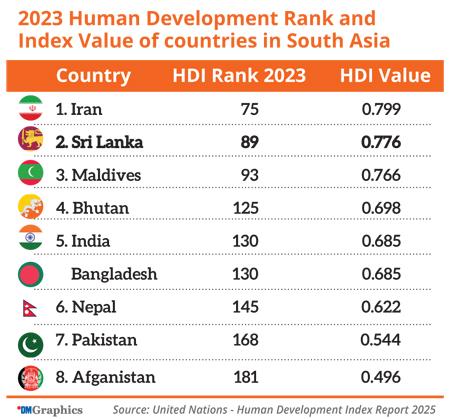 Sri Lanka continues to stand tall in the high human development category. However, latest data by the United Nations shows that the momentum is slowing, with regional peers closing in fast.
The Human Development Report 2025, released by the United Nations Development Programme (UNDP) yesterday, placed Sri Lanka in the 89th rank out of 193 countries. This is down from the 88th position it held in 2022.
The island nation recorded a HDI score of 0.776.
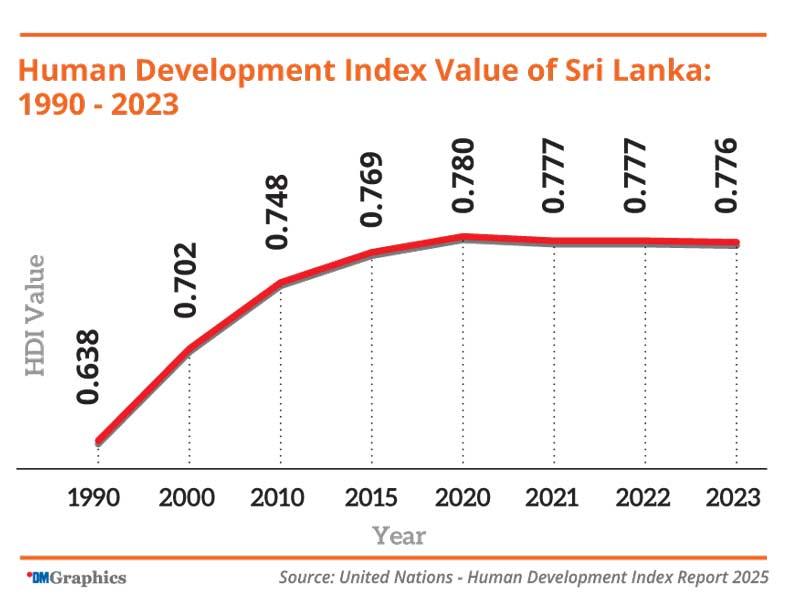
Despite being placed in the ‘high human development’ segment, the report highlights how the country has lost ground, slipping eight ranks since 2015.
The HDI evaluates long-term progress in three basic dimensions of human development; health, education, and income.
The pace of improvement for Sri Lanka has been lukewarm, with its average annual HDI growing from 2010 to 2023 at just 0.28 percent. After reaching a peak HDI value of 0.780 in 2020, the country has seen a marginal but persistent decline, with the index falling to 0.776 in 2023.
Nevertheless, within South Asia, Sri Lanka still outperforms most peers. In the 2025 report the island nation is ranked second only to Iran (75th, 0.799) and ahead of the Maldives (93rd, 0.766), Bhutan (125th), and India and Bangladesh, both ranked 130th with an HDI of 0.685.
However, the gap is narrowing. The Maldives is inching closer, and Sri Lanka’s continued stagnation threatens to undercut its long-held position as a regional leader in human development.
Further analysis shows that from 1990 to 2023, Sri Lanka improved its HDI by 21.6 percent, which is less than the 50 percent gains seen in both South Asia and East Asia and the Pacific over the same period.
While the global landscape has been troubled with crises, the report points to a historic slowdown in progress worldwide, marking the weakest HDI growth in 35 years.
It also warns that, excluding the pandemic years of 2020–2021, global development is now advancing at its slowest pace since 1990.
The report, titled ‘A matter of choice: people and possibilities in the age of Artificial Intelligence’, shows that projections for 2024 suggest that HDI growth has decelerated across every region.
However, South Asia was a bright spot in 2023, recording a 4.8 percent rise in HDI. It recorded the fastest regional growth globally, which helped the region’s average index climb 5.8 percent above pre-pandemic levels.
In contrast, Sri Lanka’s HDI in 2023 remained below its 2020 peak, highlighting the country’s relative underperformance, probably due to it still experiencing the shocks and pains from the 2022 economic crisis.
The gap between countries with Low HDI and Very High HDI continues to widen for the fourth consecutive year – a reversal of earlier trends where inequalities were narrowing.
The challenges for the least developed countries remain acute, aggravated by growing trade tensions, mounting debt burdens, and “jobless industrialisation”.
Despite these headwinds, the report makes a strong case for AI-led development. It urges policymakers to adopt a human-centered approach to technology and notes that the global public is ready for a shift.
“The choices we make in the coming years will define the legacy of this technological transition for human development. With the right policies and focus on people, AI can be a crucial bridge to new knowledge, skills, and ideas that can empower everyone from farmers to small business owners,” said UNDP Human Development Report Office Director Pedro Conceição.
21 Jul 2026 22 minute ago
21 Jul 2026 24 minute ago
21 Jul 2026 2 hours ago
21 Jul 2026 2 hours ago
21 Jul 2026 3 hours ago