22 Apr 2025 - {{hitsCtrl.values.hits}}
But deflationary impulses fading
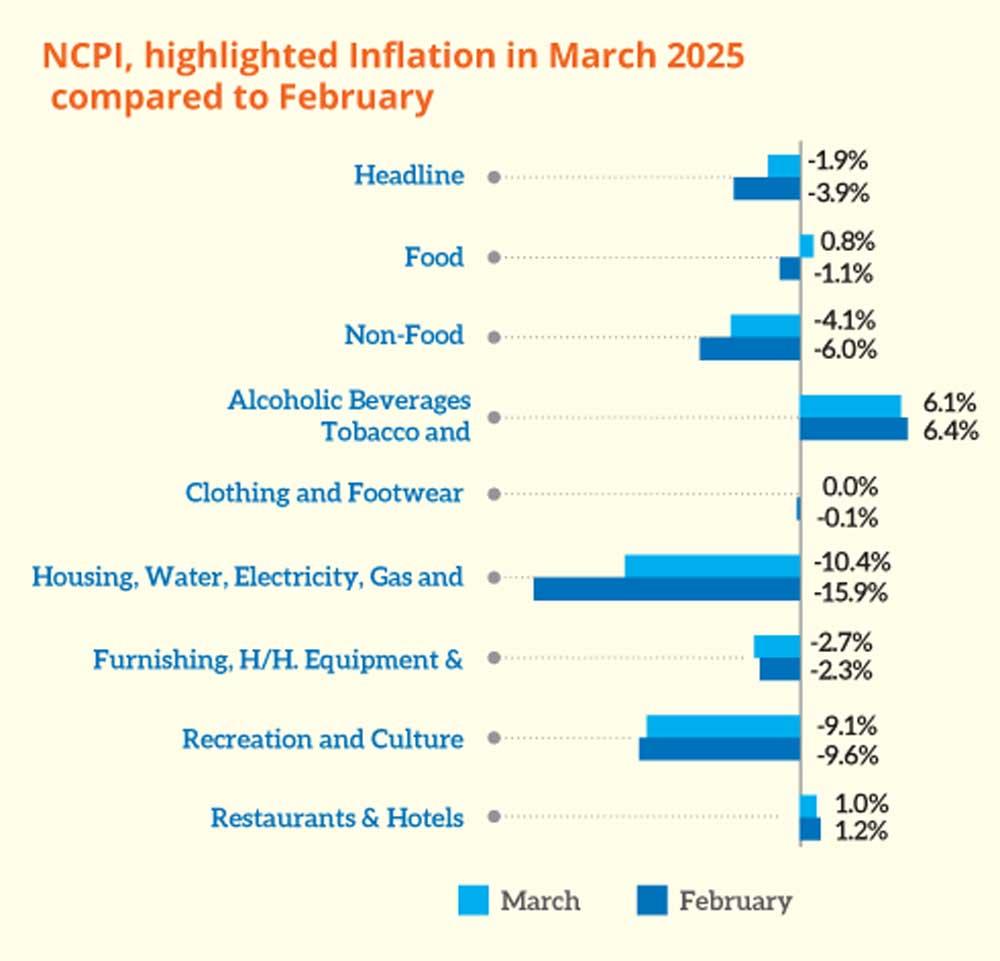
NCPI fell 1.9% in 12 months through March 2025
The national consumer prices continued to fall, albeit at a lesser pace in March, on the back of the decline in food prices as well as the slippage in non-food prices, ahead of the traditional new year.
The consumer prices measured by the National Consumer Price Index (NCPI) fell 1.9 percent in the 12 months through March 2025, slowing from the 3.9 percent decline seen through February.
Meanwhile, the national prices fell 0.1 percent on a monthly basis, at the same pace the prices fell in February over January levels.
March marks the seventh consecutive month in a row the consumer prices have declined.
However, the prices could start rising modestly in a month or two, before converging to the Central Bank’s 5.0 percent target by the year end, as the lower base effect takes hold.
The Central Bank left the interest rates unchanged for the second consecutive time in March, reiterating that it is confident that the current rates are sufficient to bring inflation back up to its desired 5.0 percent level.
The food inflation barely rose by 0.8 percent in March from a year ago but the prices measured on a monthly basis slipped 0.3 percent.
The prices of essential food items such as rice, big onions, eggs, sugar, chicken and the likes fell in March from a month ago, providing some relief to the people ahead of the new year, when usually the prices tend to rise due to the heightened festive demand.
The prices of coconuts, coconut oil and milk powder continued to rise; so were the prices of fresh fruits.
Under the non-food basket, there wasn’t any movement in the prices of power and energy in March, as there weren’t any administered price changes to move the index.
However, the annual non-food prices fell by 4.1 percent while the prices measured on a monthly basis slid 0.1 percent.
Sri Lanka’s current stretch of deflation provided the much-needed relief to the people, who were battered by hyperinflationary conditions in both 2022 and most part of 2023.
21 Jul 2026 24 minute ago
21 Jul 2026 26 minute ago
21 Jul 2026 2 hours ago
21 Jul 2026 2 hours ago
21 Jul 2026 3 hours ago