02 Apr 2025 - {{hitsCtrl.values.hits}}
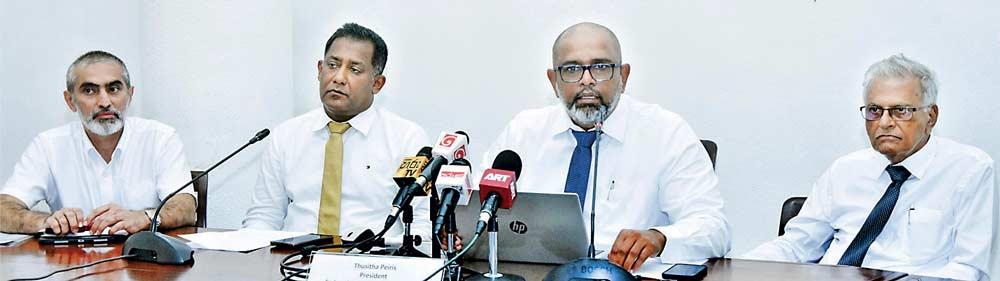 FRED Sri Lanka President Thusitha Peiris speaking to the media while other members of the Federation look on
Pic by Nimalsiri Edirisinghe
By Nishel Fernando
The Federation of Renewable Energy Developers (FRED) Sri Lanka yesterday raised serious concerns about a resurgence of the ‘diesel mafia’, accusing it of systematically moving to cause a natural death to the country’s solar power sector.
They allege that recent actions, including a drastic reduction in feed-in tariffs and the imposition of stringent clauses in Power Purchase Agreements (PPAs), will render the sector uninvestable.
At a press briefing in Colombo, FRED Sri Lanka President Thusitha Peiris asserted that a Ceylon Electricity Board (CEB)-dominated tariff committee, comprised of individuals with vested interests, has decided to reduce feed-in tariffs for solar power plants under 10MW by an unprecedented 25 percent.
He alleged manipulation of the feed-in tariff formula, including distorted cost estimates and interest rates, to justify the lower tariff. Furthermore, the committee has reportedly pegged the profit margin to the Treasury bill rate.
“Why should we undertake the complexities of commissioning and operating power plants when we can achieve comparable returns through investments in government securities?” questioned Riyas Sangani, Founder and CEO of Vidullanka PLC.
The Cabinet of Ministers is currently considering a proposal to approve this unviable tariff reduction, with a decision expected in the coming days.
Compounding the issue, the government introduced detrimental clauses in Standardised Power Purchase Agreements (SPPAs) last year. These include empowering the National System Control Center (NSCS) to curtail power output without compensation or maximum limits, requiring a 2 percent monthly energy output deposit in an escrow account, and demanding unconditional and irrevocable bonds to ensure timely commercial operation.
“The unlimited curtailment clause in the SPPA, which is not factored into the formula, will deter banks from financing new projects,” Peiris warned, attributing these moves to the diesel mafia’s intent to stifle the renewable energy sector.
Sangani highlighted the positive impact of solar power growth, noting the absence of emergency power purchases for the past three years and the improved water levels in reservoirs like Victoria.
“This benefits farmers by ensuring water availability for cultivation. However, the ‘diesel mafia’ may be seeking to eliminate this industry through reduced tariffs and restrictive PPA clauses,” he said.
Small Hydro Power Developers Association Past President Prabath Wickramasinghe estimated that the CEB could incur a Rs. 13-15 billion loss next year due to delays in SPPA approvals for approximately 300MW of projects under the 10MW category. He also highlighted the uncertainty faced by the rooftop solar industry, which holds Rs. 2 billion in stock.
Peiris criticised the government’s handling of the February 9th nationwide power outage, suggesting that officials are providing misleading information.
He pointed to the CEB’s failure to invest in Battery Energy Storage Systems (BESS) as a contributing factor to supply and demand management challenges, particularly on Sundays.
As an immediate solution, Peiris proposed a policy to establish a feed-in tariff for storage. “This would enable solar power plants, both rooftop and ground-mounted, to implement peak shaving by storing energy during the day and releasing it during evening peak demand,” he explained.
He believes the private sector could add 50 to 75MW of battery storage to the national grid within 6 to 9 months, resolving Sunday power supply issues without government investment. He also proposed an all-inclusive feed-in tariff of Rs. 50 for large projects.
FRED warned of a potential industry collapse if the government proceeds with these policies. “The rooftop solar sector, involving thousands of companies and connections, will face widespread bankruptcies, leading to service disruptions and future problems,” he cautioned, urging the government to reconsider the tariff and engage in constructive dialogue.
21 Jul 2026 25 minute ago
21 Jul 2026 27 minute ago
21 Jul 2026 2 hours ago
21 Jul 2026 2 hours ago
21 Jul 2026 3 hours ago