07 Aug 2025 - {{hitsCtrl.values.hits}}
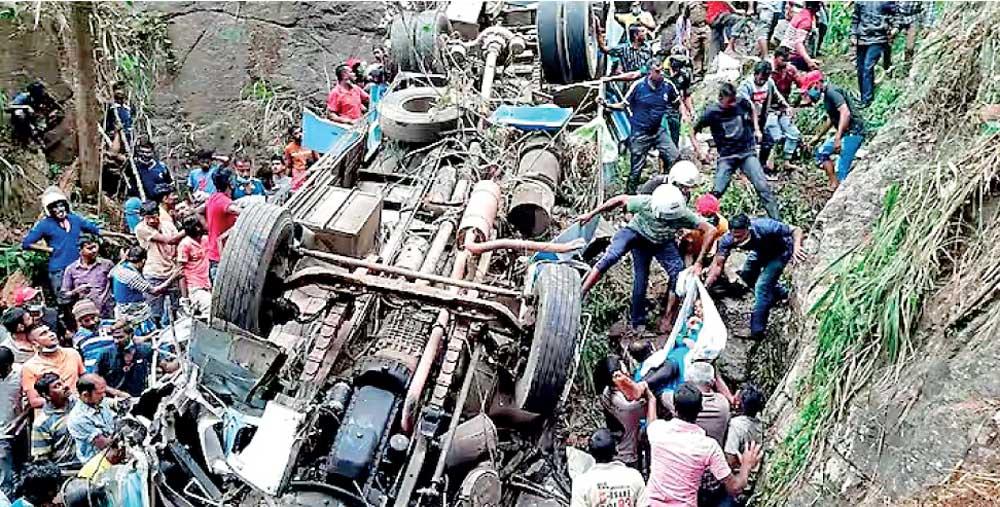
In the SLTB bus accident at Ramboda which killed 21 in May, some reports suggested the driver may have been under the influence of drugs
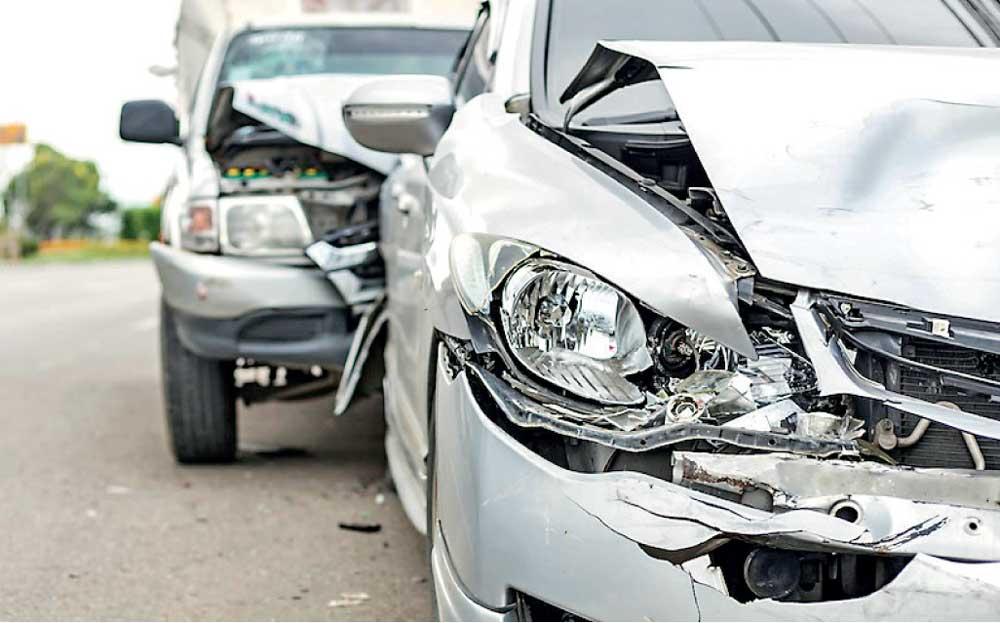
 We have always seen bad accidents in Sri Lanka. That didn’t start yesterday, or last year. Some of them – bus, train, even air crashes – were terrible. But most major accidents occur on the roads, involving motor vehicles, rather than trains and aircraft. In 2024, 2,521 people died in road accidents. We shall therefore confine ourselves to that sphere for the sake of this discussion.
Like crime, accidents have their own pathology. Causes of road accidents are many – driver negligence, pedestrian carelessness, drivers falling asleep or being under the influence of alcohol or narcotics, reckless driving, mechanical failure, driver’s health issues, bad vision, bad weather, bad roads etc. Some of the above – reckless driving, presence of alcohol and narcotics – could be viewed as pathological.
The scene of one accident from the 1980s remains engraved in my memory – passing New Kelani Bridge one morning, I saw the saddest of sights – a topped motorcycle, and an adolescent girl lying lifeless on the road – her head, resting on a fast congealing pool of blood, was strangely flattened. A Rosa private bus parked alongside told me what had happened there – a wheel had gone over the girl’s face after the motorcycle was knocked down.
This was a few years after the private bus system was introduced, bringing in a new dimension of recklessness, rage and its own peculiar pathology into our roads and road transport. I remember a story from another province. This was the time the little Honda Chally motorcycle was fast selling in Sri Lanka. In this case, the parents had decided to buy two challies for their two children (two sons, or son and daughter, I can’t remember). The whole family went out for a leisure ride on their Challies. Both children were knocked down and killed by a speeding private bus.
I have no idea if both parties were negligent or reckless in this case. But, knowing the nature of the beast, it may be correct to assume that the greater part of the blame lies with the bus driver. With very few exceptions, the entire service was run by young toughs (drivers as well as conductors) thrown into cut throat competition with each other and the Sri Lanka Transport Board (SLTB), racing on the road with scant regard to the safety of other road users.
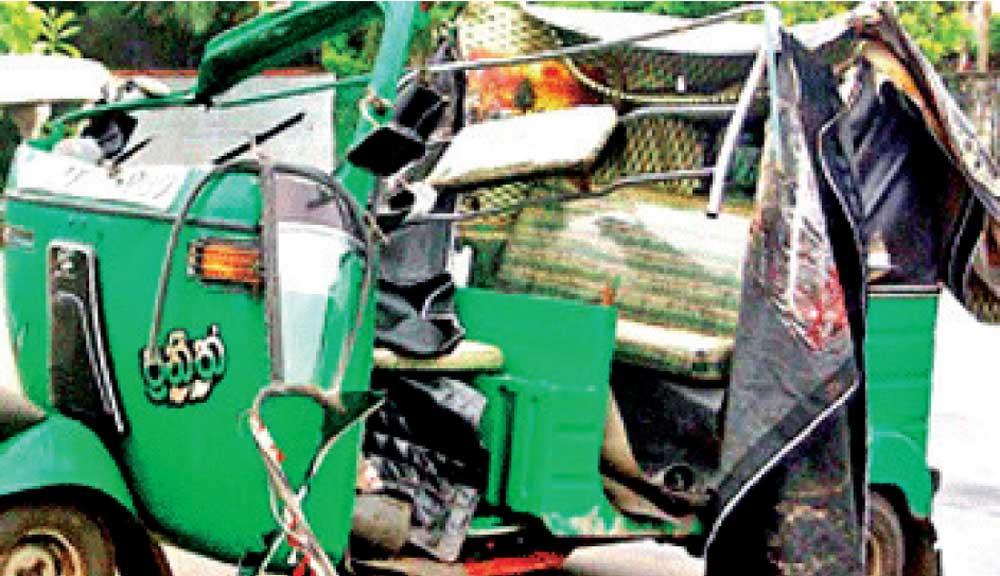
This is not an analysis of the private bus system alone and these two cases are given here examples as a new wave of driver pathology on our roads of which private buses are the biggest and most notorious symbol, followed closely by three wheelers. Pathology is a term associated with disease or crime, and those who willingly drive loaded vehicles recklessly can be placed alongside certain categories of criminals – that’s why drivers sometimes get charged with culpable homicide when their accident victims die.
Hit-and-run is often a pathological road accident category, and it isn’t just the buses (private or state-run) which are responsible. From motorcycles to SUVs, many such cases can be found.
An SLTB bus driver waiting for the light to turn green at a busy intersection ran over a pedestrian who chose to cross the road in front of the bus just as the light turned green. The driver stopped and ran to the nearest police station. It shouldn’t be taken as a case of hit and run because the driver was probably scared of ‘mob justice’ sometimes meted out in such cases, and sought police protection.
Hit and run cases usually have the driver driving his vehicle away from the accident scene, leaving the victim behind. Very often, he vanishes without driving to the nearest police station. Some drivers do just that. We can therefore separate these hit and run cases into two distinct categories – those who surrender to the law after fleeing the accident scene, and those who don’t. It’s the latter category that comes under scrutiny in this column.
Two recent hit-and-run cases which can be termed pathological come to mind. In the first instance, a young woman was run over by a three wheeler in the suburbs of Colombo a few months ago. The three wheeler didn’t stop and has not been identified. The young woman suffered severe pelvic fractures.
If the driver fled fearing the wrath of a crowd, he should have gone to the nearest police station. He fled to escape detection; such behaviour is criminal which makes it a pathological case.
In the second instance, a 15-year-old motorcycle rider hit a woman pedestrian in the southern province. The impact was so severe that one of her legs became amputated. The rider didn’t stop. He fled with the victim’s leg trailing behind him, rode home and buried the evidence in the backyard. If he stopped there, and the victim and her severed leg rushed to a hospital, surgeons could have tried to re-attach the leg.
General lawlessness
If this juvenile rider fled the accident scene to escape possible mob consequences, he should have gone to a police station.
He rode home instead and buried the leg. This raises disturbing questions. Didn’t anyone – family member, neighbour – notice what he was doing? If someone saw it and chose to keep quiet, that complicity speaks volumes about the general lawlessness of Sri Lankan society today.
It should be noted here that not every serious accident is followed by mob justice. But these pervasive fears can permeate a whole society’s psyche. Analysing the above cases, though, one can conclude that it’s an underlying contempt for the law rather than fear of it which makes drivers flee accident scenes after killing or maiming others.
One can take the example of a high-profile politician who reportedly knocked down a motorcycle rider in Rajagiriya and fled without stopping. The rider was severely injured. The politician was named, but never admitted to having caused the accident.
Such powerful figures do not need to fear if the police would mistreat them or seek bribes if they surrender to the police. It’s the same pathological condition which influenced the above-mentioned three-wheeler driver and juvenile bike rider which this politician flee. He feels above the law and has a contempt for it.
My argument is that this ‘accident-related pathology’ is derived from a tradition of politically motivated murders and other crimes which are swept under the carpet and go unpunished. Our information comes from hearsay about these crimes. This works its way into the national psyche – if you aren’t powerful enough to suppress the evidence after a crime, the next best thing is to flee the scene and pretend it didn’t happen.
Finally, if we take the recent mayhem near the General Cemetary (kanatta), Colombo when a tipper-crane ran over several motorcyclists and damaged cars (killing one person and severely injuring six more) this case has a different pathology altogether. Press reports said the driver was under the influence of cannabis. Other points are – the vehicle lost its brakes, and the driver has no heavy vehicle driving license.
All these are different aspects of an ‘accident-related pathology’ which boil down to a contempt of the law and the safety of fellow road users. The owner should have known about the driver’s license, and vehicle maintenance is his responsibility, not the driver’s. As for the cannabis story, it is a common assumption nowadays in serious accident cases. It has not yet been proven yet if this driver was under its influence when the accident happens. We have no reliable data research data yet on narcotics use by Lankan drivers. But many bus drivers are said to addicted to ice (crystal meth) a potent illegal drug. It makes users energetic but can blur their vision. In that sense, it’s worse than cannabis.
But the ‘drug use story’ can be used to nullify other important factors when a serious accident happens, such as mechanical failure of the vehicle and the driver not possessing a driving license. In the SLTB bus accident at Ramboda which killed 21 in May, some reports suggested the driver may have been under the influence of drugs.
But no such evidence was found. An inquiry ruled out mechanical failure. But a survivor said that the bus ‘veered to the left and went off the road when the driver applied the brakes.’
It sounds like a technical issue – the brakes, the steering, the suspension – any of those factors could have failed. Does the SLTB have accident investigators? Does any organisation in Sri Lanka have such professionals? When an air crash happens, expert investigators examine the crash, not the airline’s maintenance engineers. It’s the same with road transport – maintenance crews – mechanics or engineers -- can’t be expected to draw the right conclusions from the wreck of a bus which plunged down a precipice.
Being unable to find the evidence and falling back on easy-to-believe theories such as drug usage too, is part of this pathology.
This writer doesn’t feel safe on our roads any more, and it’s a feeling shared by millions of road users.
09 Jun 2026 3 minute ago
09 Jun 2026 9 minute ago
09 Jun 2026 12 minute ago
09 Jun 2026 17 minute ago
09 Jun 2026 22 minute ago