06 Oct 2016 - {{hitsCtrl.values.hits}}
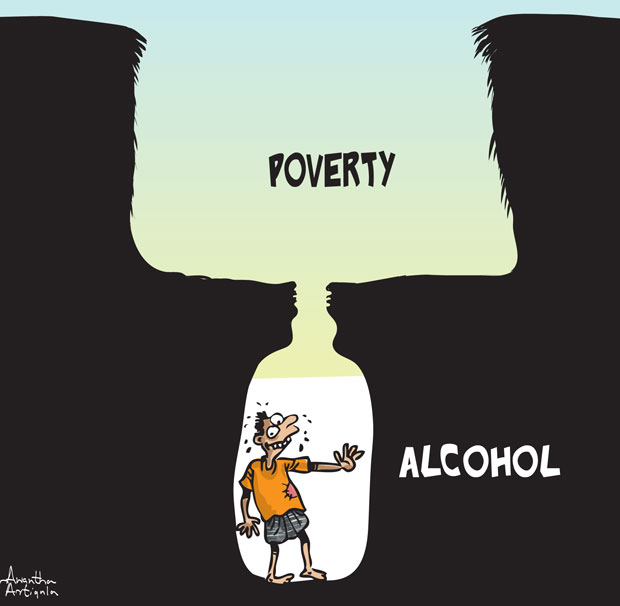
Alcohol is undoubtedly the commonest toxin willingly consumed the world over. In Sri Lanka, alcohol dependence is a major health and social problem. Most medical and social workers are aware of this. Unfortunately, a few speak openly of this grave malady which is destroying our countrymen in the prime of their lives. Consumption of increasing amounts of alcohol over a period of time leads to the development of ‘Alcohol Dependence Syndrome’ characterised by deterioration of physical and mental health, interpersonal relationships, moral and social standards, and the decline of economic status.
Buddhist perception of alcohol
2,560 years ago, the Gautama Buddha realised the evil of alcohol and advised his disciples to abstain from it. In the Kumbha Sutra he preached to Kings Sarvamithra and Kosala, he indicated 48 evils of alcohol consumption.
Abstaining from consuming alcohol and other intoxicants is the fifth precept of Buddhism. Regrettably, most Buddhist males ignore this basic precept.
History of alcohol dependence in Sri Lanka
All evidence indicates that Sri Lankans did not consume alcohol for many centuries. In 1505, following the Portuguese invasion of Sri Lanka, they promoted the drinking habit among our countrymen. In 1658, subsequent to the Dutch invasion, there was further promotion of it. In 1796, the British liberally issued liquor licences to open up taverns all over the country. They increased State coffers by tax collections and encouraged the drinking habit via the Toddy Act of 1912.
Alcohol consumption rates in Sri Lanka
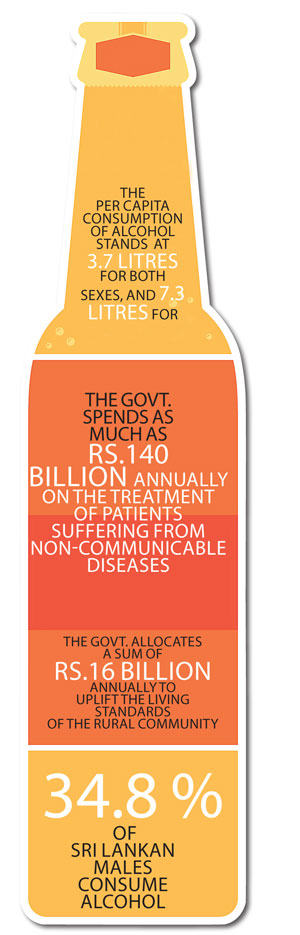
Sri Lanka has a high consumption rate for alcohol. According to the ‘WHO Global alcohol trends’ in 2014, the per capita consumption of alcohol stood at 3.7 litres for both sexes, and 7.3 litres for males only. These figures account for use of licit or recorded alcohol only. However, it is well-known that over 55% of alcohol, consumed by the Sri Lankan males, is unrecorded or illicit alcohol or Kassippu (8.9 litres). The total per capita consumption of alcohol among males in Sri Lanka will therefore amount to 16 .2 litres. This is the highest among the SAARC member states.
A survey done by the Health Ministry in 2015 showed 34.8 % of Sri Lankan males consumed alcohol. However, the NATA (National Alcohol and Tobacco Authority) statement in 2016 indicates 40% of Sri Lankan males consume alcohol. Fortunately, the prevalence among Sri Lankan females is only 0.5%, and mostly involves the upcountry tea estate workers.
Alcohol, economy and health
According to the NATA chairman, the government spends as much as Rs.140 billion (editorial - The Island August 6, 2016) annually on the treatment of patients suffering from non-communicable diseases, primarily due to alcohol and victims of road traffic accidents from drunk driving. He debunks the theory of the alcohol industry that they increase the government coffers, as the revenue from taxes on alcohol adds up to only Rs.106 billion.
According to President Sirisena, the government allocates a sum of Rs.16 billion annually to uplift the living standards of the rural community. However, he states that the expenditure on alcohol is more than double that amount. This is not surprising as each Gramasevaka division in the country annually spends a whopping Rs.10 million and Rs.7.5 million on alcohol and cigarettes respectively. This confirms the horrendous revelation that the tax payers’ money is completely wasted in the name of poverty alleviation programmes such as ‘Samurdhi and Divineguma’
It is estimated that about 65 people in Sri Lanka die due to alcohol related deaths daily. This amounts to over 23,000 deaths annually. The leading cause of death among Sri Lankans of all ages is heart diseases. However, the leading cause of death among Sri Lankan males between the ages 25 to 45 is alcohol related diseases.
Drinking culture
Today, drinking alcohol has become a national pastime. This terrible tradition of drinking has unfortunately penetrated into and intricately infiltrated every strata of our society.
The rich consume whisky while the poor resort to Kassippu. In our culture, every event is made into an occasion to drink. In rural areas, alcohol is consumed at paddy thrashing or harvesting events and when young girls reach menarche.
At funeral houses, alcohol is provided to card players who guard the corpse throughout the night, and even grave diggers for that matter. This awful practice must end.
Why do Sri Lankans drink?
A survey done at the Sri Jayewardenepura General Hospital in the author’s former unit titled ‘Alcohol consumption - causes, quantity and consequences’ in 2012, uncovered that alcohol was the panacea for everything. Alcohol was consumed with friends for recreation, insomnia, energy, exhaustion, joy or sorrow, heat or cold, courage or fear and sometimes for no reason at all.
It was also revealed that the majority (75%) had high consumption rates of more than 250m1 of hard liquor per day; far ahead of permitted levels. Arrack was the major binge (85%), followed by beer (50%), and illicit brew (46%). The majority consumed a mix of hard liquor and beverages.
Toxic effects of alcohol
Consumption of alcohol over a period of time leads to physical and psychological dependence and the development of tolerance. It is also addictive and psycho-active like heroin. However, unlike heroin which is taboo in society, alcohol is widely and socially accepted. This is all possible due to the powerful alcohol industry which is uncontrollable. In most countries, the alcohol industry is financially-strong, politically-powerful and able to lobby media, politicians and governments. In this context, we must congratulate our President Maithripala Sirisena for his personal interest taken in setting up the Presidential Task Force island-wide for the control of alcohol, tobacco and other dangerous drugs.
Consequences in Sri Lanka
Alcohol consumption is a major health and social problem in Sri Lanka. The magnitude of the problem is reflected upon; rising incidence of hospital admissions due to alcohol related diseases; rising incidence of road traffic accidents, violence and homicide; rising incidence of sexual abuse and violence against women and children; deterioration of moral and spiritual values and standards.
diseases
Alcohol and cirrhosis - Consumption of alcohol over a period of time results in fatty changes of the liver, which later transforms into cirrhosis with liver cell degeneration and accumulation of fluid in the abdomen, followed by degeneration of the brain.
Sri Lanka has the second highest incidence of cirrhosis in the world - 55/100,000 population. We are second only to Moldova, a nation of Vodka drinkers.
Alcohol and carcinomas - Alcohol consumption is directly associated with carcinoma of the stomach, oesophagus and carcinoma of the liver – hepatoma.
Alcohol and the heart - Alcohol consumption causes degeneration of the heart muscle, and heart failure causing alcohol cardiomyopathy. High blood pressure and increased cholesterol are consequences of high alcohol consumption.
Alcohol and the gastrointestinal tract - Acute and chronic gastritis and the formation of gastric-ulcers and acute and chronic pancreatitis with endless abdominal pain as well as immense suffering are consequences of regular boozing.
Alcohol and the nervous system - There is progressive degeneration of the brain leading to deterioration of intellectual functions and social behaviour, resulting in dementia. Degeneration of the peripheral nerves results in unsteady gait and increasing tendency to fall and sustain head injuries.
Alcohol and psychiatric problems
Alcohol abuse may cause many psychiatric disorders such as depression, pathological jealousy, increased tendency to epileptic fits and suicide.
Alcohol and suicide - Approximately 10 Sri Lankans die daily by committing suicide, while another 11 unsuccessful attempts are reported on the same day. Annually, about 3,500 Sri Lankan deaths result from suicide. In 1996 and 2003, Sri Lanka recorded the highest suicide rate in the world. However, in 2015, our suicide rate is 28.8 per 100,000 people. We hold the fourth rank in global suicide rates, below Guyana (South America) and North and South Korea, which rank 2 and 31 respectively. Among Sri Lankan suicides, 48 per cent are related to alcohol consumption; unlike in the West, where majority of suicides are related to depression.
Excessive consumption of alcohol leads to degeneration of the testicles, and impotence, thereby resulting in reduced fertility. Impotence often leads to alcoholics being jealous of their wives, suspecting them of engaging in extra marital affairs. This often leads to marital disharmony.
Fetal alcohol syndrome- No level of alcohol can be considered safe in pregnancy.
Consumption of alcohol between the 4th and 10th weeks of pregnancy can produce an abnormal baby with a small head, small nose and small eyes, with low birth weight and mental retardation. Babies born with this condition have been reported from the North Western Province (Chilaw) and the upcountry estate sector where women are known to consume alcohol.
Alcohol and road traffic accidents
Around seven people die daily on the roads in Sri Lanka. In 2015, a staggering 2,801 Sri Lankans died of road traffic accidents.
The majority of these miserable killings have been attributed to excessive speed, over confidence, wrong judgments, fatigue and drowsiness under the influence of alcohol. Traumatic injuries, violence and homicide - Consumption of alcohol, especially binge drinking, is associated with the development of ‘Dutch courage.’ This leads many alcoholics to engage in violent behaviour and commit crimes they would never had attempted in a sober state.
Alcohol and violence against women and children
Consequences of the breadwinner being addicted to alcohol is indeed disastrous for the entire household. The end results are unending quarrels between the parents, disharmony in the home, abject poverty, and a very gloomy home environment for the innocent children. Children from such environments often show poor social adaptability in adult life.
More often than not, we hear and read tragic stories from rural areas where husbands come home drunk, find little or no food prepared due to dire poverty and axing their wives to death in drunken frenzies.
Furthermore, in many Sri Lankan families, women obtain employment in the Middle East to improve their economic state and build their own homes.
In many instances, the mother’s absence leaves the doors wide open for drunken husbands and their boozing friends to sexually abuse young children during their binges.
Deterioration of moral and spiritual standards - To indulge in intoxicating drinks is to deteriorate through all stages of morality, concentration and wisdom.
As Ven. Bhikkhu Bodhi quotes in ‘Discipline of Sobriety’ in the Island Newspaper of August 17, 2016, the use of alcohol blunts the shame and moral dread, and thus leads almost inevitably to a breach of other precepts.
One addicted to liquor will have little hesitation to lie or steal, will lose all sense of sexual decency and may easily be provoked even to murder. Alcoholism is indeed a costly burden on our entire society.
Reducing the burden of alcohol dependence
1. Reducing the availability and accessibility of alcohol. This has been shown to reduce the consumption and consequences of alcohol. The direct association between ‘demand and supply’ is well-known.
Reducing the number of alcohol-selling outlets by shutting down all liquor stores situated within 500 metres of schools and places of worship; Cancelling all licenses issued to supermarkets; Prohibiting the sale of alcohol at all liquor outlets after 9.00 p.m.; Prohibiting alcohol consumption at hotels, restaurants and bars after 11.00 p.m.; Discontinuing the issuance of licenses for the establishment of new liquor sales outlets; Establishing short prohibitive periods of sales of alcohol during periods of increased alcohol consumption (Example: Easter, Christmas and New Year).; Strictly enforcing all policies and recommendations of NATA and the Presidential Task Force for the control of alcohol, tobacco and drugs.
2. For these programmes to be successful, the work should be time targeted, implemented to the letter and evaluated at regular intervals.
3. Strictly enforce all existing laws related to alcohol consumption and while driving, consumption at public and government offices.
4. Education and persuasion - This is possibly the most popular approach practis0ed at present to prevent alcohol intake. For this to be effective, target groups should be selected from schools, universities, low-income groups and urban slumbers.
For any programme designed to control alcoholism in Sri Lanka to be sustainable and effective, it is essential to mobilise all stakeholders to work as a team.
This should include NATA and the Presidential Task Force teams as well as Customs, the Excise Department, police, religious dignitaries, voluntary societies, NGOs, medical and social support groups and the concerned public. If the above can be achieved within a given time frame, we could rid Sri Lanka and save our countrymen from the scourge of alcohol dependence.
09 Jun 2026 4 minute ago
09 Jun 2026 7 minute ago
09 Jun 2026 29 minute ago
09 Jun 2026 1 hours ago
09 Jun 2026 1 hours ago