20 Jun 2025 - {{hitsCtrl.values.hits}}
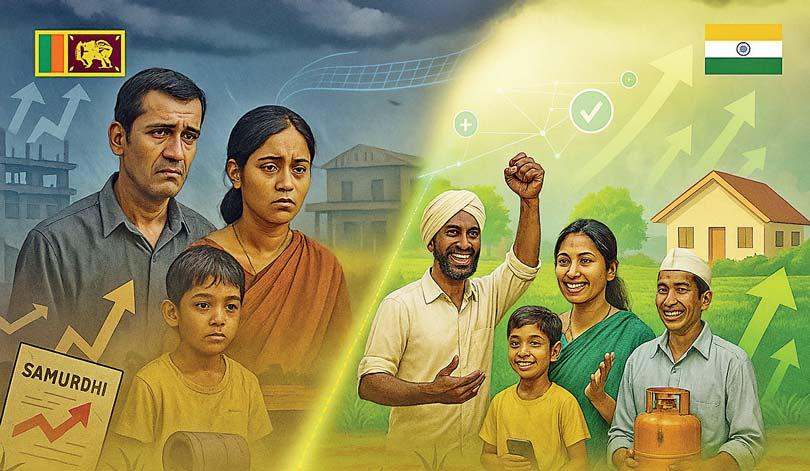
Poverty alleviation presents a critical global challenge, particularly in South Asia. While India has achieved remarkable success in reducing extreme poverty through strategic, digitally-driven initiatives, Sri Lanka faces a contrasting reality. Its 2022 economic crisis plunged a third of its population into poverty or vulnerability, necessitating urgent, data-backed policy reforms.
Poverty alleviation has become a challenge in the world, and South Asia, in particular, is no exception. For Sri Lanka, it has become a novel challenge following the economic crisis. Despite its previous achievement, more and more people slipped into poverty after the 2022 economic crisis leaving multiple challenges for policy makers in elevating the country’s socio-economic development.
According to the World Bank’s country report, the poverty rate was 24.5 percent (at US$3.65 per person per day) in 2024.
Although poverty declined marginally during the year, it remains nearly double what it was in 2019 (11.3 percent), the World Bank said.
The country is now on a growth path after the crisis. Macro-economic fundamentals are in place. Yet, the World Bank says, household incomes are well below pre-crisis levels, resulting in elevated poverty and food insecurity. Worse, vulnerability has also increased, with a third of Sri Lankans living in poverty or one shock away from falling back into it.
Poverty triggers food insecurity which, in turn, fuels malnutrition. The World Bank says malnutrition increased in 2024 posing concerns over potential long-term impacts on human capital formation and intergenerational poverty transmission.
Food prices more than doubled between 2021 and 2024. Households changed their diets, reducing the consumption of nutritious food, contributing to an increase in malnutrition from 12.2 to 17 percent (underweight among children under 5) and from 7.4 to 10.5 percent (stunting among children under 5) between 2021 and 2024, the report said.
It is now incumbent upon the government to work out developed plans to address poverty. In fact, it should feature the main policy-agenda of the government. It should always be a programme interlinked with the country’s national economic development drive. In other words, the government should ensure the trickle down benefits of national economic development. A scientific poverty alleviation programme bears fruit for sure.
Sri Lanka looks at the experience of other countries in the region for insights. In the region, India’s extreme poverty rate dropped to 5.3 per cent in 2022-23 from 27.1 percent in 2011-12, according to the latest estimates released by the World Bank.
The decline amounts to 269 million people moving above the international poverty threshold over an 11-year period, according to the World Bank.
The number of individuals classified as living in extreme poverty fell from 344.47 million in 2011-12 to 75.24 million in 2022-23. The assessment is based on the $3.00 per day poverty line (in 2021 purchasing power parity terms).
The data indicates that five states—Uttar Pradesh, Maharashtra, Bihar, West Bengal, and Madhya Pradesh—accounted for 65 per cent of India’s extreme poor in 2011-12. These same states contributed to two-thirds of the overall reduction in poverty by 2022-23.
According to the World Bank, rural extreme poverty dropped from 18.4 per cent to 2.8 percent during the period, while urban extreme poverty decreased from 10.7 per cent to 1.1 per cent.
At the earlier $2.15 per day poverty line (based on 2017 prices), the extreme poverty rate was recorded at 2.3 per cent in 2022, down from 16.2 per cent in 2011-12. In terms of absolute numbers, those living below this line declined from 205.93 million in 2011 to 33.66 million in 2022.
The World Bank data also showed progress in multidimensional poverty.
The Multidimensional Poverty Index (MPI) was at 53.8 per cent in 2005-06. It fell to 16.4 per cent in 2019-21 and further to 15.5 per cent in 2022-23.
Government programmes mentioned in the context of poverty reduction include PM Awas Yojana, PM Ujjwala Yojana, Jan Dhan Yojana, and Ayushman Bharat.
These initiatives cover sectors such as housing, clean cooking fuel, financial inclusion, and healthcare access. Systems like Direct Benefit Transfer (DBT), digital services expansion, and rural infrastructure development have also been cited as mechanisms enabling more targeted delivery of benefits.
In Sri Lanka, poverty alleviation was treated as a welfare programme in the past. Like, in the rest of the world where poverty alleviation was a success story, it cannot be considered a welfare programme merely.
Actually, it is central to national recovery and economic competitiveness. The country needs a 21st-century poverty agenda that integrates data, digital tools, inclusive planning, and evidence-based policy.
With fiscal reforms now underway and macroeconomic indicators stabilizing, the time is ripe for a pro-poor policy approach .
As for India’s case, it was not driven by economic growth alone. Instead, it relied on a multi-pronged strategy, with robust state-led initiatives supported by digital infrastructure. For example, PM Jan Dhan Yojana, integrated over 500 million individuals into the formal financial system. This provided the foundation for Direct Benefit Transfers (DBTs), ensuring government support reached intended beneficiaries without leakages. Once such a system is implemented, it reduces corruption and wastages.
Secondly, PM Ujjwala Yojana, which provided free LPG connections to over 100 million poor households, replacing traditional biomass cooking that posed serious health hazards, especially to women.
In Sri Lanka, the rising cost of cooking gas is an issue for poor families. During the crisis, a lot of people reverted to firewood. Pro-poor energy access is an important element to be considered in poverty alleviation.
In India, Ayushman Bharat programme, offers up to US $ 6,000 in free health insurance per family per year for secondary and tertiary care.
It has shielded millions from catastrophic health expenditures that often drag families into poverty. In Sri Lanka, healthcare is free, but a lot of families resort to private medication.
Now, in Sri Lanka, the government has undertaken stabilization reforms under IMF guidance. President Anura Kumara Dissanayake said recently that his government would ensure that the marginalized are looked after well.
The main welfare programme, Samurdhi, has been criticized for its inefficiency, poor targeting, and politicisation. Despite it being in operation for more than two decades, poverty is still an issue in the country. Sri Lanka also lacks a digital infrastructure that links welfare delivery to real-time data. India’s Aadhaar-enabled architecture has now become the bedrock for targeted subsidies, health access, and pension payments.
Sri Lanka has now sought India’s help in the development of digital infrastructure. Sri Lanka, or the government, for that matter, should show the resolve.
On the other hand, in poverty alleviation, South Asia is grappling with extreme climate events that involve economic hosts.
This poses yet another challenge in poverty alleviation since climate events hinder economic activities that involve the poor in main, such as agriculture and livestock keeping.
South Asia is one of the most vulnerable regions to climate shocks. The region is living through a “new climate normal” in which intensifying heat waves, cyclones, droughts, and floods are testing the limits of government, businesses, and citizens to adapt.
More than half of all South Asians, or 750 million people in the 8 countries — Afghanistan, Bangladesh, Bhutan, India, Maldives, Nepal, Pakistan, and Sri Lanka — were affected by one or more climate-related disasters in the last two decades.
The changing climate could sharply diminish living conditions for up to 800 million people in a region that already has some of the world’s poorest and most vulnerable populations, according to the World Bank.
The development of climate –smart solutions is also a matter to be incorporated into poverty alleviation programmes in the future.
09 Jun 2026 2 minute ago
09 Jun 2026 5 minute ago
09 Jun 2026 11 minute ago
09 Jun 2026 14 minute ago
09 Jun 2026 19 minute ago