17 Jun 2025 - {{hitsCtrl.values.hits}}
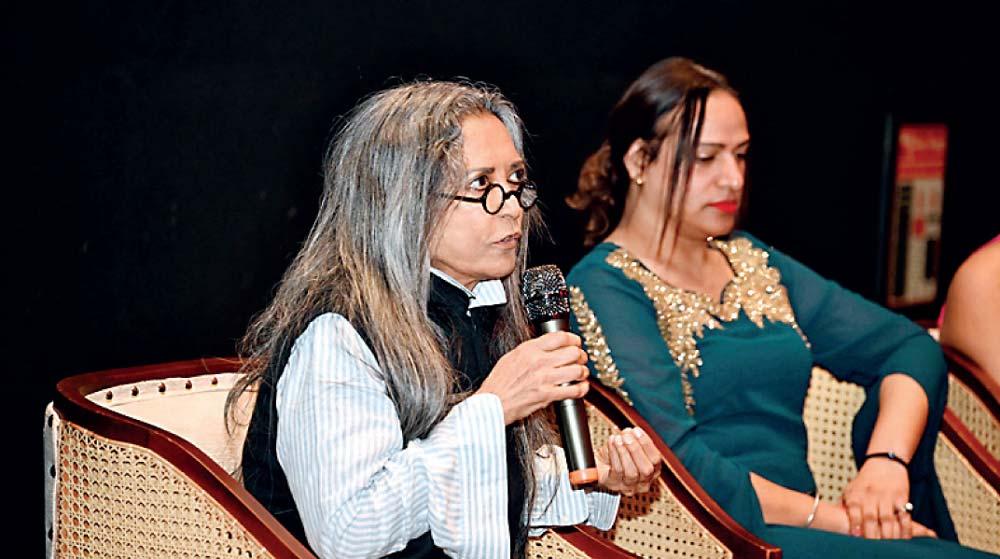
Filmmaker Deepa Mehta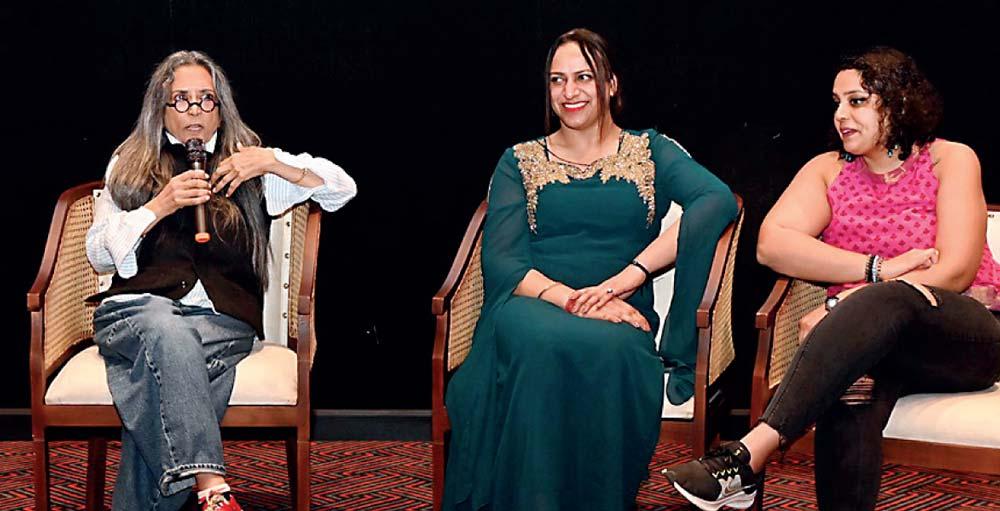
With her actors
 In celebration of the storytelling and films of Oscar-nominated director and producer Deepa Mehta, several of her works, including I Am Sirat and Funny Boy, were screened in Sri Lanka recently.
The journey of Sirat, a transgender woman navigating the complexities of living two lives — one as a son bound by familial responsibilities and the other as her true self — is the focus of the documentary: I Am Sirat. Directed by Mehta in collaboration with Sirat Taneja, who also plays the lead, the film was screened at Scope Cinemas, Havelock City Mall, on May 30, in partnership with the National Film Corporation.
Shot entirely on smart phones, the feature is celebrated for its raw and unfiltered portrayal of Sirat’s reality. Born as
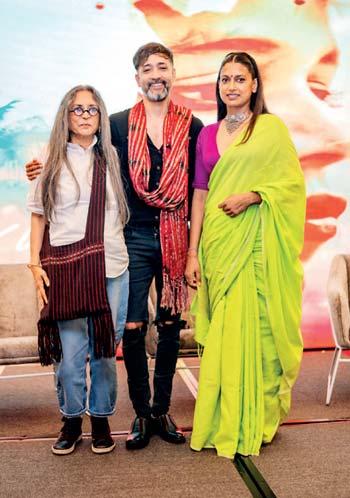 |
| With Brandon Ingram |
Aman, a male in New Delhi, Sirat is compelled to live a life that does not align with her identity due to the expectations placed on her by her mother, extended family, and her sister’s in-laws. However, away from the confines of home and in the company of friends and colleagues, Sirat is free to express herself as she truly is. I Am Sirat presents a powerful narrative about discovering and embracing one’s identity regardless of social constraints. The film has been screened globally and was shot using three phone cameras.
The screening was followed by a master class where Mehta and Taneja shared insights into the inspiration behind the film and the technical challenges they faced during production. Reflecting on her love for this unique project, which stands apart from her previous films, Mehta said: “The reason I love this film is because it has such a positive response to all the problems that we might have. Her (Sirat’s) strength and her ability to think and laugh and ponder about her own life and come out triumphant, for me, is such a positive view of life. It always gives me confidence.”
Film entirely unscripted
Responding to a question from the audience, Mehta explained that the film was entirely unscripted. “There was no script; we just went with it. I knew Sirat’s story – the dilemma of being accepted by her mother, and the reality of her life living with the mother as a son. So that drew the story: what is her life with her mother, what is her life at work, and what is her life with friends,” she said.
Taneja shared that the film was born from a personal need to create something, which is not necessarily a movie, but a means to show her mother what her life was really like. “Filming this movie was scary. I was fearful as to how it would turn out, but Deepa assured me that I could do it because I was good at making Instagram reels too. I was mainly worried because there were no retakes. But it all worked out,” she remarked.
She added: “I have received a lot of positive responses from everyone and I thank everyone for it. What I should say is that you need to have the courage to accept yourself, because if you accept yourself, then society will follow.”
Meanwhile, Funny Boy was screened on June 1, not just as a celebration of the film itself, but also as a poignant remembrance of significant events closely tied to its themes: passing of the month marking 16 years since the end of the civil war, the anniversary of the burning of the Jaffna Library, and the month of Pride.
Funny Boy, based on the acclaimed novel by Shyam Selvadurai, follows Arjie’s journey of sexual awakening from a young boy to a teenager who falls in love with a male classmate. The story unfolds against the backdrop of mounting political tensions between the Sinhalese and Tamils in the years leading up to the 1983 uprisings.
During the discussion following the screening, Brandon Ingram, who plays the teenage Arjie, shared that acting in the film felt like stepping into a time machine, allowing him to experience the ethnic tensions that occurred before he was born. “This was very special and very important because this is our story. I think it’s very important to remember, and that is what this movie did for me: it helped me remember,” he remarked.
He went on to say that one of the most personal challenges in playing Arjie was revisiting his own teenage years. “As a gay man, it was challenging because I had to reconnect with my 17-year-old self, someone who had no idea what he was going through at the time, and probably had no one to speak to either. It brought a lot of emotions to the surface. But once I got through the hard part of reliving it, it became healing. It helped me make peace with a lot of things I thought I had already dealt with, but hadn’t. It was very beautiful. I loved it, and I would do it all over again,” he said.
Nimmi Harasgama, who plays Arjie’s mother, noted that acting in the film felt surreal, especially since she had personally witnessed the 1983 riots and had family members affected by it. “My father is Sinhalese and my mother is Tamil. During the riots, all of my mother’s relatives hid in our rented flat. I think I brought those feelings into the film without even realising it. And I think I played my mother who was a Colombo Tamil. So this film is very close to me,” she shared.
Harasgama further said that she had read the novel in the 1990s and had always dreamed of being part of the film. “My dream was to be directed by Deepa. The experience, from the very beginning, has been one of the best experiences of my life. For Deepa, it’s all about being as authentic as possible in your role, and hopefully we managed to do that,” she said.
Exploring intolerance
Mehta noted that the film highlights how quick people are to judge those whose sexuality or religion they do not understand. “The intolerance of people is something I’ve always wanted to explore,” she added.
Speaking of her experience filming in Sri Lanka, Mehta said, “I really love Colombo. There’s something about the city that is fascinating. I feel at home here, which is strange. The people I’ve met, the locations we’ve visited, the houses we filmed in, and the talent I’ve worked with have all been quite miraculous. I’ve done three films in and around this city, and that’s pretty unusual. All three films have been extremely satisfying. Since Funny Boy belongs to Shyam Selvadurai, I was really happy that the novel – which is semi-autobiographical – came to life in this city,” she observed.
David Hamilton, the film’s producer, spoke about the richness of Sri Lanka’s locations, noting that the three films were shot across 118 different locations in Colombo.
Errol Kelly, the production designer, also highlighted the colonial-era streets and beautiful houses of Colombo. He spoke about the creative challenge of taking certain locations and transforming them to reflect different time periods throughout the decades.
09 Jun 2026 6 minute ago
09 Jun 2026 2 hours ago
08 Jun 2026 08 Jun 2026
08 Jun 2026 08 Jun 2026
08 Jun 2026 08 Jun 2026