04 Feb 2017 - {{hitsCtrl.values.hits}}
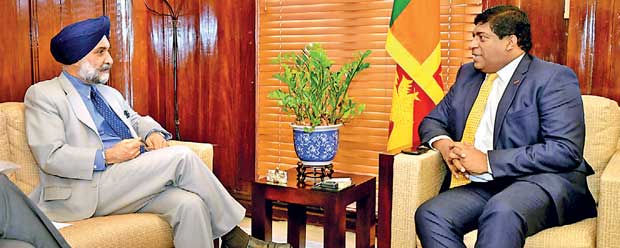
The Indian High Commissioner in Sri Lanka this week had said hopes Sri Lanka and India to sign the proposed trade pact without further delay, in order to strengthen bilateral ties between the two countries, a Finance Ministry communiqué said.
“Indian High Commissioner Taranjit Singh Sandhu told the Finance Minister during the meeting that further strengthening the bilateral ties between India and Sri Lanka are of paramount importance for both countries. He said India expects both countries will be able to sign the proposed free trade agreement without further delay,” it said.
Sandhu, the newly appointed High Commissioner said that the signing of the proposed trade pact between India and Sri Lanka would empower the ongoing development activities in the island.
“The High Commissioner said that the proposed free trade agreement will bring a lot of privileges to Sri Lanka and said that his country has drawn attention to further diversify the existing Indian projects in the island,” the Finance Ministry stated.
Responding to the Indian High Commissioner, Finance Minister Ravi Karunanayake said that the assistance given by neighbouring India is highly appreciated by Sri Lankans.
According to the communiqué, the Minister further said that the international community including world’s powerful countries have agreed to assist Sri Lanka in its future forward march in respect of the transparent foreign policy of President Maithripala Sirisena and Prime Minister Ranil Wickremesinghe.
Sri Lanka’s foreign direct investments have consecutively fallen since the current government came into office two years ago.
Now the government is negotiating Free Trade Agreements (FTA) with Singapore and China, while half a dozen more are planned, calling trade Sri Lanka’s only option.
The Indian trade pact, titled the Economic and Technology Cooperative Agreement (ETCA), is an expansion of the Indo-Lanka FTA to include trade in services and investment, and is a revival of the controversial Comprehensive Economic Partnership Agreement (CEPA). Despite government officials’ claims that ETCA does not include the exchange of natural persons as CEPA did, ETCA has also run into similar levels of public resistance due to the government’s reluctance to share details about the trade pact.
Indian media reports had last month said that the Indian government is not willing to allow Sri Lanka to remove limitations placed on key export products in entering India through the Free Trade Agreement, a condition upon which many supporters of ETCA in Sri Lanka are backing the deal.
Institute of Policy Studies Deputy Director Dr. Dushni Weerakoon last week said that Sri Lanka is unlikely to experience much investments through pacts with India or Singapore, but that the Chinese deal might be different since the Chinese government is able to direct actions of Chinese companies.
09 Jun 2026 10 minute ago
09 Jun 2026 30 minute ago
09 Jun 2026 38 minute ago
09 Jun 2026 49 minute ago
09 Jun 2026 53 minute ago