Reply To:
Name - Reply Comment
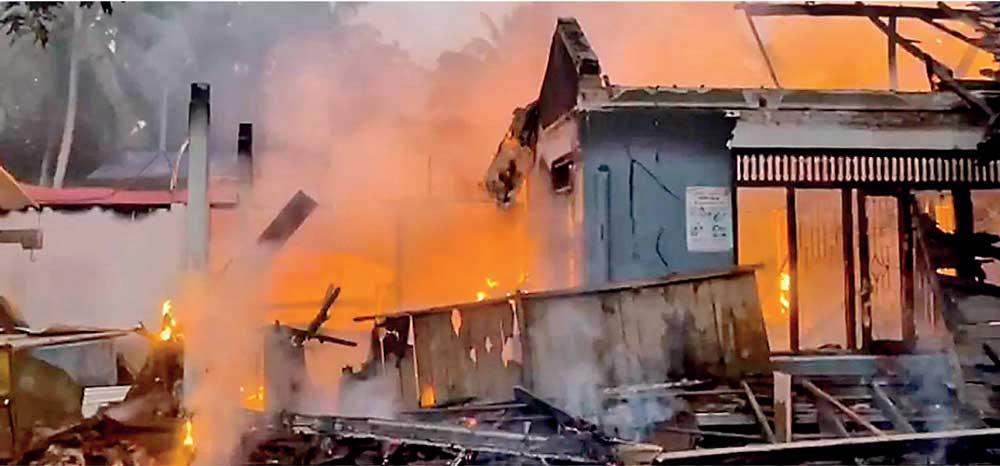
A devastating fire that gutted the Maupiya Sewana care home in Batagoda, Anguruwathota
 Whenever a child is born into a Sri Lankan family, everything changes. Parents, grandparents, relatives and neighbours gather around. Money is found, time is given, and every possible effort is made to protect that newborn life. We worry about the child’s food, health, education and future. We build a circle of protection around the beginning of life.
Yet, as a rheumatologist working in the busy corridors of our government hospital system, I see another side of life every day. I see what happens at the other end of the human journey. I see elderly men and women arriving with painful joints, weak muscles, poor eyesight, unsteady walking, loneliness and fear. And I am forced to ask a painful question: why do we protect the beginning of life with such devotion, but allow its final years to become so unsafe?
Sri Lanka is changing. Our families are changing. Our elderly are living longer, but many are also living alone, physically fragile, and poorly protected. Recent tragedies have shown us that elderly safety has become a matter of life and death.
Not long ago, a fire broke out in an elders’ home in Sri Lanka, killing more than 12 senior citizens. These elderly people did not die because no one cared about them. They died because, when danger came, they could not escape. In the middle of the night, weak limbs, painful knees, stiff backs, poor vision and slow reactions turned a fire into a death trap. For a young person, running out of a burning building may be instinctive. For an elderly person with arthritis, poor balance or disability, it may simply be impossible.
Some time back, the country was shaken again by the murder of an elderly woman inside her home. The most heartbreaking detail was not only the crime itself, but the fact that her death went unnoticed for days. She had lived alone, died alone, and her body was discovered inside a brief case too late.
These incidents are not just isolated tragedies. They are warnings. They reveal a deeper failure in how we care for and protect our ageing population.
The newly released 2024 National Census gives us a clearer picture of this crisis. Sri Lanka is now an ageing nation. Around 18% of our population is aged 60 years or above. That means nearly one in five Sri Lankans is now an older adult. This is not a small vulnerable group at the edge of society. This is a large and growing section of our population.
Of greater concern is the number of elderly people living alone. Sri Lanka now has more than 640,000 single-person households. Of these, 370,229 are occupied by people over the age of 60. Most strikingly, 71.3% of these elderly individuals living alone are women.
Behind these numbers are real people. A widow sleeping alone in a small house. A grandmother with knee arthritis struggling to walk to the bathroom at night. An elderly man with poor eyesight trying to cook for himself. A retired woman with diabetes and high blood pressure living behind a locked door, with no one checking on her daily.
When we hear of an elderly woman being attacked by a thief, or an older person dying unnoticed at home, we must understand that these are the human consequences of these census figures. They are the stories hidden behind hundreds of thousands of closed doors.
Physically vulnerable
As a clinician, I know that elderly safety cannot be separated from physical health. Many older adults are not just “old”; they are physically vulnerable. The 2024 census highlights that more than half of Sri Lankans aged 60 and above live with at least one chronic non-communicable disease, especially high blood pressure and diabetes. In addition, many suffer from osteoarthritis, inflammatory arthritis, muscle weakness, poor balance, visual impairment, memory problems and frailty.
For such a person, a slippery bathroom floor is not a minor inconvenience. It is a fracture waiting to happen. A staircase without a handrail is not just poor design. It is a serious danger. A dark doorway, an unsafe kitchen, an open flame, or a delayed emergency response can become fatal.
We must also remember that an elderly person cannot always defend themselves. If a thief enters the home of a 75-year-old woman with severe knee deformity, poor eyesight or mild dementia, she may not be able to run, fight back, shout loudly, or even reach a phone in time. Her vulnerability is not only social. It is physical, medical and environmental.
For decades, Sri Lanka has rightly taken pride in its achievements in maternal and child health. We built strong systems to protect mothers and children. That was one of the great successes of our public health sector. But the needs of the country have changed. The same seriousness we gave to the beginning of life must now be
extended to its final years.
We urgently need a government-supported mechanism to identify and monitor elderly people living alone. Community health systems should not only ask whether a child is vaccinated or whether a pregnant mother is safe. They must also ask whether an elderly person is living alone, whether they can walk safely, whether their bathroom is safe, whether they have access to food and medicines, whether they are at risk of falls, fire, neglect or crime, and whether someone checks on them regularly.
Importantly, even the Sri Lanka Police have now recognised this danger. Recent public notices have urged citizens to look out for elderly people living alone in their neighbourhoods and to check on them regularly. This is a welcome and timely reminder. But it should not remain only as a police appeal after tragedy has occurred. It must become part of our everyday community culture. A simple knock on the door, a phone call, or a neighbour asking whether an elderly person is safe can sometimes be the difference between life and death.
Elderly safety audits should become part of community care. Homes of solitary seniors should be assessed for basic risks: slippery floors, poor lighting, unsafe stairs, lack of handrails, fire hazards, inaccessible toilets and poor emergency communication. Local authorities, public health workers, social services, police and community organisations must work together to create a protective net around those who are most vulnerable.
This is not charity. It is responsibility.
The people now living through the final years of life are the same people who built our homes, raised our families, taught our children, worked in our fields, offices, hospitals and schools, and carried this country through difficult decades. They should not have to spend their last years in fear,
silence and isolation.
Sri Lanka must wake up to this silent crisis. Safety should not be a privilege reserved only for newborns and children. It should be a promise that follows every citizen until the very last breath.
Dr. Himantha Atukorale -- MBBS (Colombo) MD FRCP(Edin) is Fellow of American College of Rheumatology and Consultant Rheumatologist