Reply To:
Name - Reply Comment
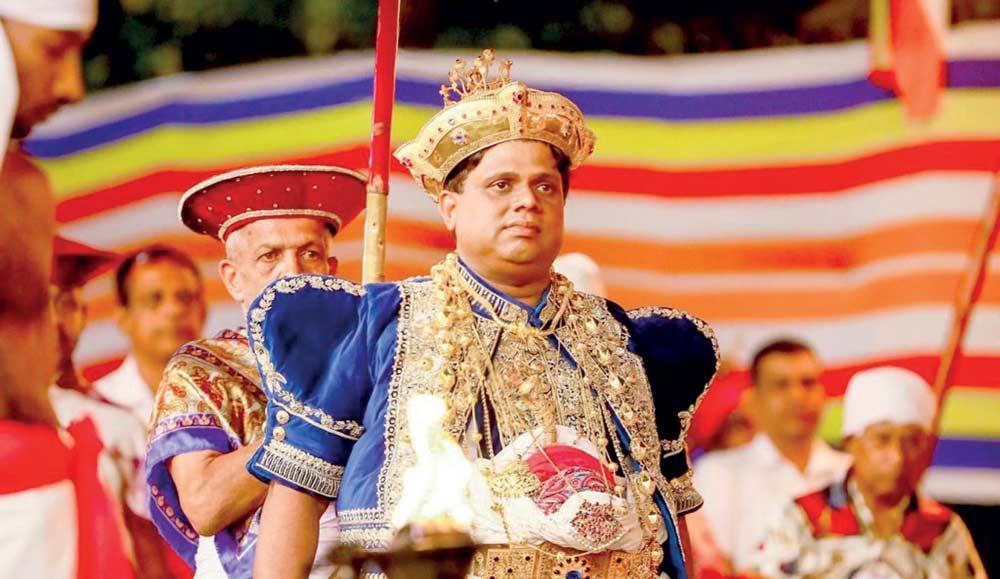
Pradeep Nilanga Dela, the current Diyawadana Nilame whose second term ended last September, will step down after the November 7th election. Despite managing temple lands and the Sacred Tooth Relic, the role is limited by electoral rules that exclude women.
FILE PHOTO
 Seventy-five women Divisional Secretaries out of 175 are prevented from voting in the Diyawadana Nilame election due to provisions in the 1931 “Vihara and Devalagam Act” that predate women’s entry into the Civil Service
Despite extending the Diyawadana Nilame’s term from five to ten years and barring politicians from contesting, no attempt has been made to revise the electoral system to include women, even by female lawmakers
The election encompasses only 175 out of 331 Divisional Secretariats, with 348 persons eligible to vote, including 138 Buddhist monks and lay trustees, whilst 75 female Divisional Secretaries are kept outside this framework
By Rajitha Weerakoon
A sizable chunk of voters will not cast their vote this year in the election of the Diyawadana Nilame, as the “Vihara and Devalagam Act” under which the election is conducted has no provisions allowing women to use their vote. Repeated requests to amend the Act have fallen on deaf ears, with the result that seventy-five (75) women Divisional Secretaries out of the hundred and seventy-five (175) will not exercise their vote this year. This is in spite of the fact that their work extends to land issues that belong to the Dalada Maligawa and the Devales, which have been complicated due to the lands, paddy fields and property having been gifted by Kings and Chieftains.
In the electoral system of the post of the Diyawadana Nilame, 18 out of the 25 Districts of Sri Lanka are covered by the “Vihara and Devalagam Act” or the “Buddhist Temporalities Ordinance”. In 1931, when the British passed the Act, no women were serving in the then Civil Service. Therefore, the need was not there to include women in the election of the Diyawadana Nilame.
However, over the last 94 years, except for the extension of the Diyawadana Nilame’s term from five to ten years and the prohibition on politicians contesting the post, no attempt has been made, even by women lawmakers who show concern for women’s rights, to revise the electoral system to include women. Functions of the female members in the Sri Lanka Administrative Service, however, are the same as their male counterparts, which include development planning, public issues and disaster management, to mention a few.
The electoral system of the post of Diyawadana Nilame in the Act covers Divisional Secretaries of eighteen (18) out of the 25 Districts of Sri Lanka as eligible to vote. These include Matale, Kegalle, Kurunegala, Nuwara Eliya and two divisions of Ampara, as well as Anuradhapura, Polonnaruwa, Trincomalee and Vavuniya. Also included are Badulla and Monargala, while Divisional Secretariats in certain sections of Puttalam, as well as Galle, Neluwa and Matara, are also part of the electoral map.
With some demarcations extending beyond the then Kandyan Kingdom, the guidelines used by the British in deciding the Divisions are indeed puzzling.
What should be of concern, however, is that the electoral system covers 175 out of the 331 Divisional Secretariats and keeping out 75 of them is a serious breach of women’s rights.
According to the existing electoral system, 348 persons are eligible to vote, which include 138 Buddhist monks along with the Mahanayakas of the Malwatte, the Asgiriya Chapters and their two Deputy Mahanayakas. The list also includes the incumbent Chief Priests in the Rajamaha Viharasa located in the former Kandyan Kingdom.
The Nilames in the second grouping comprise the Diyawadana Nilame, the Basnayake Nilames of 31 Devalas (whose term is five years) and the lay Trustees of Temples within the area covered by the “Vihara and Devalagam Act” of which the annual income in the three preceding years has to be estimated by the Commissioner of the Buddha Sasana as over one thousand rupees.
Six candidates are contesting the post of the Diyawadana Nilame, including the incumbent Pradeep Nilanga Dela, with the end of his second term last September. The election of the new Diyawadana Nilame will be held on November 7th, as he has to be elected three months following the end of the previous term, as spelt out in the “Vihara and Devalagam Act”.
Civil organisations have called on the government to keep a close watch on the election to ensure transparency and fair play. This explains the concerns of the public with the Diyawadana Nilame as the custodian, who is responsible for the protection of the Sacred Tooth Relic enshrined in the Dalada Maligawa, preserving its sanctity by following the associated rites and customs and undertaking the massive organisation of the Kandy Esala Perahera, which has transformed into an iconic event.
The elected candidate also has to oversee all aspects of the administration of its staff, the vast extent of land, paddy fields and property granted to the Dalada Maligawa by Kings and Chieftains and its assets, which run into millions.