Reply To:
Name - Reply Comment
 Global economic frameworks, long dependent on automated and profit-maximizing capitalist models, are facing increasing international scrutiny. Beris Gwynne, the co-founder and chair of the GRFC, is at the forefront of a growing movement seeking to redesign these entrenched systems. Drawing from her extensive early career as an Australian public servant and diplomat, Gwynne observed that the governance and finance systems established over the past centuries effectively operate on an outdated colonial model. She notes that the long-held belief in trickle-down economics has failed to materialize, leaving vulnerable populations unable to negotiate fair deals for their labour and resources.
 |
| Beris Gwynne |
The concept of rethinking finance was heavily influenced by earlier systemic critiques, including the Club of Rome’s 1970s “Limits to Growth” paper, which highlighted the impossibility of endless extraction on a planet with finite resources. The current rethinking finance initiative officially gained traction during events like Geneva, Switzerland’s Building Bridges Week, where discussions revealed a deep misalignment between traditional profit-driven economic philosophies and global sustainability goals. To counter this, the movement is actively attempting to restore the human element to economic activity.
As Gwynne articulated during a recent discussion with Mirror Business in Colombo, the collaborative is not anti-capitalist, anti-business, or anti-profit; rather, they believe current systems are managed by automation instead of human beings, and it is time to restore that human element. The fundamental belief driving the collaborative is that profitability must be balanced with ecological responsibility and community equity, moving beyond isolated philanthropy to redesign mainstream finance.
Sri Lankan opportunity and localized resilience
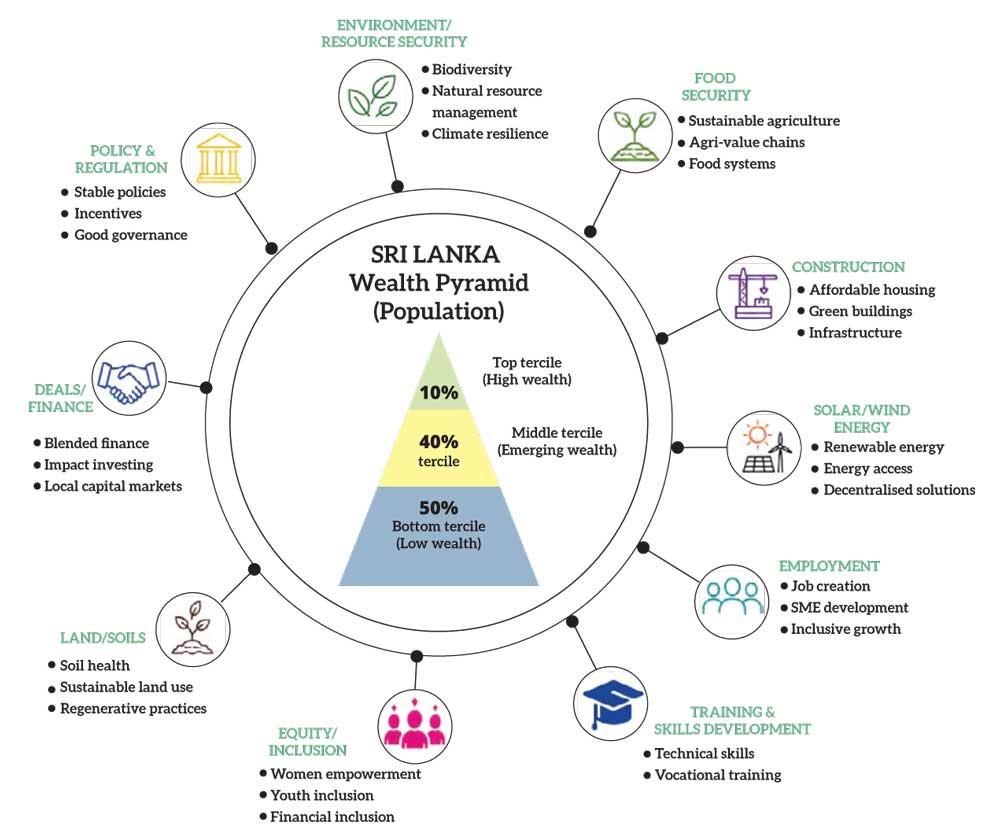
Sri Lanka has strategically emerged as the collaborative’s primary launching pad in the Asian region, driven by abundant local talent and a shifting political landscape that is increasingly receptive to sustainable alternatives. The focus on Sri Lanka is not merely theoretical; it is rooted in the practical resilience demonstrated by its citizens during times of crisis. Gwynne highlighted this proactive approach, recalling her firsthand experience of how local communities and authorities mobilized effectively during Cyclone Ditwah late last year. She observed how people organized immediately, including district officials who started work helping to get people to safety. Working closely with Cheryl Arndt, Managing Director of Incitare (Pvt) Ltd in Sri Lanka, the organization is looking to empower the local population to step out of legacy economic structures and lead their own regenerative growth. This strategy directly addresses the structural economic imbalances mapped within the Sri Lankan wealth pyramid. According to this wealth pyramid data, 50 percent of the Sri Lankan population is currently situated in the bottom tercile characterizing low wealth, with another 40 percent in the emerging middle tercile. By prioritizing job creation, decentralized renewable energy, and inclusive skills development, the collaborative explicitly targets systemic wealth generation for these highly vulnerable demographics.
Empowering communities through sustainable technology
The first tangible project launched under this collaborative partnership is an innovative solar bakery oven, engineered and adapted specifically for the local climate. The team recognized early on that importing technologies designed for desert environments would ultimately fail during the monsoon seasons in South Asia. Consequently, Incitare worked with local Sri Lankan partners, including the National Youth Council and vocational training centres, to develop a more robust, climate-appropriate model. This system utilizes solar power but also features a bottled biogas backup system, which links directly back to regenerative agriculture practices by supporting the creation of biochar and biogas in farming communities.
The overarching objective extends far beyond simply manufacturing and selling equipment; it focuses on creating localized employment and enterprises to ensure citizens have a reliable source of income while enhancing national food security. The ovens are designed for diverse commercial applications. Gwynne stated that the idea is to create employment and enterprises alongside food security, noting that the technology can be utilized for community baking, fish drying, and nut roasting to offer significant enterprise opportunities.
Pioneering green construction with industrial help
Beyond localized solar technology, Incitare Sri Lanka is dedicating significant resources toward the future of sustainable construction materials to combat environmental degradation and lower industry emissions. The collaborative recently convened a high-level policy roundtable focusing heavily on industrial hemp alongside other climate-smart materials such as kenaf, rice husk, and coconut husk applications. Industrial hemp is re-emerging globally as a strategic crop with highly lucrative applications across food systems, textiles, biomaterials, and circular manufacturing systems.
Despite its vast economic and ecological potential for soil rehabilitation and green building, the sector in Sri Lanka remains severely constrained by outdated legislation that fails to legally distinguish industrial hemp from narcotic cannabis. The recent roundtable brought together policymakers, agricultural scientists, and investors to establish an evidence-based platform to guide urgent regulatory reform. By modernizing these legal frameworks, the initiative aims to position Sri Lanka as a future-oriented innovation destination capable of capturing a profitable share of the growing international market for sustainable building materials, which aligns with the broader construction and land soil objectives of the wealth pyramid.
Scaling for systemic transformation
Securing the necessary large-scale capital for these transformative projects remains one of the organization’s most significant hurdles. Traditional wealthy investors often prioritize maximum financial returns over systemic ecological stability. However, Gwynne warns that this mindset is fundamentally flawed in the face of planetary decline. She stressed that if the whole ecosystem collapses, having a large sum of money will not ensure safety.
The collaborative is actively seeking substantial investments, looking entirely past traditional aid grants towards funding brackets of $40 million to $50 million (roughly Rs. 12 billion to Rs. 15 billion) to achieve true industrial scale. To attract this level of funding, they are working closely with finance professionals to structure proposals using blended financing models and impact investing tools. This ensures that the initiatives present viable business cases to family offices and philanthropists. Affirming this strategy, Gwynne stated they do not want to present investors with an aid project. Through these strategic partnerships, Incitare International aims to prove that a reimagined financial system can successfully deliver resilient economies, equitable wealth distribution, and a restored natural environment.