Reply To:
Name - Reply Comment
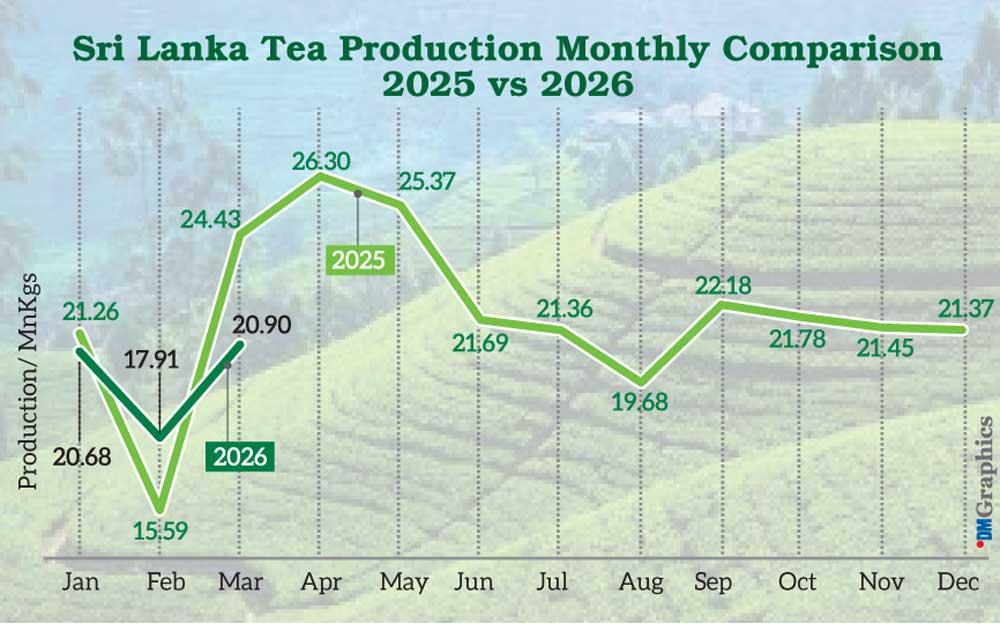
Sri Lanka’s tea output lost momentum in March, with production falling sharply year-on-year across all elevations, showing early signs of a fragile supply-side recovery despite a modest improvement over the 2024 levels.
National production for March 2026 stood at 20.90 million kilogrammes, down 3.53 million kilogrammes, from 24.43 million kilogrammes recorded a year earlier, marking a 14.5 percent contraction.
The decline was broad-based, with high-grown, mid-grown and low-grown teas all registering negative variances, underscoring structural and weather-linked pressures across the sector.
The steepest percentage fall was recorded in the mid-grown segment, which dropped nearly 22 percent year-on-year, while the high-grown teas contracted by over 18 percent.
The low-grown production, typically the backbone of Sri Lanka’s export volumes, also declined by over 10 percent, adding pressure to the overall output. Green tea remained relatively stable, posting only a marginal dip.
Despite the annual decline, the March output remained slightly ahead of the 2024 levels, indicating that while the sector is still off last year’s pace, it has not fully reversed the gains made during the post-crisis stabilisation phase.
On a cumulative basis, the January-March period reflects a similar trend of moderation. Total production reached 59.61 million kilogrammes, down 2.17 million kilogrammes from the corresponding period in 2025, a 3.5 percent decline. The contraction was again evident across all elevations except green tea, which continued to show resilience with a modest increase.
Compared with 2024, however, the cumulative output shows a marginal improvement, suggesting that the sector remains on a gradual recovery path, albeit uneven and vulnerable to shocks.
The March setback sharpens focus on the sustainability of production volumes at a time when the global demand dynamics remain uncertain and cost pressures persist, particularly amid the rising energy prices linked to geopolitical tensions.